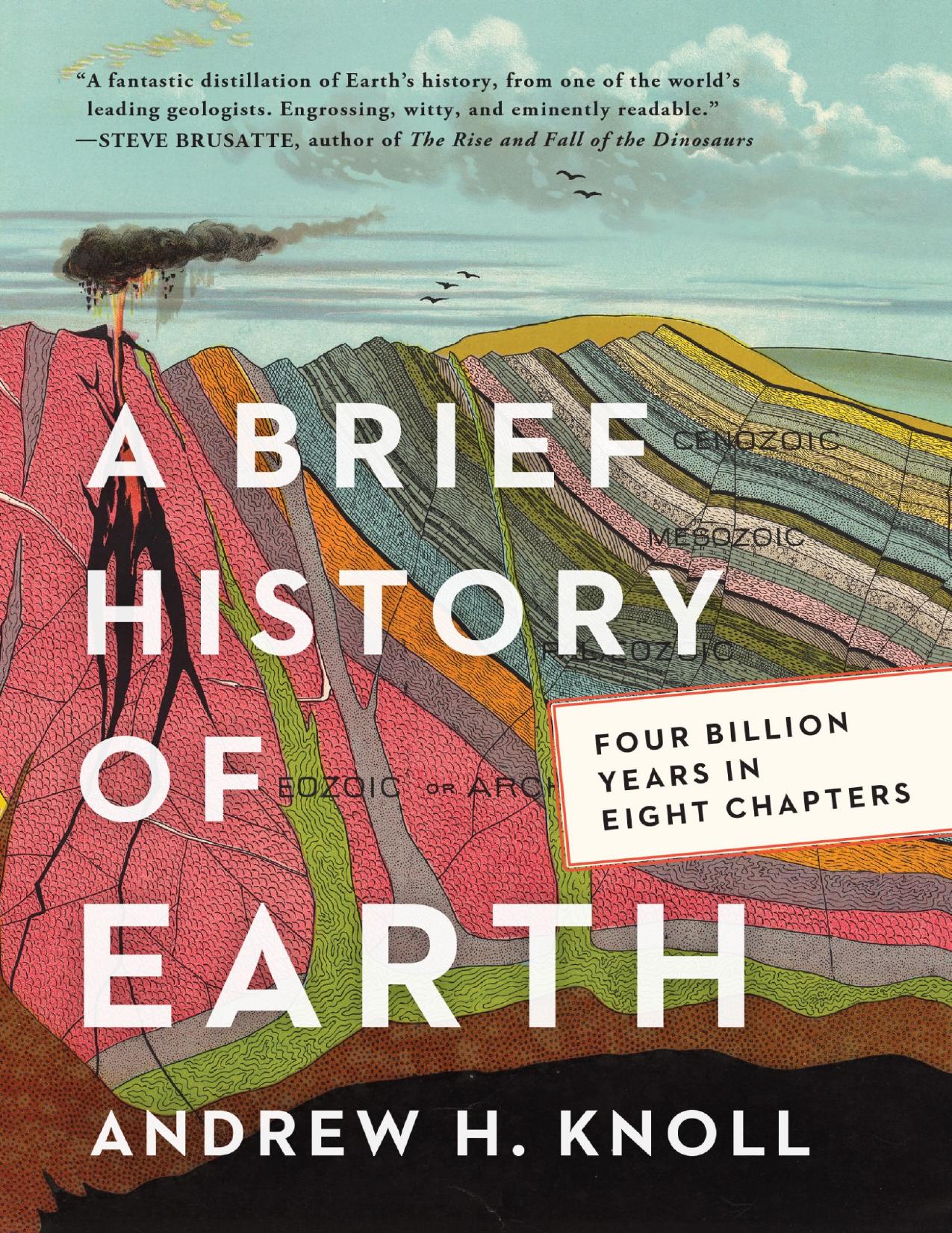
A Brief History of Earth by Andrew H. Knoll
Author:Andrew H. Knoll
Language: eng
Format: epub, pdf
Publisher: Custom House
Published: 2021-02-09T00:00:00+00:00
© 1xpert/adobe.stock.com
6
Green Earth
PLANTS AND ANIMALS COLONIZE LAND
Todd Marshall
IN 1991, I boarded an aging Aeroflot jetliner in Moscow, bound for Yakutsk, a Siberian city 3,000 miles (4,900 kilometers) to the east. For much of the eight-hour flight, I peered out the window, seeing little below but a seemingly endless expanse of forest, broken only by the silver threads of rivers as they meandered toward the Arctic Ocean. During the Cambrian Period, as trilobites reveled in their evolutionary youth, a similar flight would have traversed mostly bare rock, here and there tinted by microbial slime. The green of Siberian landscapes, then, reflects another biological revolution, the colonization of land by complex multicellular organisms.
Microbes probably took root on land early in Earth history, but it is plants that changed the world, providing both food and physical structure for complex terrestrial ecosystems. Today, some 400,000 species of land plant account for half of Earthâs photosynthesis and an estimated 80 percent of our planetâs total biomass. Indeed, Earthâs resplendent robe of green is such a pervasive feature of our planet that it can be detected from space. In 1990, as NASAâs Galileo spacecraft winged toward Jupiter, it trained its mechanical eyes on the distant Earth, revealing in our planetâs reflected light a distinctive peak in the near-infraredâthe so-called Vegetation Red Edge. This signature arises because land vegetation strongly absorbs incoming visible radiation but reflects infrared wavelengths back to space. Visitors to the early Earth would have observed no such feature.
Animals, although born in ancient oceans, are today most diverse on landâinsect species alone far outnumber all animal species in the sea. A huge and mostly undocumented diversity of fungi permeates soils, and myriad protists and bacteria cycle carbon, nitrogen, sulfur, and other elements on land, much as they have long done in water.
Clearly, our familiar world of fields and forests, grasshoppers and rabbits reflects a remarkable transformation of continents and islands, carried out only in the most recent 10 percent of Earthâs history. How did the greening of our planet take place, and what were its consequences for Earth itself?
IN 1912, WILLIAM MACKIE, a physician by training, passed through the village of Rhynie, Scotland, while surveying the regional geology. Rhynie, about thirty miles northwest of Aberdeen, sits among rolling fields, with few rocky outcrops to divert the geologist, so when Mackie noticed some unusual stones in the walls bounding local fields, he stopped to take a closer look. The rocks were made of chert (SiO2), and even cursory examination showed them to contain what appeared to be fossil stems, some preserved in growth position. Mackie had discovered the Rhynie Chert, paleobotanyâs counterpart to the Burgess Shale. Deposited 407 million years ago in and around hot springs similar to those found today in Yellowstone or the North Island of New Zealand, Rhynie provides a remarkably clear glimpse of terrestrial ecosystems in evolutionary adolescence.
Plants are the acknowledged stars of Rhynieâs show, although, as we shall see, they share the stage with myriad other kinds of organisms. Many
Download
This site does not store any files on its server. We only index and link to content provided by other sites. Please contact the content providers to delete copyright contents if any and email us, we'll remove relevant links or contents immediately.
Whiskies Galore by Ian Buxton(42021)
Introduction to Aircraft Design (Cambridge Aerospace Series) by John P. Fielding(33134)
Rewire Your Anxious Brain by Catherine M. Pittman(18658)
Craft Beer for the Homebrewer by Michael Agnew(18249)
Cat's cradle by Kurt Vonnegut(15365)
Sapiens: A Brief History of Humankind by Yuval Noah Harari(14393)
Leonardo da Vinci by Walter Isaacson(13341)
The Tidewater Tales by John Barth(12664)
Thinking, Fast and Slow by Kahneman Daniel(12318)
Underground: A Human History of the Worlds Beneath Our Feet by Will Hunt(12101)
The Radium Girls by Kate Moore(12035)
The Art of Thinking Clearly by Rolf Dobelli(10495)
Mindhunter: Inside the FBI's Elite Serial Crime Unit by John E. Douglas & Mark Olshaker(9347)
A Journey Through Charms and Defence Against the Dark Arts (Harry Potter: A Journey Throughâ¦) by Pottermore Publishing(9277)
Tools of Titans by Timothy Ferriss(8403)
Wonder by R. J. Palacio(8118)
Turbulence by E. J. Noyes(8057)
Change Your Questions, Change Your Life by Marilee Adams(7788)
Nudge - Improving Decisions about Health, Wealth, and Happiness by Thaler Sunstein(7712)
