Trade Unionists Against Terror by Deborah Levenson-Estrada
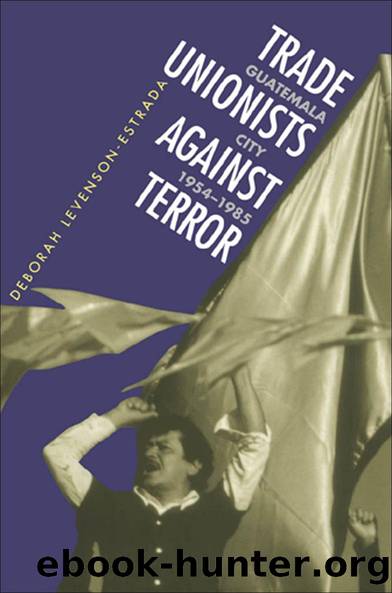
Author:Deborah Levenson-Estrada [Levenson-Estrada, Deborah]
Language: eng
Format: epub
Tags: History, Latin America, Central America, Political Science, General
ISBN: 9780807844403
Google: dMiLOnkdYrQC
Publisher: UNC Press Books
Published: 1994-01-15T02:41:07+00:00
The October 1978 Uprising
Shortly after Lucas GarcÃa took office in July, a series of bus driversâ strikes paralyzed the capital for months. The strikes began after a group of nonunionized bus drivers from four companies that had repeatedly prevented unionization met in June at the CNT headquarters to devise a method of fighting for a wage increase in the absence of unions. By 1978 few companies had unions, although many bus workers had been organized into unions over the previous two and one-half decades.7 Two bus workersâ federations, which by now were virtually paper organizations with little active membership, were registered with the Labor Ministry. One was the Union of Automobile Pilots (SPAS), initiated in the 1950s by Communists within the Autonomous Federation of Guatemalan Unions (FASGUA). The other was the National Federation of Transport Workers (FENOT), started by Christian labor militants in the 1960s and affiliated with the National Central of Workers, which was more militant than FASGUA or SPAS.
At the June meeting the drivers decided to dust off the name of FENOT to give an air of formality to their call for a citywide wage of Q10 ($10) daily, improved service, and retention of the five-cent fare. The cost and quality of public transportation were already nightmarish for the cityâs consumers. At five cents transportation was a major expense as well as unsatisfactory: customers waited in long lines to get into overcrowded and dangerous vehicles. Because the buses only ran on main roads, riders were often obliged to pay the inflated fares of special microbuses, which were usually owned by the same bus companies, to go to and from bus routes.
The cityâs municipal council, which established the wages of drivers employed by the 350 companies that owned the 857 buses in service, did not respond to the driversâ demands. So in early July, the drivers started progressively longer work stoppages. By the tenth of the month, the stoppages lasted all day. Then the drivers simply took all of the buses and drove them to the only place that was beyond the jurisdiction of state authorities, the University of San Carlos, which had autonomy from state control and had been a stronghold of progressive politics since the 1954 coup.
Many students, led by supporters of the militant and vocal Guerrilla Army of the Poor (EGP), welcomed the drivers on the universityâs spacious lawns with food, drink, entertainment, and words of encouragement. Fearing army or police action on the campus, the Communists in the Guatemalan Labor party (PGT) argued that the drivers should leave and accused the National Central of Workers of provoking a fare increase by endorsing the driversâ actions.8 The universityâs rector intervened in the dispute to authorize the driversâ presence at the university over the objections of the Communists, who led the oldest and most influential student association. The drivers, with their buses, camped on the university grounds until the Labor Ministry âagreed to study the issue of the minimum wage, which the Minister conceded should not be less than Q7 a day because that is the minimum necessary for the family to survive in Guatemala.
Download
This site does not store any files on its server. We only index and link to content provided by other sites. Please contact the content providers to delete copyright contents if any and email us, we'll remove relevant links or contents immediately.
| Africa | Americas |
| Arctic & Antarctica | Asia |
| Australia & Oceania | Europe |
| Middle East | Russia |
| United States | World |
| Ancient Civilizations | Military |
| Historical Study & Educational Resources |
Cat's cradle by Kurt Vonnegut(15324)
Pimp by Iceberg Slim(14476)
4 3 2 1: A Novel by Paul Auster(12363)
Underground: A Human History of the Worlds Beneath Our Feet by Will Hunt(12081)
The Radium Girls by Kate Moore(12012)
Wiseguy by Nicholas Pileggi(5765)
The Fire Next Time by James Baldwin(5423)
Perfect Rhythm by Jae(5394)
American History Stories, Volume III (Yesterday's Classics) by Pratt Mara L(5293)
Paper Towns by Green John(5174)
Pale Blue Dot by Carl Sagan(4994)
A Higher Loyalty: Truth, Lies, and Leadership by James Comey(4946)
The Mayflower and the Pilgrims' New World by Nathaniel Philbrick(4484)
The Doomsday Machine by Daniel Ellsberg(4481)
Killers of the Flower Moon: The Osage Murders and the Birth of the FBI by David Grann(4433)
The Sympathizer by Viet Thanh Nguyen(4382)
Too Much and Not the Mood by Durga Chew-Bose(4333)
The Borden Murders by Sarah Miller(4303)
Sticky Fingers by Joe Hagan(4186)
