Social Support and Motherhood by Oakley Ann
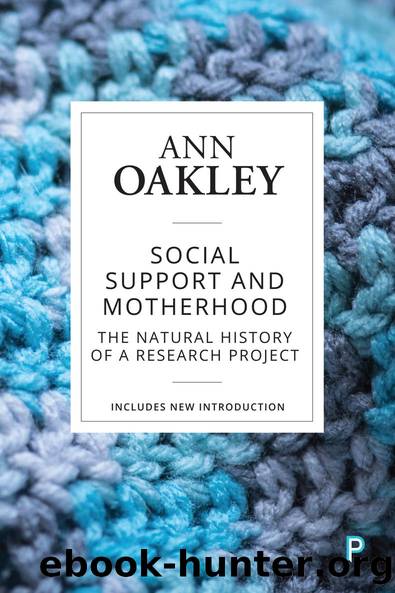
Author:Oakley, Ann [Oakley, Ann]
Language: eng
Format: epub
Tags: Social Science, Sociology, General, Marriage & Family
ISBN: 9780631182733
Google: PcSrDwAAQBAJ
Barnesnoble:
Goodreads: 4018768
Publisher: Policy Press
Published: 1992-01-01T00:00:00+00:00
Conclusion
Different kinds of lessons can be derived from the experiences of the research midwives in the SSPO study. One set of lessons concerns the doing of research in the maternity services. This is an activity which requires delicate steering through the politics of the structure within which care is provided, including the control over obstetric work defined and exercised by medical and midwifery hierarchies (Garcia et al. 1988). Another moral is about the nature of the midwivesâ work in the study: their comments reflect both an appreciation of the autonomy the job offered them, and a dislike of the need to submit their work to the arbitration of pre-set rules. The clearest examples of this were in relation to the procedure for random allocation, and the termination of the social support when the babies were born. Because of the experimental design of the study, and the timing of the âinformed consentâ procedure, the research midwives were also led to reflect â more, perhaps, than researchers in many other kinds of research â about the ways in which taking part in research may subtly and not so subtly influence the lives of those who agree to do so. Their reflections on the extent to which the studyâs design meant that women allocated to the control group may have both felt in receipt of support initially and then deprived of it are particularly interesting from the viewpoint of assessing the âsuccessâ of the study. As noted earlier by designing the study in this way, so as to inform the control group for ethical reasons, we may well have minimized differences between intervention and control groups, and thus reduced our chances of establishing a âstatistically significantâ impact of social support. (Conversely, of course, a âdeprivationâ response on the part of some control group women may have worsened outcome and increased intervention â control group differences.)
Through the medium of the midwivesâ experiences, the SSPO study throws a good deal of light on the way in which the maternity services currently operate in the four areas where the study was done. Much of this is no surprise to anyone who is acquainted with the âconsumer satisfactionâ literature. As the research midwives reported, the maternity services may too often consist of different professionals giving conflicting information and advice, the results of which can increase womenâs stress. This is particularly the case for a group already exposed to stress, as many of the women in the SSPO study were by virtue of their obstetric histories and current social and medical circumstances. In these respects, the findings of the SSPO study simply confirm other studies â both descriptive surveys of childbearing womenâs attitudes, and other intervention studies such as the trial of the âKnow Your Midwifeâ scheme which show the contribution that continuity of care can make to the health of women and babies (Flint and Poulengeris 1987). In addition, our study shows how the research role of generalized social supporter can be preferred by women to the
Download
This site does not store any files on its server. We only index and link to content provided by other sites. Please contact the content providers to delete copyright contents if any and email us, we'll remove relevant links or contents immediately.
| Anthropology | Archaeology |
| Philosophy | Politics & Government |
| Social Sciences | Sociology |
| Women's Studies |
Cecilia; Or, Memoirs of an Heiress — Volume 1 by Fanny Burney(32559)
The Great Music City by Andrea Baker(32020)
Cecilia; Or, Memoirs of an Heiress — Volume 2 by Fanny Burney(31957)
Cecilia; Or, Memoirs of an Heiress — Volume 3 by Fanny Burney(31943)
We're Going to Need More Wine by Gabrielle Union(19049)
All the Missing Girls by Megan Miranda(16034)
Pimp by Iceberg Slim(14513)
For the Love of Europe by Rick Steves(14144)
Bombshells: Glamour Girls of a Lifetime by Sullivan Steve(14077)
Talking to Strangers by Malcolm Gladwell(13374)
Norse Mythology by Gaiman Neil(13371)
Fifty Shades Freed by E L James(13244)
Mindhunter: Inside the FBI's Elite Serial Crime Unit by John E. Douglas & Mark Olshaker(9345)
Crazy Rich Asians by Kevin Kwan(9294)
The Lost Art of Listening by Michael P. Nichols(7507)
Enlightenment Now: The Case for Reason, Science, Humanism, and Progress by Steven Pinker(7315)
The Four Agreements by Don Miguel Ruiz(6766)
Bad Blood by John Carreyrou(6623)
Weapons of Math Destruction by Cathy O'Neil(6282)
