People of the Tower (Ark Chronicles 4) by Heppner Vaughn
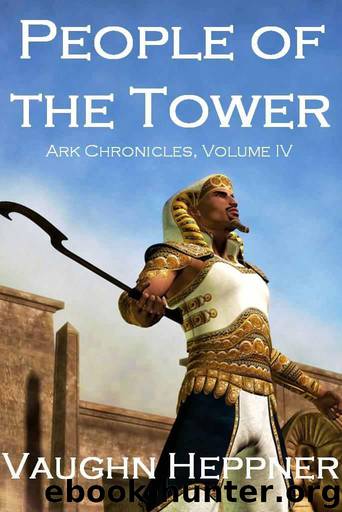
Author:Heppner, Vaughn [Heppner, Vaughn]
Language: eng
Format: azw3, epub
Published: 2010-06-11T04:00:00+00:00
10.
Almost fifty leagues southeast of Babel along the Euphrates River lay the new city of Erech. It was part of the kingdom of Shinar, the four cities of the alluvial plain ruled by Nimrod. The kingdom was composed of Babel, Erech, Akkad and Calneh. City, of course, was a misnomer, but the term tickled the vanity of the king. In reality, Erech held a little over seventy people.
The terrain was practically identical to that of Babel: a raised riverbank, reed swamps where spring floods had overflowed, with bushes and dates palms here and there, and with dusty plains inland where gazelle and lions dwelt. Near the newly-built brick wall, small canals crisscrossed and sprouted with amazingly abundant crops of wheat, barley and sesame. Within the city was a collection of mud brick homes, a smithy or two, a tiny temple and beside it a two-story mud brick palace. Within the palace lived the governor of Erech, a Mighty Man and a follower of Nimrod: Gilgamesh the Ghost Stalker and his wife Opis.
This city as well as the others practiced the new form of government. No clan or half clan went to Erech, Akkad or Calneh. Instead, individual families went. Clans as such, in these three cities, had been broken up. All were subjects of the king and as such were oath-bound to give fealty to the king’s servant. Thus, Japhethites, Shemites and Hamites lived in equality in Erech, and most were of the fourth or fifth generation of Noah.
Gilgamesh was aware of Nimrod’s real reason for building new cities and filling them with equal portions from the three tribes. The stated reason was obedience to Jehovah, obedience to the great command to fill the Earth. The king had nothing against colonization, just not in a helter-skelter fashion.
“Let us build an empire,” Nimrod said, “united, protected, growing outward in a rational manner, rather than splintering into packets of humanity that live little above the beasts.”
Through these three cities, Nimrod had stilled the whispers that said he shook his fist at Jehovah. What Nimrod also did was weaken clan authority in order to increase his own. He had chosen younger people to populate these new centers because they were more malleable to the new ideas and because they were less set in the old ways of clan affiliation.
This morning, Gilgamesh hunted with Ramses, who visited from Babel, having come by foot.
They presently strolled home across the dusty plain. A small gazelle lay over Gilgamesh’s shoulder. Several hounds with their tongues lolling trailed behind. In his fist, Gilgamesh carried his lance of elm wood. Ramses had a bow. Each wore hunting leathers as of old, but time had changed them. Ramses had developed a small paunch, and Gilgamesh no longer seemed skeletal and wild, as in the days when he had haunted the great southern marsh.
The only new item to Gilgamesh’s wardrobe was a talisman or amulet. A stone cylinder—a miniature rolling pin—with carvings on it hung from his neck by a leather cord.
Download
People of the Tower (Ark Chronicles 4) by Heppner Vaughn.epub
This site does not store any files on its server. We only index and link to content provided by other sites. Please contact the content providers to delete copyright contents if any and email us, we'll remove relevant links or contents immediately.
Bittersweet (True North #1) by Sarina Bowen(4843)
Housekeeping by Marilynne Robinson(4437)
Royally Matched (Royally Series) by Emma Chase(4320)
The Rosie Effect by Graeme Simsion(3462)
The Cellar by Natasha Preston(3335)
The Husband's Secret by Liane Moriarty(2553)
The Wrong McElroy by KL Hughes(2481)
His Forgotten Fiancée by Evelyn M. Hill(2409)
The Partner by John Grisham(2396)
Plain Protector by Alison Stone(2385)
Her Hill Country Cowboy by Myra Johnson(2307)
Her Cowboy Boss by Patricia Johns(2124)
Unlocked: A Love Story by Karen Kingsbury(2123)
A Kingsbury Collection by Karen Kingsbury(2101)
Unworthy by Antonio Monda(2086)
The Masterpiece by Francine Rivers(1988)
Outsider by Castillo Linda(1901)
01 The Rising by Tim Lahaye(1889)
Unplanned (A Kennedy Stern Christian Suspense Novel Book 1) by Alana Terry(1866)
