Migrants and Citizens by Tisha M. Rajendra
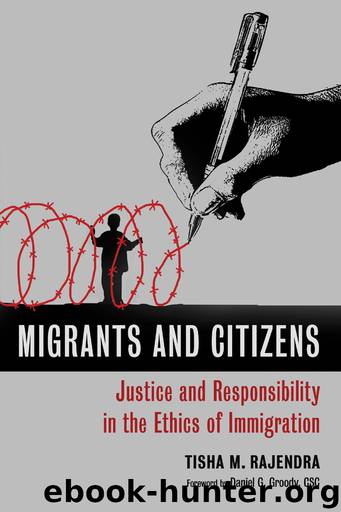
Author:Tisha M. Rajendra
Language: eng
Format: epub
Publisher: Wm. B. Eerdmans Publishing Co.
1. John Rawls, Political Liberalism, expanded ed., Columbia Classics in Philosophy (New York: Columbia University Press, 2005), 12.
2. Rawls, A Theory of Justice, 4. Hereafter, page references to this work appear in parentheses within the text.
3. John Rawls, Justice as Fairness: A Restatement, ed. Erin Kelly (Cambridge, MA: Harvard University Press, 2001), 42–43.
4. Iris Marion Young argues that Rawls’s account of the basic structure is “vague, ambiguous, and shifting” because Rawls wrongly thinks of structures as a small part of society, rather than a set of social-structural processes that underlie every part of social life (Young, Responsibility for Justice, 64–74).
5. See, e.g., Charles R. Beitz, Political Theory and International Relations (Princeton: Princeton University Press, 1979).
6. For the full eight principles, see Rawls, Law of Peoples, 37.
7. Rawls, Law of Peoples, 106.
8. See Rawls’s definition of the well-ordered society in Rawls, Justice as Fairness, 8–9.
9. Rawls, Law of Peoples, 108–11.
10. Rawls, Law of Peoples, 111.
11. In response, Pogge raises the objection that poverty makes countries vulnerable to exploitation from more powerful countries. While Rawls is correct that corruption breeds poverty, poverty also breeds corruption. In any case, the reasons for political corruption are far more complicated than Rawls suggests here. Thomas Pogge, “An Egalitarian Law of Peoples,” Philosophy and Public Affairs 23, no. 3 (1994): 213.
12. Rawls, Law of Peoples, 8.
13. Rawls, Law of Peoples, 53–54.
14. O’Neill, Towards Justice and Virtue, chap. 4. Hereafter, page references to this work appear in parentheses within the text.
15. O’Neill, Bounds of Justice, chap. 7.
16. O’Neill, Towards Justice and Virtue, 173.
17. O’Neill, Bounds of Justice, 200.
18. O’Neill, Bounds of Justice, 201.
19. O’Neill, Towards Justice and Virtue, 136–37.
20. O’Neill, Bounds of Justice, 132.
21. Nussbaum, Frontiers of Justice. Hereafter, page references to this work appear in parentheses within the text.
22. Nussbaum, Creating Capabilities, 18.
23. Nussbaum, Creating Capabilities, 35–36.
24. I am not entirely sure that O’Neill would disagree that some account of human rights and/or capabilities is required for a full account of justice. In fact, she refers to such rights and capabilities herself (O’Neill, Towards Justice and Virtue, 170, 173). Elsewhere, she draws on Kant’s portrayal of humans as both autonomous and capable of action and “finite and mutually vulnerable, dependent on material resources and not always well disposed to one another” (O’Neill, Bounds of Justice, 138). This emphasis on both the agential capacities of the person and the person’s embodied and vulnerable nature gives O’Neill an account of obligation that leaves her not too far from Nussbaum.
25. Nussbaum, Creating Capabilities, 211.
26. Nussbaum, Creating Capabilities, 3.
27. Nussbaum, Creating Capabilities, chap. 1.
28. See, e.g., Walzer, Spheres of Justice, chap. 2; Rawls, The Law of Peoples; David Miller, National Responsibility and Global Justice (Oxford: Oxford University Press, 2007), chap. 8.
29. This point comes from a conversation with Daniel Kanstroom.
30. Nussbaum, Creating Capabilities, 115–17.
31. E.g., O’Neill, Bounds of Justice, 121.
32. Cristina L. H. Traina, “Facing Forward,” in Distant Markets, Distant Harms: Economic Complicity and Christian Ethics, ed. Daniel K. Finn (Oxford: Oxford University Press, 2014).
Download
This site does not store any files on its server. We only index and link to content provided by other sites. Please contact the content providers to delete copyright contents if any and email us, we'll remove relevant links or contents immediately.
| Anthropology | Archaeology |
| Philosophy | Politics & Government |
| Social Sciences | Sociology |
| Women's Studies |
Cecilia; Or, Memoirs of an Heiress — Volume 1 by Fanny Burney(32549)
Cecilia; Or, Memoirs of an Heiress — Volume 2 by Fanny Burney(31948)
Cecilia; Or, Memoirs of an Heiress — Volume 3 by Fanny Burney(31932)
The Great Music City by Andrea Baker(31918)
We're Going to Need More Wine by Gabrielle Union(19037)
All the Missing Girls by Megan Miranda(15965)
Pimp by Iceberg Slim(14489)
Bombshells: Glamour Girls of a Lifetime by Sullivan Steve(14061)
For the Love of Europe by Rick Steves(13949)
Norse Mythology by Gaiman Neil(13351)
Talking to Strangers by Malcolm Gladwell(13351)
Fifty Shades Freed by E L James(13233)
Mindhunter: Inside the FBI's Elite Serial Crime Unit by John E. Douglas & Mark Olshaker(9325)
Crazy Rich Asians by Kevin Kwan(9280)
The Lost Art of Listening by Michael P. Nichols(7497)
Enlightenment Now: The Case for Reason, Science, Humanism, and Progress by Steven Pinker(7307)
The Four Agreements by Don Miguel Ruiz(6747)
Bad Blood by John Carreyrou(6613)
Weapons of Math Destruction by Cathy O'Neil(6267)
