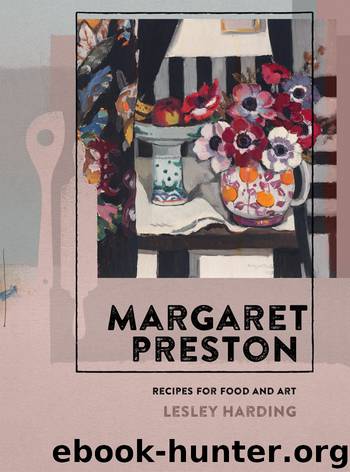
Margaret Preston by Lesley Harding
Author:Lesley Harding
Language: eng
Format: epub
ISBN: 9780522870138
Publisher: Melbourne University Publishing
Still life 1921 (detail), see page 145.
THE GENTLE ART OF ARRANGING FLOWERS CHAPTER 6
Margaret Preston in her garden in Mosman 1922
Photographer unknown Fairfax Photos
Although Preston could hardly have known it when she chose the still life as her preferred type of painting at the National Gallery School in the 1890s, the genre was on the cusp of a major resurgence. From antiquity to the seventeenth century, still life rose periodically from the lowliest rank in painting—under religious and history painting, landscape and portraiture—to a position of greater prominence, as its capacity to represent the interests of the current age ebbed and flowed. Come the late nineteenth century, Cézanne began using this particularly amenable subject to trial and refine his experiments with the formal and spatial aspects of image making, thereby signalling its significance to the development of modernism. Cézanne’s pears, oranges and apples, bottles, jugs, and rustic tablecloths were the constituent ingredients for innumerable paintings, in which he arranged and analysed the objects of his own home kitchen and dining table—not to mimic a familiar domesticity, but to visualise it in alternative ways. His compatriot, the artist Maurice Denis, likened Cézanne’s process to that of a weaver in the way he assembled colours and forms, and integrated figure and ground, the finished result resembling a Persian carpet or mosaic, or the handcrafts of patchwork, tapestry or cross-stitch.1
For Preston this was not a style to be imitated, but instead a manner of thinking that could prompt individual development, though the relationship to applied arts and pattern will have appealed to her sensibility. Similarly, she admired Picasso but did not adapt his cubist inventions for her own ends, as many artists would. Rather, she gathered together a number of precepts demonstrated in his art that made the best sense, and deployed them in her work as guiding principles. She highlighted what she believed to be the most useful ideas of Cubism in an article for the journal Manuscripts in 1933:
1 To have a definite geometrical axis.
2 To use perspective as a servant, not as a master. In other words, to use it when and where it is needed, so that, if distortion is necessary to the work it can be used equally as the set rules of perspective.
3 To give objects geometrical shapes in formal relation to each other.
4 To absolutely eliminate all photographic likeness and return to classical form (Michel Angelo).2
Download
This site does not store any files on its server. We only index and link to content provided by other sites. Please contact the content providers to delete copyright contents if any and email us, we'll remove relevant links or contents immediately.
Whiskies (Collins Gem) by dominic roskrow(45529)
101 Whiskies to Try Before You Die by Ian Buxton(45321)
World's Best Whiskies by Dominic Roskrow(45123)
Whiskies Galore by Ian Buxton(42160)
The Fast Metabolism Diet Cookbook by Haylie Pomroy(21261)
Chic & Unique Celebration Cakes by Zoe Clark(20149)
Craft Beer for the Homebrewer by Michael Agnew(18343)
The Bone Broth Miracle: How an Ancient Remedy Can Improve Health, Fight Aging, and Boost Beauty by Ariane Resnick(16707)
For the Love of Europe by Rick Steves(14914)
Tools of Titans by Timothy Ferriss(8594)
Chowders and Soups by Liz Feltham(8447)
A Court of Wings and Ruin by Sarah J. Maas(8113)
How to Be a Bawse: A Guide to Conquering Life by Lilly Singh(7615)
The Institute by Stephen King(7152)
Cravings: Recipes for All the Food You Want to Eat by Chrissy Teigen & Adeena Sussman(6864)
Wiseguy by Nicholas Pileggi(5940)
The Last Wish (The Witcher Book 1) by Andrzej Sapkowski(5594)
Spare by Prince Harry The Duke of Sussex(5370)
Room 212 by Kate Stewart(5273)
