Manufacturing Consent by Edward S. Herman
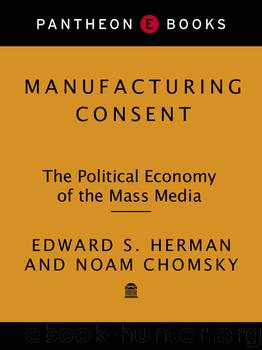
Author:Edward S. Herman [Herman, Edward S.]
Language: eng
Format: epub
ISBN: 978-0-307-80162-3
Publisher: Knopf Doubleday Publishing Group
Published: 2011-06-22T04:00:00+00:00
5.3. THE EARLY STAGES: A CLOSER LOOK
The “first Indochina war,” fought by the French and their client forces and largely supplied by the United States, came to an end with the Geneva Accords of 1954, which established a partition at the 17th parallel pending reunification through elections within two years. The United States pledged not to obstruct these arrangements.
The Geneva settlement was quickly undermined by the United States and its client regime because it was taken for granted on all sides that elections would lead to a unified Vietnam under Viet Minh rule. “American intelligence sources were unanimous that Diem [the U.S.-imposed client] would lose any national election,” George Kahin concludes from a close inspection of the available record. The Viet Minh had agreed to the Geneva decision for regroupment of its forces well to the north of territories it controlled on the basis of “the assurance that the struggle for the control of Vietnam would be transferred from the military to the political level, a realm in which the Vietminh leaders knew their superiority over the French and their Vietnamese collaborators was even greater than it was militarily.… For the Vietminh, this was the heart of the Geneva Agreements.”49
The secret U.S. response to the perceived disaster of Geneva was a plan to resort to military action (including attacks on China if deemed necessary) in the event of “local Communist subversion or rebellion not constituting armed attack,” in explicit violation of the UN Charter, which limits the use of force to self-defense in the event of “armed attack” until the UN Security Council is able to respond. This crucial decision, misrepresented beyond recognition in the Pentagon Papers history and generally ignored, also recommended operations against China, “covert operations on a large and effective scale” throughout Indochina (including North Vietnam), remilitarization of Japan, development of Thailand “as the focal point for U.S. covert and psychological operations in Southeast Asia,” etc.50 Defense Secretary Robert McNamara observed in a memorandum for President Johnson that “Only the U.S. presence after 1954 held the south together … and enabled Diem to refuse to go through with the 1954 provision calling for nationwide free elections in 1956.”51
Surveying the media during this period, Howard Elterman observes that “during a six-month period in 1955 and 1956, there was virtually no news coverage” about the U.S. policy of undermining the Geneva Accords in the New York Times and the three newsweeklies. Communist charges to this effect were occasionally mentioned on back pages but dismissed as propaganda—accurate propaganda, in fact. When the evasion of elections was conceded, it was justified on the basis of Communist terror and regimentation. The Times (June 2, 1956) described Vietnam as a country “divided into the Communist regime in the north and a democratic government in the south”—namely, the murderous and corrupt Diem dictatorship. Newsweek denounced the “wide infiltration in South Vietnam” in support of the “implacable purpose” of the Viet Minh, while U.S. News & World Report condemned Ho Chi Minh for “plotting new Red aggression in Southeast Asia.
Download
This site does not store any files on its server. We only index and link to content provided by other sites. Please contact the content providers to delete copyright contents if any and email us, we'll remove relevant links or contents immediately.
| Anthropology | Archaeology |
| Philosophy | Politics & Government |
| Social Sciences | Sociology |
| Women's Studies |
The Great Music City by Andrea Baker(33722)
Cecilia; Or, Memoirs of an Heiress — Volume 1 by Fanny Burney(32726)
Cecilia; Or, Memoirs of an Heiress — Volume 2 by Fanny Burney(32090)
Cecilia; Or, Memoirs of an Heiress — Volume 3 by Fanny Burney(32068)
We're Going to Need More Wine by Gabrielle Union(19178)
All the Missing Girls by Megan Miranda(16737)
For the Love of Europe by Rick Steves(14937)
Pimp by Iceberg Slim(14805)
Bombshells: Glamour Girls of a Lifetime by Sullivan Steve(14221)
Norse Mythology by Gaiman Neil(13576)
Talking to Strangers by Malcolm Gladwell(13556)
Fifty Shades Freed by E L James(13353)
Mindhunter: Inside the FBI's Elite Serial Crime Unit by John E. Douglas & Mark Olshaker(9532)
Crazy Rich Asians by Kevin Kwan(9422)
The Lost Art of Listening by Michael P. Nichols(7623)
Enlightenment Now: The Case for Reason, Science, Humanism, and Progress by Steven Pinker(7440)
The Four Agreements by Don Miguel Ruiz(6918)
Bad Blood by John Carreyrou(6733)
Weapons of Math Destruction by Cathy O'Neil(6475)
