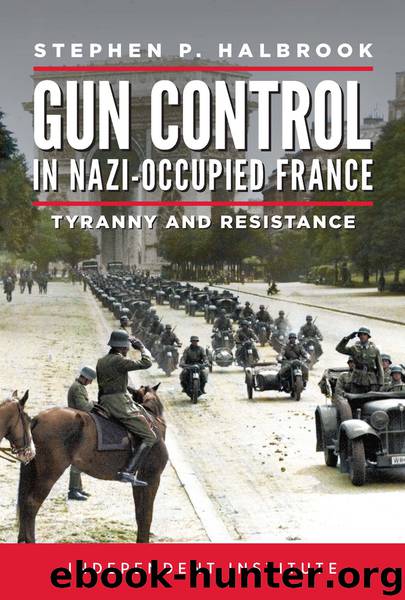
Gun Control in Nazi Occupied-France by Stephen P. Halbrook
Author:Stephen P. Halbrook
Language: eng
Format: epub
Publisher: Independent Institute
Published: 2018-06-13T04:00:00+00:00
More Executions and Looting of Arms
Executions for possession of weapons continued on an almost daily basis. Stülpnagel issued an Avis on October 23 that Pierre Lerein from Floirac (Gironde) was executed that day for possession of arms and explosives. Le Matin could not resist condemning such people and finding their execution to be just.90 The next day saw another Stülpnagel Avis announcing the execution of the following people for possession of arms and ammunition: Roger Jean Bonnand from Paris, Paul Grossin from Mitry-Mory (Seine-et-Marne), and Hubert Sibille from Cornimont (Vosges). Le Matin again had this tongue-lashing: “They were keeping arms, why? There are people who foolishly or deliberately hide arsenals at home…. Anyone in possession of a pistol or a gun can only be looked at as a potential assassin. And expect the most serious sanctions.91
The Vichy government negotiated three and four-day extensions of the next hostage execution dates for the attacks in Nantes and Bordeaux respectively. It was said to be doubling its efforts to apprehend the assassins and save the lives of hostages.92 In Bordeaux, the mayor and town council issued calls to help search for the guilty parties.93 After some French people provided information that narrowed the scope of the search for the Nantes and Bordeaux attackers, and refused the financial award, Stülpnagel decided that any of their parents held as prisoners of war in Germany could return to France, and would consider release of other family members.94
Stülpnagel then declared a grace period on the executions to allow the people to assist the investigations. He was pleased to inform Vichy that the Führer agreed, thus allowing the French to help apprehend the assassins.95
Meanwhile, the confiscation of usable arms continued unabated, with nuances. An order from the district headquarters (Kreiskommandantur) in Lunéville on October 28 required the surrender of all rifles, carbines, hunting firearms, pistols, revolvers, other firearms, and sidearms (bayonets and swords) produced in 1870 or later. It exempted arms produced before 1870, together with all other slashing and thrusting weapons, regardless of date of manufacture. The owner of each exempted weapon was required to have paperwork confirming that the item need not be surrendered.96 The Germans did not want to fool with arms that would be useless for resistance.
However, looting the good stuff could continue. The head of the Armed Forces High Command (Oberkommando der Wehrmacht, or OKW) in Berlin issued an order on October 28 that no compensation would be paid for hunting guns confiscated from private citizens in France and Belgium. The excuse was that neither France nor Belgium reimbursed Germans for hunting guns confiscated during the occupation of the Rhineland after World War I.97 While it is difficult to believe that these post–World War I confiscations remotely compared to those in World War II, this was no more than a justification for massive looting of firearms from private citizens in violation of international law.
In the German perspective, plundering public and private property was revenge for the reparations Germany had to pay France based on the Versailles Treaty following the Great War.
Download
This site does not store any files on its server. We only index and link to content provided by other sites. Please contact the content providers to delete copyright contents if any and email us, we'll remove relevant links or contents immediately.
| Africa | Americas |
| Arctic & Antarctica | Asia |
| Australia & Oceania | Europe |
| Middle East | Russia |
| United States | World |
| Ancient Civilizations | Military |
| Historical Study & Educational Resources |
Room 212 by Kate Stewart(5130)
The Crown by Robert Lacey(4819)
Endurance: Shackleton's Incredible Voyage by Alfred Lansing(4788)
The Iron Duke by The Iron Duke(4367)
The Rape of Nanking by Iris Chang(4222)
Joan of Arc by Mary Gordon(4117)
Killing England by Bill O'Reilly(4008)
Say Nothing by Patrick Radden Keefe(3991)
I'll Give You the Sun by Jandy Nelson(3451)
Shadow of Night by Deborah Harkness(3376)
Hitler's Monsters by Eric Kurlander(3347)
Mary, Queen of Scots, and the Murder of Lord Darnley by Alison Weir(3214)
Blood and Sand by Alex Von Tunzelmann(3207)
Eleanor & Park by Rainbow Rowell(3184)
Darkest Hour by Anthony McCarten(3135)
Margaret Thatcher: The Autobiography by Thatcher Margaret(3087)
Book of Life by Deborah Harkness(2943)
Red Famine: Stalin's War on Ukraine by Anne Applebaum(2940)
The One Memory of Flora Banks by Emily Barr(2870)
