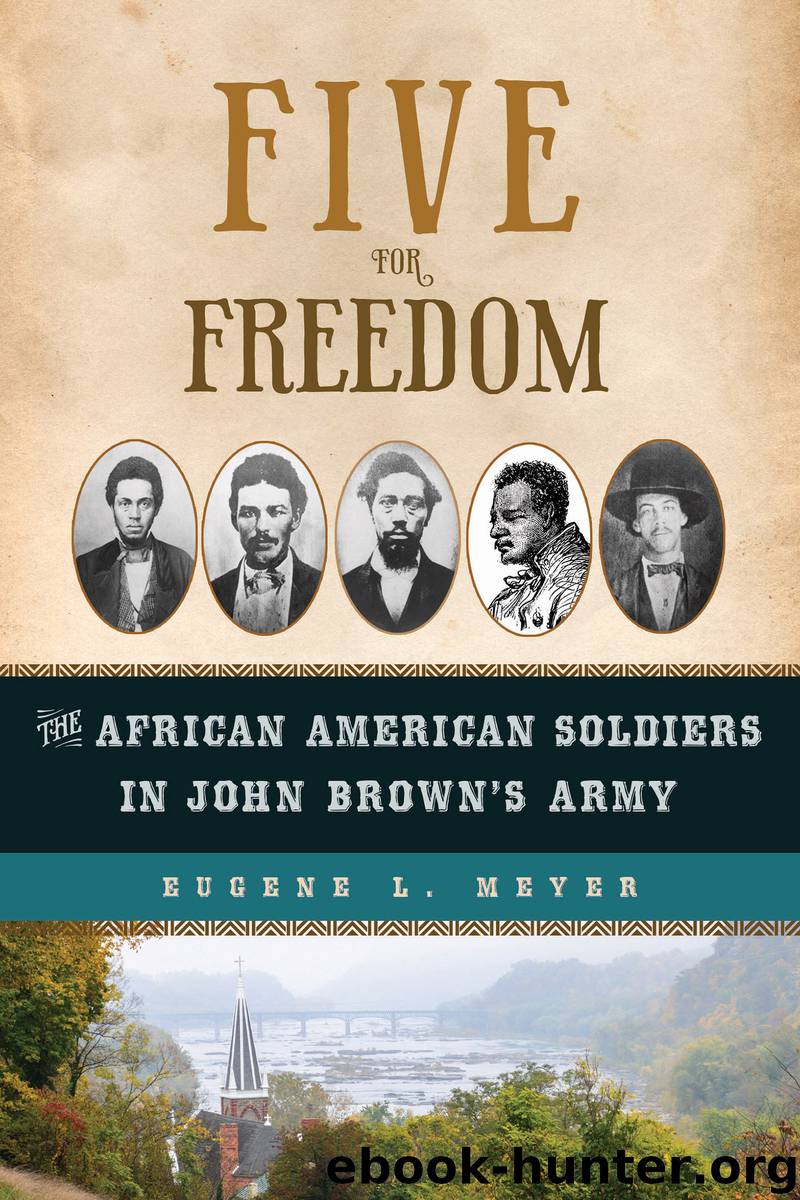
Five for Freedom by Eugene L. Meyer
Author:Eugene L. Meyer
Language: eng
Format: epub
Publisher: Chicago Review Press
Published: 2018-12-08T16:00:00+00:00
* * *
For the family and descendants of Dangerfield Newby, there were both challenges and opportunities during chaotic times of civil war, Reconstruction, Jim Crow, and beyond.
Sometime during the first half of 1860, the widow Jennings sold Harriet Newby and some of her children south to a Louisiana planter.25 The evidence of Harriet’s absence is found in the 1860 Census for Prince William County, which has Virginia Jennings owning only two slave boys, both of whom she had hired out to others.
In Louisiana, Harriet met William Robinson, sixteen years younger—precisely when and under what circumstances are unclear. He was born in 1840 in Berkeley County, now West Virginia, home to many free blacks. Census records from 1850 show a William Robinson, age nine, residing in Berkeley’s Ninth District, in a large household headed by John T. Henderson, a fifty-eight-year-old innkeeper. Only William and Jane Robinson, born “about” 1841, are racially identified (as black). Presumably, the others in the household were white. But how did Robinson get to Louisiana?
William Robinson may have enlisted in the US Colored Troops formed after President Lincoln issued the Emancipation Proclamation. New Orleans and Baton Rouge were occupied by federal troops from 1862 through the rest of the war, during which three hundred thousand Louisiana slaves were liberated. So it is possible that Harriet and her children were among those liberated and that she and William met in a camp for “contrabands,” escaped slaves or those affiliated with Union forces, in the Baton Rouge area.
There is another possibility: in May 1861, the First Louisiana Native Guard formed in New Orleans mostly from free persons of color to fight for the Confederacy. It disbanded in April 1862 after the state legislature decreed that only “free white males capable of bearing arms” could belong.26 In September, some members joined the Union Army, under the same name; it later became the Seventy-Third Regiment Infantry of the United States Colored Troops, drawing recruits from beyond the immediate vicinity. The regiment participated in the long and ultimately successful 1863 siege of Port Hudson, a cotton and sugar exporting center twenty miles north of Baton Rouge.
Civil War pension records contain yet another tantalizing if strange clue to their relationship. They show a Harriet Robinson as “widow” and “dependent” linked to William H. Robinson, whose service was with the First Regiment of the US Colored Infantry. Two claims were filed from Virginia for “soldier” William H. Robinson, alias Henry Robinson, alias Henderson Robinson, the first for Robinson as “invalid” in 1888, the second for his widow, in 1893. But Harriet had died in 1884. The processing officer deemed these claims to be fraudulent.
At some point from 1863 to 1865, Harriet Newby met and married William Robinson and had three children with him in Louisiana. At the war’s end, they traveled north. Harriet went to Ashtabula in search of a lost son from her marriage to Newby, possibly Dangerfield Newby Jr., not finding him but receiving a warm welcome. “She came north after the
Download
This site does not store any files on its server. We only index and link to content provided by other sites. Please contact the content providers to delete copyright contents if any and email us, we'll remove relevant links or contents immediately.
| Africa | Americas |
| Arctic & Antarctica | Asia |
| Australia & Oceania | Europe |
| Middle East | Russia |
| United States | World |
| Ancient Civilizations | Military |
| Historical Study & Educational Resources |
Cat's cradle by Kurt Vonnegut(15362)
Pimp by Iceberg Slim(14517)
4 3 2 1: A Novel by Paul Auster(12398)
Underground: A Human History of the Worlds Beneath Our Feet by Will Hunt(12100)
The Radium Girls by Kate Moore(12033)
Wiseguy by Nicholas Pileggi(5791)
The Fire Next Time by James Baldwin(5452)
Perfect Rhythm by Jae(5409)
American History Stories, Volume III (Yesterday's Classics) by Pratt Mara L(5310)
Paper Towns by Green John(5194)
Pale Blue Dot by Carl Sagan(5012)
A Higher Loyalty: Truth, Lies, and Leadership by James Comey(4965)
The Mayflower and the Pilgrims' New World by Nathaniel Philbrick(4506)
The Doomsday Machine by Daniel Ellsberg(4492)
Killers of the Flower Moon: The Osage Murders and the Birth of the FBI by David Grann(4449)
The Sympathizer by Viet Thanh Nguyen(4396)
Too Much and Not the Mood by Durga Chew-Bose(4349)
The Borden Murders by Sarah Miller(4329)
Sticky Fingers by Joe Hagan(4204)
