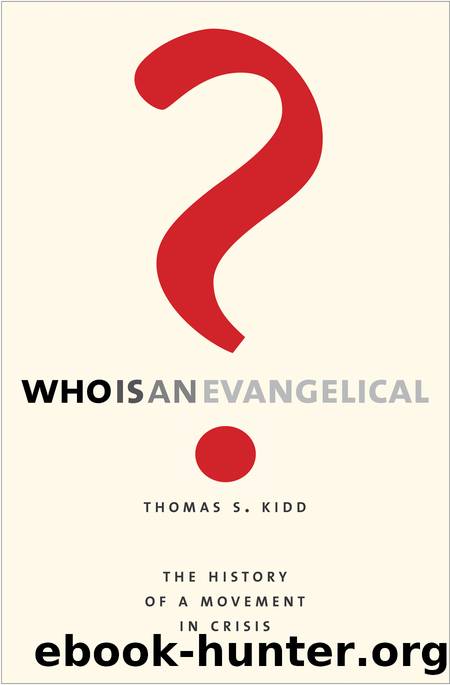
Who Is an Evangelical? by Thomas S. Kidd
Author:Thomas S. Kidd
Language: eng
Format: epub
ISBN: 9780300249040
Publisher: Yale University Press
In the early 1960s, many American Christians were more concerned about civil rights than the Supreme Courtâs decisions on school prayer and Bible reading. Some of the most visible leaders of the civil rights movement, such as Ella Baker, Martin Luther King Jr., and the Unitarian Howard Thurman, were not recognizably evangelical, even if they were formed by the black church. (Kingâs preaching drew on evangelical themes, but his theology often reflected the modernism of his doctoral education at Boston University.) Many of the âlocal peopleâ in the campaigns for civil rights did embrace evangelical beliefs. One was Fannie Lou Hamer, who worked to register black voters in Mississippi. In 1963, she endured torture from police and prisoners at a Winona, Mississippi, jail in retaliation for her activism. Driven by her deep faith, Hamer would not give up the fight for civil rights. Charles Marsh, whose book Godâs Long Summer poignantly documented the roles that faith played in the struggle for and against civil rights, wrote that Hamer was inspired by a piety âevangelical in the most vigorous sense of the term, a robust and disciplined love of Jesus of Nazareth, of the whole scandalous story of his life, death, and resurrection.â10 Hamer, the daughter of sharecroppers, would expose the white-dominated Democratic Partyâs passivity on civil rights in televised testimony at the 1964 Democratic National Convention.
John Perkins was one of the African American civil rights leaders most closely aligned with evangelicals. Many in Perkinsâs family were bootleggers, and he was the first person in his family to accept Christ as Savior. Perkins had formerly seen religion as a distraction for oppressed southern blacks, but after moving from Mississippi to California he began to study the Bible for himself and realized that he needed salvation. When he came to the moment of conversion, he exclaimed, âGod for a black man? Yes, God for a black man! This black man! Me! That morning I said yes to Jesus Christ.â11 Perkins returned to Mississippi in 1960, establishing a church and evangelistic ministry. Over time, Perkins expanded his focus from pure evangelism to social and civil rights advocacy. After helping to organize a civil rights boycott in Mendenhall, Mississippi, Perkins was arrested and viciously beaten by highway patrol officers and a sheriff ironically named Jonathan Edwards.
In the following decades, Perkins would become a pioneer of holistic community ministry. He is arguably the most important figure in introducing African Americansâ social justice concerns to white evangelicals. He became a popular speaker at majority-white evangelical colleges and served on the board of evangelical organizations such as Prison Fellowship, World Vision, and the National Association of Evangelicals. Perkins is uniquely positioned because of his combination of experience in civil rights and his unquestioned evangelical beliefs. Perkinsâs evangelistic and social ministry is one of the clearest fulfillments of what Carl Henry had called for in The Uneasy Conscience of Modern Fundamentalism.12
White evangelical responses to civil rights ranged from cautious support to staunch opposition. Some white evangelicals expressed sympathy but worried about radical influences in the civil rights movement.
Download
This site does not store any files on its server. We only index and link to content provided by other sites. Please contact the content providers to delete copyright contents if any and email us, we'll remove relevant links or contents immediately.
Fangirl by Rainbow Rowell(9373)
How to Bang a Billionaire by Alexis Hall(8228)
Wonder by R. J. Palacio(8187)
The Thirst by Nesbo Jo(7030)
The Space Between by Michelle L. Teichman(6991)
Assassin’s Fate by Robin Hobb(6312)
Wiseguy by Nicholas Pileggi(5874)
The Night Circus by Erin Morgenstern(5310)
Paper Towns by Green John(5263)
The Kite Runner by Khaled Hosseini(5251)
Bittersweet (True North #1) by Sarina Bowen(4894)
Gerald's Game by Stephen King(4730)
Too Much and Not the Mood by Durga Chew-Bose(4406)
Pillow Thoughts by Courtney Peppernell(4356)
Goodbye Paradise(3885)
Good by S. Walden(3634)
Twelve Days of Christmas by Debbie Macomber(3612)
The Rosie Effect by Graeme Simsion(3544)
The Cellar by Natasha Preston(3406)
