Whirlwind: The Air War Against Japan, 1942-1945 by Barrett Tillman
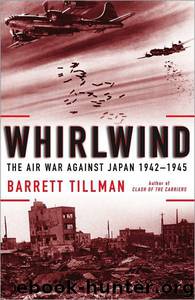
Author:Barrett Tillman [Tillman, Barrett]
Language: eng
Format: epub
Tags: General, History, Japan, United States, World War; 1939-1945, World War II, Military, 20th Century, Campaigns, Asia, Aerial Operations; American, Bombing; Aerial, Aviation
ISBN: 9781416584407
Publisher: Simon & Schuster
Published: 2010-03-02T00:00:00+00:00
Strategic Attacks Resume
In striking contrast to Japan’s declining industrial output that spring, America’s was still accelerating. Female workers personified as “Rosie the Riveter” represented only about one war worker in ten, but her robust, can-do image spoke for all Americans engaged in the headlong rush of production. Men and women, young and old, wielded rivet guns and bucking bars, torque wrenches and welders. Factories expended unprecedented efforts at reducing absenteeism, from pay bonuses to providing day-care centers. Coming off a decade-long economic depression, employees earned more money than some had seen in all their lives, and many worked as much overtime as they could manage.
But behind the enormous energy and dedication lay something stronger if subtler. Virtually every war worker had relatives in uniform: eventually nearly 400,000 families were entitled to display the gold star pennant denoting a loved one who died in their nation’s service. To thousands of workers, every bomber rolling off the production line meant the war drew incrementally closer to its end.
Unlike Japan’s factories, which were increasingly blasted into rubble or starved of essential materials, America’s remained unmolested Vulcan’s forges, churning out ever greater numbers of aircraft. Renton, Omaha, Wichita, and Marietta outproduced not only Tokyo, Yokohama, Nagoya, and Osaka, but the rest of Japan combined. No statistics better state the vast disparity between the two nations than the fact that from 1942 to 1945 America produced nearly 4,000 very heavy bombers while Japan built none. Counting all multi-engine bombers (B-17s, ’24s, ’29s, and ’32s), the score was 34,000 to ten.
* * * * *
After the March fire blitz and the kamikaze diversion there still remained much to do. The Army-Navy Joint Target Group had marked thirty-three urban areas for destruction, but Japan’s aviation industry remained the top priority. LeMay decided that with a growing force he could have it both ways. He would continue the daylight “precision” attacks against aircraft factories when sorties could be scheduled within the wider bombing campaign against other target sets.
A later generation would call LeMay’s philosophy a “force multiplier.” Not only was XXI Bomber Command going to conduct a two-phase campaign, it would do so with greater efficiency than before. As already demonstrated, the low-level missions against urban-industrial areas permitted double the bomb loads with less wear and tear on often overstressed engines. Thus, more sorties could be launched to destroy the dispersed factories that eluded precision attacks. Increasing emphasis was placed upon heavy industries producing machine tools, electrical systems, and ground-combat equipment such as artillery.
In order to continue a sustained effort, the 20th Air Force required increased logistic support, especially more bombs and fuel. LeMay needed to convince Admiral Chester Nimitz that the results would justify the logistic effort, and while the Pacific Theater commander was leery of the airman’s claim that crews could fly 120 hours per month—about eight missions—he saw the potential. Despite their cool relationship, LeMay was impressed with how Nimitz and the Navy delivered. Later he conceded, “How they got the ships and the supplies out there in six weeks I don’t know.
Download
This site does not store any files on its server. We only index and link to content provided by other sites. Please contact the content providers to delete copyright contents if any and email us, we'll remove relevant links or contents immediately.
| Africa | Americas |
| Arctic & Antarctica | Asia |
| Australia & Oceania | Europe |
| Middle East | Russia |
| United States | World |
| Ancient Civilizations | Military |
| Historical Study & Educational Resources |
The Sympathizer by Viet Thanh Nguyen(4470)
The Rape of Nanking by Iris Chang(4285)
World without end by Ken Follett(3525)
Ants Among Elephants by Sujatha Gidla(3507)
Blood and Sand by Alex Von Tunzelmann(3264)
Japanese Design by Patricia J. Graham(3238)
The Queen of Nothing by Holly Black(2704)
City of Djinns: a year in Delhi by William Dalrymple(2597)
India's Ancient Past by R.S. Sharma(2505)
Foreign Devils on the Silk Road: The Search for the Lost Treasures of Central Asia by Peter Hopkirk(2497)
Tokyo by Rob Goss(2490)
Inglorious Empire by Shashi Tharoor(2477)
In Order to Live: A North Korean Girl's Journey to Freedom by Yeonmi Park(2418)
Tokyo Geek's Guide: Manga, Anime, Gaming, Cosplay, Toys, Idols & More - The Ultimate Guide to Japan's Otaku Culture by Simone Gianni(2414)
India's biggest cover-up by Dhar Anuj(2391)
The Great Game: On Secret Service in High Asia by Peter Hopkirk(2382)
Goodbye Madame Butterfly(2300)
Batik by Rudolf Smend(2229)
Living Silence in Burma by Christina Fink(2101)
