Tolstoy and Tolstaya by Donskov Andrew; Woodsworth John; Klioutchanski Arkadi
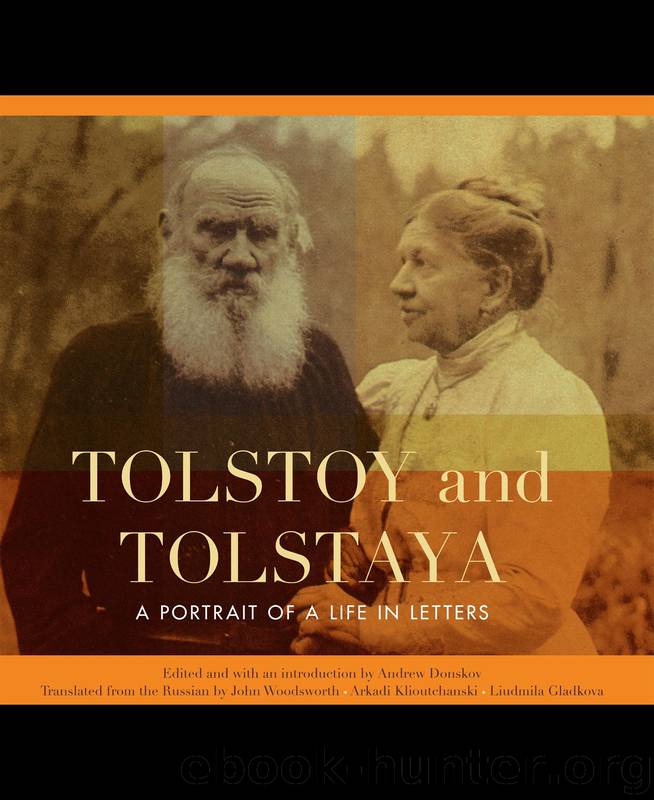
Author:Donskov, Andrew; Woodsworth, John; Klioutchanski, Arkadi
Language: eng
Format: epub
Publisher: University of Ottawa Press
Published: 2017-03-09T16:00:00+00:00
PART III
LETTERS 1889–1910
INTRODUCTION TO LETTERS, PART III
The correspondence between Lev Nikolaevich Tolstoy and his wife over the last two decades of their married years certainly reflected the drama of their life itself. Tolstoy’s return to fiction writing had been accomplished with such masterpieces as The Death of Ivan Ilyich [Smert’ Ivana Il’icha] (1886) and The Kreutzer Sonata [Krejtserova sonata] (1889). He would be active on the belletristic scene well into his advanced years: his novel Hadji Murat [Khadzhi Murat] was finished in 1904, although published only posthumously, together with some of his other later works. In time, however, this artistic endeavour became a source of deepening family discord with Tolstoy’s public renunciation in 1891 of copyright on all his works published after 1881.
In the meantime, Tolstaya continued producing one edition after another of her husband’s ever-popular Complete Collected Works [PSS]. However, she kept encountering more and more difficulties with censorship in respect to his later offerings, which were often controversial thanks to their deliberate — and even emphatic — conflict with official political and religious values of the time. Initially this involved The Kreutzer Sonata, but later included some of his theatrical plays such as The power of darkness [Vlast’ t’my]. In 1891, Sofia Andreevna obtained a personal audience with Emperor Alexander III and a compromise was achieved.
In the following years, Lev Nikolaevich became a kind of cult figure in both his home country and the world at large. While he remained, of course, a great artist, it was his philosophical and religious works (often crossing into the realm of burning social issues) that gained him many new followers. He was being seen more and more not so much as a famous writer but as a kind of guru with a devoted following of ‘Tolstoyans’. His vocal opposition to what he viewed as hypocrisy and intolerance in the official Russian Orthodox Church eventually led to his formal ex-communication in 1901. Sofia Andreevna, by contrast, remained a devoted adherent of the church and its traditional practices, even while considering her husband’s ex-communication as an unwarranted punitive measure.
All this signalled a deepening rift between husband and wife. Certain events brought them brief periods of reconciliation, such as their joint efforts in famine relief (1891–93) and (to a lesser extent) in the relocation of the Doukhobors to Canada (1898–99). Another unifying emotional experience was the birth — and (only seven years later) death — of their last child Ivan (Vanechka) (1888–1895). As a family they did manage to come to an amicable agreement (1891) concerning the division of the inheritance among the surviving children. But these occasional moments of respite could not compensate indefinitely for the widening gulf between them in their philosophical and moral worldviews. Tolstoy rejected the idea of personal property and gave his wife full power-of-attorney over his financial affairs, but not without expressing continual disapproval of the very fact that she (and the rest of the family) dealt with ‘earthly’ issues, while he was devoting his whole attention to ‘spiritual’ seekings.
Download
This site does not store any files on its server. We only index and link to content provided by other sites. Please contact the content providers to delete copyright contents if any and email us, we'll remove relevant links or contents immediately.
Fanny Burney by Claire Harman(26607)
Empire of the Sikhs by Patwant Singh(23090)
Out of India by Michael Foss(16861)
Leonardo da Vinci by Walter Isaacson(13341)
Small Great Things by Jodi Picoult(7156)
The Six Wives Of Henry VIII (WOMEN IN HISTORY) by Fraser Antonia(5519)
The Wind in My Hair by Masih Alinejad(5103)
A Higher Loyalty: Truth, Lies, and Leadership by James Comey(4967)
The Crown by Robert Lacey(4820)
The Lonely City by Olivia Laing(4808)
Millionaire: The Philanderer, Gambler, and Duelist Who Invented Modern Finance by Janet Gleeson(4482)
The Iron Duke by The Iron Duke(4367)
Papillon (English) by Henri Charrière(4278)
Sticky Fingers by Joe Hagan(4207)
Joan of Arc by Mary Gordon(4117)
Alive: The Story of the Andes Survivors by Piers Paul Read(4037)
Stalin by Stephen Kotkin(3973)
Aleister Crowley: The Biography by Tobias Churton(3646)
Ants Among Elephants by Sujatha Gidla(3470)
