The Sons of Night by Gimenez Antoine; Sharkey Paul; Gimenologues
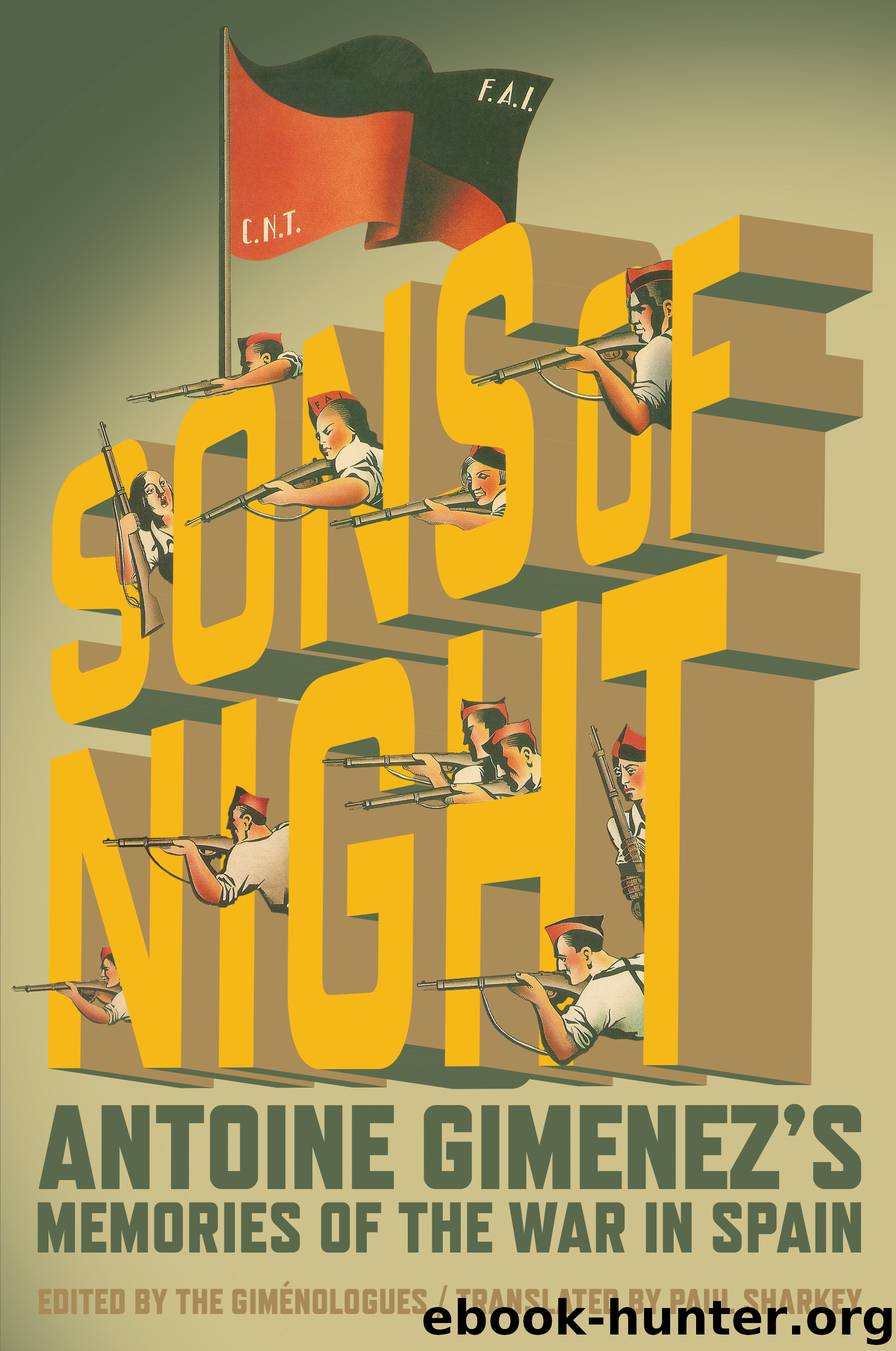
Author:Gimenez, Antoine; Sharkey, Paul; Gimenologues
Language: eng
Format: epub
Publisher: AK Press
Published: 2018-12-31T16:00:00+00:00
{45}
page 123
For those who might have doubts as to the reality of such free love in the Aragonese countryside of 1936, let us look at one of the testimonies collected by the historian Hanneke Willemse. According to one old woman living in Albalate de Cinca, the social revolution brought few changes to the lives of the adult women in that farming town. On the other hand, it really changed the lives of young people. No more priests, no more public authorities to point the finger at unmarried couples! Girls and boys were in each other’s company all the time and they shared the same ideas: they were active in the Libertarian Youth.
One former Durruti Column militiaman points out that “from 1933 onward there had been a degree of change in respect to sexual relations. The truth is that free love was already a topic of conversation [….] and we were even talking about contraceptives.”234
He went on to say that they were not able to use these “because the girls would not let us touch them.” Then, when he returned from the front in December 1936 to relax in the village, he found that his sister and all his friends were public about their liaisons and were not holding back from sexual relations. He himself slept with his friend, Rosalía. “Now, he says, if her father had known about it he’d have killed me.”235
To put it another way, and Gimenez opens our eyes to this, mothers might scheme with their daughters in order to keep fathers’ noses out of it. It may be that Aragonese youngsters had acquired a degree of confidence in their behavior because the new village community looked upon them pretty much as autonomous individuals. Or maybe it was because they found themselves more left to their own devices because of the upheaval in day-to-day life. Félix Carrasquer, who was actively involved in the Albalate de Cinca peasant collective, touches on the issue in his book:
As for what is known as the generation gap, we cannot say that there was actually anything of the sort in the collectives, because […] the traditional tension between one generation and another was never manifest in any systematic way nor was it as radical as it might have been. […] [For] the authority principle […] had been undermined by the impact of the collectives, where the relationship model, founded upon free, mutually reliant partnership, acted as a catalyst between the intransigence of the older generation and the rebelliousness of the younger. […]236
We took a collaborative approach to work and various plans, and this brought the generations together. The discrimination that women had always been subjected to was becoming less and less stark.
[…] woman being placed on an equal footing within the collective, her independence as far as her husband or parents were concerned was absolutely not determined by any economic factor. We need only remember here the family wage from which every collectivist, man or woman, adult, youngster or child benefited. The
Download
This site does not store any files on its server. We only index and link to content provided by other sites. Please contact the content providers to delete copyright contents if any and email us, we'll remove relevant links or contents immediately.
Fanny Burney by Claire Harman(26681)
Empire of the Sikhs by Patwant Singh(23163)
Out of India by Michael Foss(16999)
Leonardo da Vinci by Walter Isaacson(13436)
Small Great Things by Jodi Picoult(7276)
The Six Wives Of Henry VIII (WOMEN IN HISTORY) by Fraser Antonia(5577)
The Wind in My Hair by Masih Alinejad(5162)
A Higher Loyalty: Truth, Lies, and Leadership by James Comey(5044)
The Crown by Robert Lacey(4886)
The Lonely City by Olivia Laing(4886)
Millionaire: The Philanderer, Gambler, and Duelist Who Invented Modern Finance by Janet Gleeson(4558)
The Iron Duke by The Iron Duke(4430)
Papillon (English) by Henri Charrière(4347)
Sticky Fingers by Joe Hagan(4279)
Joan of Arc by Mary Gordon(4181)
Alive: The Story of the Andes Survivors by Piers Paul Read(4107)
Stalin by Stephen Kotkin(4030)
Aleister Crowley: The Biography by Tobias Churton(3696)
Ants Among Elephants by Sujatha Gidla(3508)
