Samurai Assassins by Hillsborough Romulus;
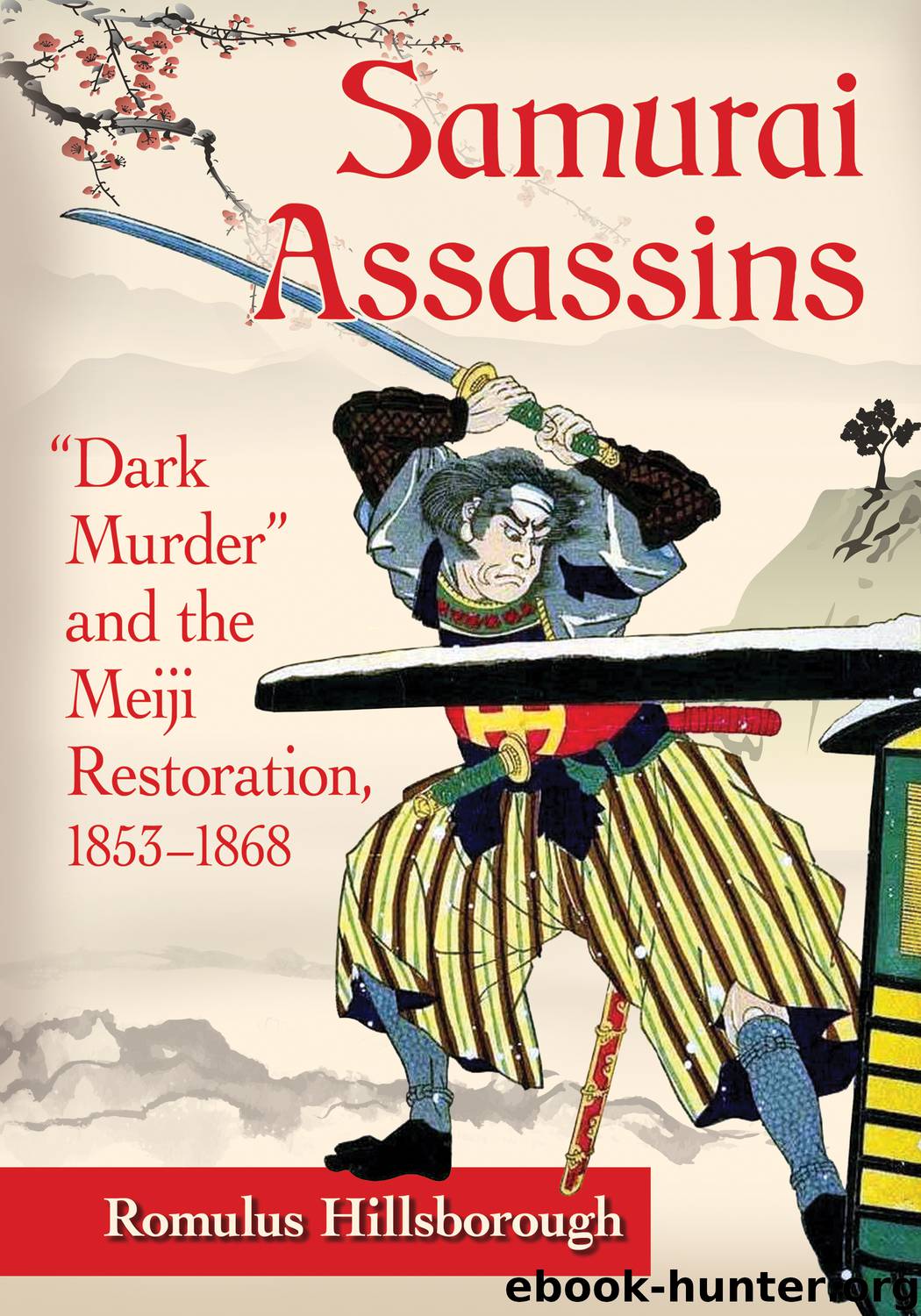
Author:Hillsborough, Romulus;
Language: eng
Format: epub
Publisher: McFarland & Company, Incorporated Publishers
Published: 2017-03-21T04:00:00+00:00
12
The Failed Rebellions of Chōshū and Mito
The Ikédaya Incident
Over the past year, the Chōshū rebels and their rōnin cohorts, collectively the only remaining force intent on overthrowing the Bakufu, had been planning a countercoup in Kyōto to regain the control over the Imperial Court they had lost in the Coup of 8/18. In the following summer, Genji 1 (1864), they plotted to set fire to the Imperial Palace and in the ensuing uproar kidnap the Emperor and assassinate the protector of Kyōto, and even Nakagawa-no-Miya, based on rumors that the latter plotted to remove the Emperor to Hikoné.1 Once in possession of the Emperor, they planned to bring him to Chōshū, arrange for an Imperial decree to attack the Bakufu, and have the Chōshū daimyo appointed protector of Kyōto.
But the Shinsengumi was on to them. The Shinsengumi had been formed in the spring of Bunkyū 3 (1863) under the supervision of the protector of Kyōto to reestablish order in the city. The corps was commanded by two extraordinarily tough men: Kondō Isami and Hijikata Toshizō, both of them sons of wealthy peasant families of the Tama region in the province of Musashi just southwest of Edo. But both had impeccable samurai morals. Kondō had been adopted by a local kenjutsu instructor of the Tennen Rishin Style, whom he succeeded as master at the Shieikan school in Edo. Hijikata was a top student at the Shieikan. In early Bunkyū 3, the two friends, with several other swordsmen of the Shieikan, joined a group of rōnin called the Rōshi Corps (“rōshi” being a euphemism for the derogatory “rōnin), recruited by the Bakufu in Edo to quell the violence in Kyōto in preparation for the shōgun’s arrival there. The Rōshi Corp was the precursor to the Shinsengumi.
Kondō and Hijikata were probably driven not only by a sense of loyalty to the Bakufu, instilled in them as natives of a region adjacent to Edo and under Tokugawa jurisdiction, but also by a once-in-a-lifetime opportunity to use their formidable kenjutsu skills to make a name for themselves as bona fide Tokugawa samurai. (We have already examined a similar motivation in Tanaka Shimbé.) Perhaps to prove themselves as samurai, these peasants’ sons imposed upon their corps a code of conduct based on the most stoic traditions of the samurai class. Strictly forbidden were “violating the code of samurai,” “quitting the corps,” “raising money for selfish purposes,” taking it upon oneself to make acquisitions,” and “fighting for personal reasons.” Violators of the code who were deemed worthy as samurai were required to commit seppuku; those less worthy were beheaded. Attached to the prohibitions was a particularly severe regulation that perhaps more than anything else defined the Shinsengumi: Any corpsmen who drew his sword on an enemy without killing him would be required to commit seppuku, just as if he had been wounded from behind, itself a gross violation of bushidō.2 Bolstered by this code, most of the Shinsengumi wielded a highly lethal sword; and the carte blanche
Download
This site does not store any files on its server. We only index and link to content provided by other sites. Please contact the content providers to delete copyright contents if any and email us, we'll remove relevant links or contents immediately.
| Africa | Americas |
| Arctic & Antarctica | Asia |
| Australia & Oceania | Europe |
| Middle East | Russia |
| United States | World |
| Ancient Civilizations | Military |
| Historical Study & Educational Resources |
The Sympathizer by Viet Thanh Nguyen(4463)
The Rape of Nanking by Iris Chang(4276)
World without end by Ken Follett(3522)
Ants Among Elephants by Sujatha Gidla(3502)
Blood and Sand by Alex Von Tunzelmann(3256)
Japanese Design by Patricia J. Graham(3231)
The Queen of Nothing by Holly Black(2689)
City of Djinns: a year in Delhi by William Dalrymple(2590)
India's Ancient Past by R.S. Sharma(2500)
Foreign Devils on the Silk Road: The Search for the Lost Treasures of Central Asia by Peter Hopkirk(2496)
Tokyo by Rob Goss(2486)
Inglorious Empire by Shashi Tharoor(2475)
In Order to Live: A North Korean Girl's Journey to Freedom by Yeonmi Park(2416)
Tokyo Geek's Guide: Manga, Anime, Gaming, Cosplay, Toys, Idols & More - The Ultimate Guide to Japan's Otaku Culture by Simone Gianni(2413)
India's biggest cover-up by Dhar Anuj(2386)
The Great Game: On Secret Service in High Asia by Peter Hopkirk(2379)
Goodbye Madame Butterfly(2296)
Batik by Rudolf Smend(2225)
Living Silence in Burma by Christina Fink(2098)
