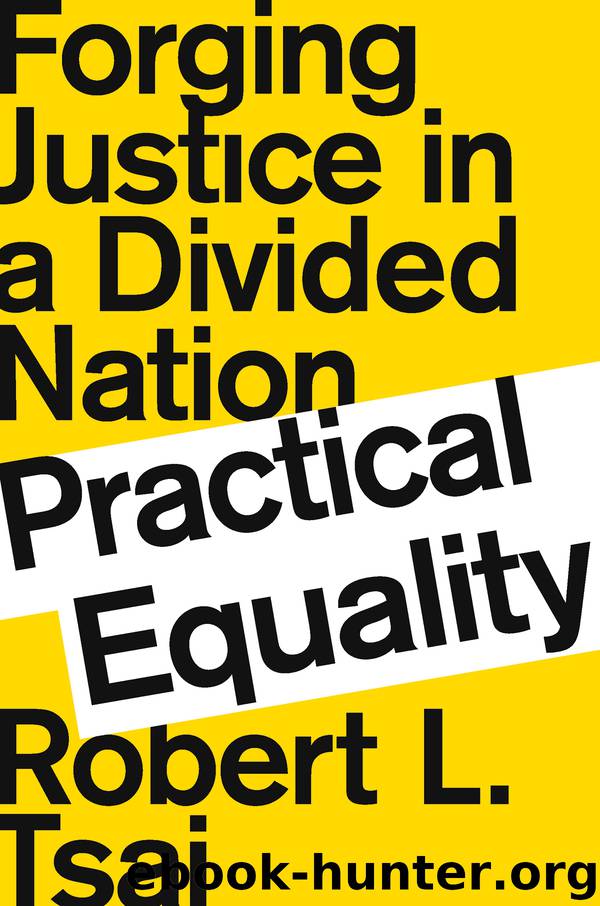
Practical Equality by Robert Tsai
Author:Robert Tsai
Language: eng
Format: epub
Publisher: W. W. Norton & Company
Published: 2018-12-20T16:00:00+00:00
BEHIND PRISON WALLS
PEOPLE CONVICTED OF CRIMES serious enough to warrant imprisonment face the loss of personal space, reduced control over nutrition and exercise, a diminished sense of health and well-being. They experience indignities and inconveniences on a daily basis. This is all par for the course. There is even a euphemism for all this suffering: “the ordinary incidents of prison life.” But just how bad do conditions have to get before it can be said that incarceration practices dehumanize an inmate?
Traditional egalitarianism does little good behind prison walls, where “the government’s power is at its apex.” We presume that inmates are locked up for what they did rather than for who they are. That distinction justifies their general suffering behind bars. They have a set of fundamental rights, such as the right to speech and religious worship, but even those can be curtailed for penological reasons.
The principle of fairness is also at its ebb in the prison context. Prisons already severely constrain an individual’s liberty in two senses: first, in the sense that any additional action might only marginally increase the general suffering an inmate already experiences; second, in the sense that constraints on liberty are justified by the inmate’s previous wrongdoing as well as any legitimate penological interests. As a result, a prisoner has to show he faces an “atypical and significant hardship” before he can even cry foul.34
What passes for fair play in prison isn’t what we would tolerate on the outside. Demont Conner learned this the hard way inside the Halawa Correctional Facility, a maximum-security prison in Oahu. A guard subjected him to a strip search on his way to a religious session, including an inspection of his anal area, and he reacted angrily, swearing at the officer. He was written up for two offenses: “high misconduct” for allegedly interfering with a correctional function and “low moderate misconduct” for using foul language. A disciplinary committee heard the matter but denied Conner a request to call witnesses and sentenced him to thirty days in solitary confinement. The inmate argued that this deprived him of due process.
His case reached the Supreme Court, where the Justices seized the opportunity to create fresh roadblocks to due process claims by inmates. Normally, we would examine prison regulations to see whether they created an enforceable expectation. Now the Justices went a step further, requiring an inmate to show that he has been subjected to “a dramatic departure from the basic conditions” of his existence before he could claim an unfair deprivation of his (already reduced) liberty.
Chief Justice Rehnquist, who wrote the opinion, then made a sweeping application of this new constitutional rule. He looked around and found a variety of regulations that allowed prison authorities to clamp down on inmates, mashed them all together, and concluded that the prison had broad discretion to use force on inmates. To deal with a breach of order, correctional officers could use administrative segregation or protective custody, or even put the entire population on lockdown. So an
Download
This site does not store any files on its server. We only index and link to content provided by other sites. Please contact the content providers to delete copyright contents if any and email us, we'll remove relevant links or contents immediately.
Day by Elie Wiesel(2786)
The Age of Genius by A. C. Grayling(2592)
Gideon's Spies: The Secret History of the Mossad by Gordon Thomas(2356)
The Gulag Archipelago (Vintage Classics) by Aleksandr Solzhenitsyn(2106)
FATWA: Hunted in America by Pamela Geller(2013)
Columbine by Dave Cullen(1870)
Men Explain Things to Me by Rebecca Solnit(1729)
The Rule of Law by Bingham Tom(1702)
Anatomy of Injustice by Raymond Bonner(1671)
Examples & Explanations: Administrative Law by William F. Funk & Richard H. Seamon(1649)
Three Cups of Tea by Greg Mortenson(1621)
The Source by James A. Michener(1619)
That Every Man Be Armed by Stephen P. Halbrook(1584)
ADHD on Trial by Michael Gordon(1581)
Future Design by Unknown(1580)
Gideon's Spies by Gordon Thomas(1512)
Palestinian Walks by Raja Shehadeh(1499)
Constitutional Theory by Carl Schmitt(1458)
Nothing to Envy by Barbara Demick(1451)
