Pol Pot by Philip Short
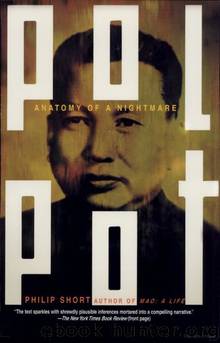
Author:Philip Short [Short, Philip]
Language: eng
Format: epub
Publisher: Henry Holt and Co.
Published: 2004-02-08T16:00:00+00:00
Future Perfect
IT WAS NOT
the triumphal entry that most insurgents dream of.
Three days
after the fall of Phnom Penh, on the morning of April 20, Pol returned to the city he had last seen twelve years before. Then he had been a fugitive, hidden in the back of a lorry, fleeing to Vietnam. Now he was escorted from the forward headquarters at Sdok Toel in a captured armoured car, surrounded by a phalanx of jeeps carrying the leaders of the three Zones which had co-ordinated the offensive – Mok from the South-West; Koy Thuon and Ke Pauk from the North; Vorn Vet and Cheng On from the Special Zone – Pol’s deputy, Nuon Chea; Khieu Samphân; the Chief of Staff, Son Sen, and the four chief division commanders, San, Saroeun, Soeun and Thin.
But old reflexes die hard. Instead of proceeding directly down Highway 5, which would have taken them past dense crowds of urban deportees, the convoy took a devious back route, along narrow dirt roads through bombed-out hamlets and paddy-fields, to emerge near Pochentong Airport and enter the city from the west. At the railway station, where communist Cambodia’s new leaders would spend the next few weeks, there was no honour guard. ‘Pol’s arrival was secret,’ his aide, Phi Phuon explained. ‘There was no announcement, no ceremony, nothing to show he was there.’
The railway station had been chosen because it stood well apart from other buildings and was easy to defend. It had been built in the 1930s to a French-Cambodian colonial design, with an art deco, Mediterranean-style façade of concrete latticework, decorated in ochre and white, for light and ventilation, and inside, above a cavernous passenger hall, a single floor of offices. It was there, in a large,
open work area
with three small enclosed bureaux on either side, that Pol and his colleagues spent their days discussing the outline of their new state, sleeping at night on rattan mats spread out on the concrete floor.
Nuon Chea and Khieu Samphân were sent to inspect the Northern Zone checkpoint at Prek Kdam, on Highway 5, while Mok shuttled back and forth to the South-Western Zone HQ near Takeo. All three reported
that the evacuation was proceeding smoothly. And, to them, it was. For the CPK leadership, 20,000 dead was a small price to pay for demolishing, at a stroke, Cambodian capitalism, and erasing the social frontier between the city and the countryside.
Yet, crucial though the evacuation was for the future Khmer Rouge polity, the leadership did not find it easy to justify.
Pol himself offered two contradictory sets of reasons. To Westerners he maintained that ‘this action was not pre-planned . . . It was the realisation that a food shortage was imminent . . . and that there was a plan by US lackeys to attack us that prompted [it].’ None of that was true. Not only were food supplies adequate, but it was far more difficult logistically for the Khmers Rouges to provide grain to moving columns of deportees than it would have been if they had stayed put.
Download
This site does not store any files on its server. We only index and link to content provided by other sites. Please contact the content providers to delete copyright contents if any and email us, we'll remove relevant links or contents immediately.
| Africa | Americas |
| Arctic & Antarctica | Asia |
| Australia & Oceania | Europe |
| Middle East | Russia |
| United States | World |
| Ancient Civilizations | Military |
| Historical Study & Educational Resources |
The Sympathizer by Viet Thanh Nguyen(4447)
The Rape of Nanking by Iris Chang(4266)
World without end by Ken Follett(3512)
Ants Among Elephants by Sujatha Gidla(3495)
Blood and Sand by Alex Von Tunzelmann(3243)
Japanese Design by Patricia J. Graham(3220)
The Queen of Nothing by Holly Black(2660)
City of Djinns: a year in Delhi by William Dalrymple(2582)
India's Ancient Past by R.S. Sharma(2493)
Foreign Devils on the Silk Road: The Search for the Lost Treasures of Central Asia by Peter Hopkirk(2482)
Tokyo by Rob Goss(2469)
Inglorious Empire by Shashi Tharoor(2463)
In Order to Live: A North Korean Girl's Journey to Freedom by Yeonmi Park(2411)
Tokyo Geek's Guide: Manga, Anime, Gaming, Cosplay, Toys, Idols & More - The Ultimate Guide to Japan's Otaku Culture by Simone Gianni(2400)
India's biggest cover-up by Dhar Anuj(2381)
The Great Game: On Secret Service in High Asia by Peter Hopkirk(2375)
Goodbye Madame Butterfly(2289)
Batik by Rudolf Smend(2213)
Living Silence in Burma by Christina Fink(2093)
