Otto Abetz and His Paris Acolytes by Mauthner Martin;
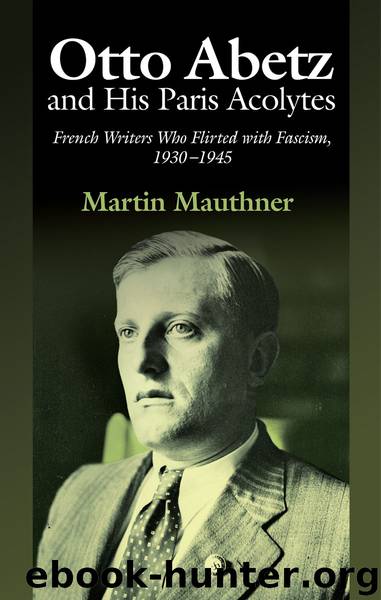
Author:Mauthner, Martin;
Language: eng
Format: epub
Publisher: Sussex Academic Press
Published: 2016-03-04T16:00:00+00:00
16
“Die for Danzig?”
Yes, Says Henri de Kérillis
With hatred in his heart, an exhilarated Henri de Kérillis felt a wild joy as he flew his small aircraft over Alsace and crossed the Rhine. His plane was one of nine, and all were carrying bombs. Kérillis and his fellow aviators were about to avenge the many casualties caused by German air attacks on French towns in the spring of that year, 1916. It was four o’clock on a sunny June afternoon when the squadron approached Karlsruhe. Women and children crowded the streets below. At least some of them will suffer in their turn, Kérillis said to himself gleefully; they are going to sweat a little blood. The French bombs killed 117 and injured 140 German civilians. Kérillis later learned that among the injured was Otto Abetz, then 13 years old. His father had taken him to Hagenbeck’s traveling circus on that holiday.
Kérillis’s experiences during the First World War — he remained haunted by France’s dead children, its devastated towns and ruined villages, and its enormous grief — would mould firmly his attitude to Germany in the decades to come. He would remain stubbornly impervious to the argument, so forcefully expressed in Keynes’s devastating critique, that France’s demands at the postwar negotiating table had been too harsh. Given the enormous destruction and widespread misery Germany had caused, the victors had rightly cut the country down to size; of that, he was never in any doubt. And he saw no need even to contemplate a revision of that attitude. Well before Hitler arrived on the Berlin political scene, Germany was already agitating for changes to the peace settlement forced on it, and preparing to rebuild its military capacity. Kérillis would have none of it. He did not reason that German unrest was a consequence of the humiliating way the victors had treated the defeated nation. He would never join those other combatants who, with time, would exhibit a Churchillian magnanimity and seek the path of understanding. Kérillis, a Catholic and a right-wing nationalist, saw himself as a patriot above all. He never wavered in his mistrust of Germany, and more especially of Hitler’s Germany.
In the bleak wilderness that was French politics in the “hollow” 1930s, few on the Catholic right campaigned as vigorously and as consistently against the Nazi menace as did Kérillis. Like Churchill, however, he had against him a French equivalent of the Cliveden set, as well as much of the French left. In addition, he was something of an intellectual bully, whose intemperate polemics ultimately propelled even many of his friends to despair.
Born in 1889, Kérillis grew up in Médoc and attended a Jesuit college in Bordeaux. He was the son of a naval officer who was also a mathematician and inventor. His mother, despite the conservative family background, sympathized with the Dreyfusards. After failing his Baccalauréat — a zero in Latin — he went into the army and joined the cavalry. While convalescing, after being wounded at the battle of the Marne, he concluded that the days of fighting on horseback were over.
Download
This site does not store any files on its server. We only index and link to content provided by other sites. Please contact the content providers to delete copyright contents if any and email us, we'll remove relevant links or contents immediately.
Fanny Burney by Claire Harman(26609)
Empire of the Sikhs by Patwant Singh(23090)
Out of India by Michael Foss(16861)
Leonardo da Vinci by Walter Isaacson(13344)
Small Great Things by Jodi Picoult(7158)
The Six Wives Of Henry VIII (WOMEN IN HISTORY) by Fraser Antonia(5520)
The Wind in My Hair by Masih Alinejad(5105)
A Higher Loyalty: Truth, Lies, and Leadership by James Comey(4967)
The Crown by Robert Lacey(4823)
The Lonely City by Olivia Laing(4808)
Millionaire: The Philanderer, Gambler, and Duelist Who Invented Modern Finance by Janet Gleeson(4483)
The Iron Duke by The Iron Duke(4368)
Papillon (English) by Henri Charrière(4278)
Sticky Fingers by Joe Hagan(4208)
Joan of Arc by Mary Gordon(4119)
Alive: The Story of the Andes Survivors by Piers Paul Read(4037)
Stalin by Stephen Kotkin(3973)
Aleister Crowley: The Biography by Tobias Churton(3647)
Ants Among Elephants by Sujatha Gidla(3472)
