Ocean Under the Ice by Robert L. Forward
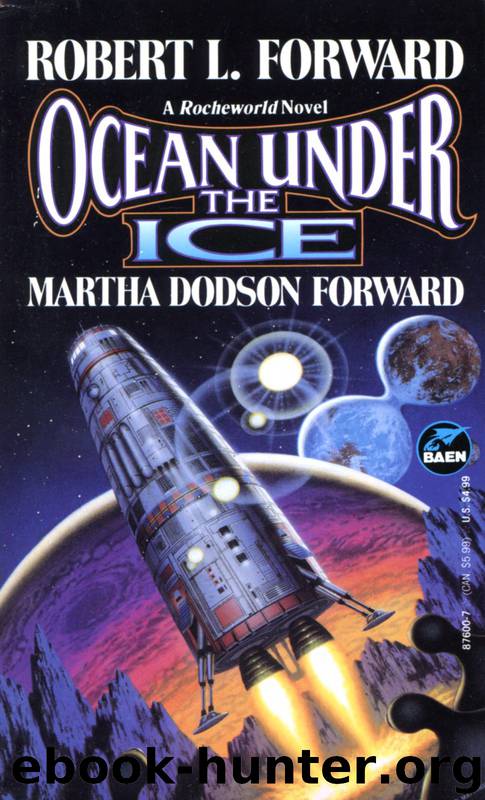
Author:Robert L. Forward [Forward, Robert L.]
Language: eng
Format: epub
Tags: Fiction, Science Fiction, General, Hard Science Fiction
ISBN: 9780595166213
Google: y7sJAAAACAAJ
Publisher: iUniverse
Published: 2000-12-14T13:30:00+00:00
* * *
When Cinnamon arrived back at Victoria, however, it was Katrina who had the most interesting news about the icerugs.
“The icerugs and flouwen are related!” exclaimed Katrina, as Cinnamon joined her in the small area on Victoria that served as combined laboratory and sick bay. “Their cellular structure is the same. In both of them, the basic cell is shaped like a fat dumbbell — two knobs connected by a thick neck. I haven’t had time to do any detailed scans yet, but the images from the tunneling array microscope show that both the icerug and flouwen cells have complex semirandom patterns on their surfaces that serve as both the genetic code and the long term memory for the creatures. And…” she continued, still punching icons on the screen as the imaging continued. “…they use the same basic genetic code patterns, indicating that the flouwen and icerugs definitely have a common genetic ancestor. The same goes for the coelasharks.”
She looked up at Cinnamon and pointed at her screen. “This is a scan of some coelashark muscle tissue that Little White brought back. The cells here in the muscle tissue have specialized, and changed basic shape by joining into long strands of knobs, but the basic coelashark cell is also double-knobbed, and uses the same basic genetic code pattern, so icerugs and coelasharks have a common genetic ancestor.”
“How closely related are they?” asked Cinnamon.
“Not close at all,” said Katrina. “Again, I haven’t had time to get detailed maps of the genetic patterns in order to run comparisons, but just a quick scan shows a major difference. The coelasharks have two sets of genes, each slightly different from the other, one set on one knob of the cell and the other set on the other knob. That makes them diploid. The icerugs, however, have only one set of genes, the patterns on the two knobs of their cell are the same. So, they are monoploid while the coelasharks are diploid — that’s a major difference which indicates that they are not closely related at all.”
“On Earth, a diploid genetic structure usually indicates a more complex and therefore a more advanced life form,” said Cinnamon. “Yet the icerugs seem to be much more intelligent than the icerugs.”
“Since they only need one knob of their cell for reproduction,” said Katrina. “Perhaps they use the other knob for thinking — changing the patterns on the cell surface to store long term memories. Anyway, even though distantly related, they are related.”
“If that’s true, then following the pattern on Earth, probably all life on Zulu is related to each other — and thence to the flouwen,” mused Cinnamon.
“So far, they are,” said Katrina. “The sample of smallfish and the boardweed that Gray-Mote gave Little White also show a double-knob cell structure.”
“I wondered how it happened? Did life from here go to Rocheworld, or the other way around? Rocheworld does come pretty close to Gargantua once every three orbits.”
“The geyser here throws lots of biological material from Zulu into space,” said Katrina.
Download
This site does not store any files on its server. We only index and link to content provided by other sites. Please contact the content providers to delete copyright contents if any and email us, we'll remove relevant links or contents immediately.
| Fantasy | Gaming |
| Science Fiction | Writing |
Sita - Warrior of Mithila (Book 2 of the Ram Chandra Series) by Amish(55330)
The Crystal Crypt by Dick Philip K(37073)
Cat's cradle by Kurt Vonnegut(15574)
Ready Player One by Cline Ernest(15158)
Always and Forever, Lara Jean by Jenny Han(15084)
The Last by Hanna Jameson(10400)
Year One by Nora Roberts(9971)
Persepolis Rising by James S. A. Corey(9582)
The remains of the day by Kazuo Ishiguro(9233)
Never let me go by Kazuo Ishiguro(9119)
Red Rising by Pierce Brown(9011)
Dark Space: The Second Trilogy (Books 4-6) (Dark Space Trilogies Book 2) by Jasper T. Scott(8338)
The handmaid's tale by Margaret Atwood(7925)
Frank Herbert's Dune Saga Collection: Books 1 - 6 by Frank Herbert(7372)
The Circle by Dave Eggers(7268)
The Testaments by Margaret Atwood(7130)
Legacy by Ellery Kane(6779)
Pandemic (The Extinction Files Book 1) by A.G. Riddle(6698)
Six Wakes by Mur Lafferty(6418)
