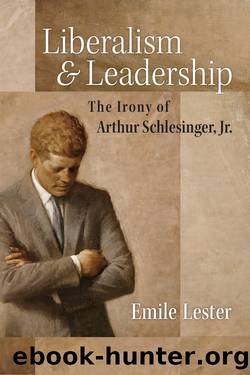
Liberalism and Leadership by Emile Lester;
Author:Emile Lester; [Lester, Emile]
Language: eng
Format: epub
Publisher: University of Michigan Press (limited)
4. The Terror and the Hope
The shadow was never far from him; that rendezvous at midnight in some flaming town.
—Arthur Schlesinger, Jr., A Thousand Days
As violence is a kind of romance, bound up with the energies of youth, so romance is itself a kind of violence.
—Joyce Carol Oates, Afterword to them
Schlesinger had done his best in The Age of Roosevelt to paint his subject with the somber colors of irony that he admired. But the irrepressible cheer of Franklin Roosevelt proved hard to deny. At most, the inner sadness and despair Schlesinger occasionally attributes to him were subordinate, well-repressed facets of his personality almost never apparent even to his most intimate friends and often hidden from Roosevelt himself. Roosevelt’s ironic detachment was not organic, but a necessary and hard-won acquired trait. He wielded inscrutability as a Machiavellian technique of power, enabling him to evade politically damaging commitments and to keep allies as well as enemies on the defensive. His detachment in the service of liberal ends often made him cruel in his treatment of subordinates and opponents, but it did not make him tragic.
In John F. Kennedy, Schlesinger thought he had found the hero foretold in his and Niebuhr’s postwar writings on ironic liberalism. “His mind,” Schlesinger (1965, 722) wrote, “was not prophetic, impassioned, mystical, ontological, utopian, or ideological. It was less exuberant than Theodore Roosevelt’s, less scholarly than Wilson’s, less adventurous than Franklin Roosevelt’s. But it had its own salient qualities—it was objective, practical, ironic, skeptical, unfettered, and insatiable.” This irony was no surface sheen, but the river dwelling deep within that cut the channels of Page 134 →Kennedy’s thought and political decisions. Kennedy’s disdain for cheap sentiment in politics, Schlesinger speculated, sprung from the turbulence of his ancestors’ Irish Catholic history. His Irish background imbued him with “toughness” and “the view of life as comedy and as tragedy,” while his Catholicism made him an outsider and gave him an instinctive appreciation of what it meant to be marginalized that the insider patrician Roosevelt had to struggle to achieve (78–79). Roosevelt could sympathize with those alienated from the mainstream; Kennedy’s upbringing made him able to empathize.
The hollows of Kennedy’s detachment were further carved by raging tides that washed away too many of his and Schlesinger’s own generation. Not only Roosevelt, but those born a mere decade or two before Kennedy, such as Adlai Stevenson and Lyndon Johnson, were “rooted in another and simpler America.” Kennedy, though, was “the first representative in the White House of a distinctive generation . . . which was born during the First World War, came of age during the depression, fought in the Second World War and began its public career in the atomic age” (113). Schlesinger was born less than six months after Kennedy, and his commentary on how the events of Kennedy’s generation shaped his views tells us much about how Schlesinger believed these events shaped his own perspective.
Drawing from the often disastrous events of his time, Kennedy’s detachment had a darker hue than Roosevelt’s.
Download
This site does not store any files on its server. We only index and link to content provided by other sites. Please contact the content providers to delete copyright contents if any and email us, we'll remove relevant links or contents immediately.
Fanny Burney by Claire Harman(26591)
Empire of the Sikhs by Patwant Singh(23066)
Out of India by Michael Foss(16839)
Leonardo da Vinci by Walter Isaacson(13303)
Small Great Things by Jodi Picoult(7112)
The Six Wives Of Henry VIII (WOMEN IN HISTORY) by Fraser Antonia(5493)
The Wind in My Hair by Masih Alinejad(5085)
A Higher Loyalty: Truth, Lies, and Leadership by James Comey(4945)
The Crown by Robert Lacey(4799)
The Lonely City by Olivia Laing(4796)
Millionaire: The Philanderer, Gambler, and Duelist Who Invented Modern Finance by Janet Gleeson(4457)
The Iron Duke by The Iron Duke(4345)
Papillon (English) by Henri Charrière(4251)
Sticky Fingers by Joe Hagan(4181)
Joan of Arc by Mary Gordon(4091)
Alive: The Story of the Andes Survivors by Piers Paul Read(4014)
Stalin by Stephen Kotkin(3950)
Aleister Crowley: The Biography by Tobias Churton(3626)
Ants Among Elephants by Sujatha Gidla(3458)
