John Key by John Roughan
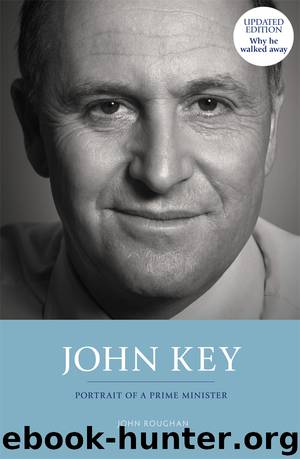
Author:John Roughan [Roughan, John]
Language: eng
Format: epub
ISBN: 9780143771197
Publisher: Penguin Random House New Zealand
Published: 2013-04-08T00:00:00+00:00
When Key announced his government, Turia and Sharples were named as ministers outside the cabinet, as were ACT’s Rodney Hide and Heather Roy, and Peter Dunne. New Zealand has had seven elections using mixed member proportional representation (MMP) and, contrary to expectations, the country is not developing a tradition of coalition government where ministers of more than one party comprise the supreme decision-making body, the cabinet. The first attempted coalitions, National with New Zealand First in 1996 and Labour with the Alliance in 1999, did not end happily. Thereafter, both National and Labour have found it more practical to be minority governments with the support of smaller parties that also prefer to keep their distance from the dominant party. Rather than full coalitions, the usual arrangement has become ‘confidence and supply’ agreements that bind the smaller partner to vote with the larger party in Parliament only on issues of confidence in the government and (financial) supply. On all other issues, the smaller party, including its ministers, remains free to vote against government bills it does not like.
The Maori Party’s negotiated agreement with National contained few specific policies but plenty of hopeful principles for dealing with each other. Turia told Audrey Young her party had entered the negotiations with one purpose in mind, ‘that if we were able to achieve a respectful relationship, a mana-enhancing relationship, then anything was possible’. One of the few specific elements of the agreement was that the government would not pursue National’s long-standing policy to abolish the separate Maori seats, and the Maori Party would not press its aim to have the seats ‘entrenched’ in the Electoral Act, which would mean they could not be abolished by a bare majority of Parliament.
National’s other principal partner, ACT, with as many seats as the Maori Party (five), had negotiated a more detailed agreement. ACT secured a taskforce reviewing government spending, a productivity commission, a parliamentary review of Labour’s carbon emissions trading scheme and a ‘2025 Taskforce’ headed by Don Brash to look at the economy that far ahead. ACT had brought Sir Roger Douglas back to Parliament on its list and also hoped he would be made a minister. Key quickly made it clear he would not have him. Nor was he much interested in Brash’s taskforce. When it produced its first report at the end of 2009 – recommending, among other things, that $9 billion be slashed from the $40 billion budget and the top tax rate be reduced to 20–25 cents in the dollar – Key and English barely acknowledged it.
Dunne, with only one vote to offer, had not been in a position to negotiate very much. He was largely content to be Minister of Revenue as he had been previously in the Labour-led government. Explaining the technicalities of taxation is not a task that many politicians are anxious to take on.
But the Maori Party’s prime interest, its relationship with Key’s government, had an immediate consequence for the way the government has functioned with all its partners.
Download
This site does not store any files on its server. We only index and link to content provided by other sites. Please contact the content providers to delete copyright contents if any and email us, we'll remove relevant links or contents immediately.
Fanny Burney by Claire Harman(26607)
Empire of the Sikhs by Patwant Singh(23090)
Out of India by Michael Foss(16861)
Leonardo da Vinci by Walter Isaacson(13341)
Small Great Things by Jodi Picoult(7153)
The Six Wives Of Henry VIII (WOMEN IN HISTORY) by Fraser Antonia(5519)
The Wind in My Hair by Masih Alinejad(5101)
A Higher Loyalty: Truth, Lies, and Leadership by James Comey(4966)
The Crown by Robert Lacey(4819)
The Lonely City by Olivia Laing(4805)
Millionaire: The Philanderer, Gambler, and Duelist Who Invented Modern Finance by Janet Gleeson(4482)
The Iron Duke by The Iron Duke(4367)
Papillon (English) by Henri Charrière(4278)
Sticky Fingers by Joe Hagan(4207)
Joan of Arc by Mary Gordon(4117)
Alive: The Story of the Andes Survivors by Piers Paul Read(4037)
Stalin by Stephen Kotkin(3973)
Aleister Crowley: The Biography by Tobias Churton(3644)
Ants Among Elephants by Sujatha Gidla(3469)
