Inside Story by Philip Webster
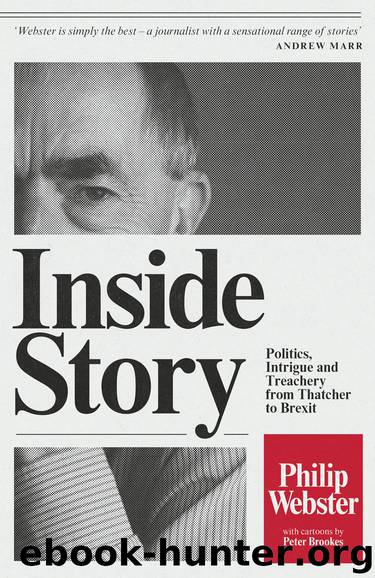
Author:Philip Webster
Language: eng
Format: epub
Publisher: HarperCollins Publishers
Published: 2016-09-04T16:00:00+00:00
But it went on because Blair declined to sack Brown, probably fearing he would be even more dangerous on the back-benches. One Blairite confided to me at the time: ‘If he sacks him, Gordon would have a government in exile waiting for him to fall.’
Relations hit their direst point in the autumn of 2003 when Brown, for the first time, went for Blair publicly. In his conference speech he ridiculed Blair’s ‘best when we’re boldest’ speech from the previous year and brought the house down with his payoff line, ‘Best when we’re Labour’. Brown’s allies knew exactly what they were doing. Blair was vulnerable because of Iraq, and now was the moment to attack. Blair hit back with a defiant speech the next day, which was seen as a riposte to his chancellor. It was an amazing spectacle: the two most powerful men in Britain arguing in public as if the Opposition parties did not exist.
John Prescott, the deputy PM, called the two men to a peace dinner at Admiralty House in London. Again, as always with this pair, it was unclear what had been agreed. Brown went away thinking he had at last got a promise that power would be handed over the following autumn; the Blairites and Prescott seemed to suggest it was conditional on his good behaviour before then.
The early months of 2004 were as bad as any Blair had endured. Iraq was bearing down on him, Lord Hutton’s report on the death of Dr David Kelly was dismissed as a whitewash, and he only narrowly survived a Commons vote on tuition fees. My own next bit part in this unfolding melodrama came when I was briefed that in April 2004 Blair had met with several senior figures to tell them he intended to ‘pre-announce’ in May a decision to go later in the year.
Brown had been waiting for years for Blair to go but suddenly found himself telling the Prime Minister that his proposed course was unwise because it would make him a lame duck and open the way to a long leadership contest. Brown had believed Blair had given him an assurance at Admiralty House and for him, it was better to stick to it.
This really was an open goal. Prescott had hinted that a denouement was close when he told Tom Baldwin, then deputy political editor of The Times, that the ‘tectonic plates of politics were shifting’. That was the nearest Brown came to leading Labour into the 2005 election. During the early summer, key allies like Tessa Jowell and Charles Clarke had private conversations with Blair to boost his morale. His mood lifted quickly. From suggesting privately that he was endangering his party, he started thinking more positively about standing again, and once more disappointing Brown.
The PM took the political world by storm by suddenly announcing after the end of the Labour conference that he intended to go on and serve a full third term (but not a fourth), that he was buying
Download
This site does not store any files on its server. We only index and link to content provided by other sites. Please contact the content providers to delete copyright contents if any and email us, we'll remove relevant links or contents immediately.
Fanny Burney by Claire Harman(26602)
Empire of the Sikhs by Patwant Singh(23085)
Out of India by Michael Foss(16853)
Leonardo da Vinci by Walter Isaacson(13336)
Small Great Things by Jodi Picoult(7141)
The Six Wives Of Henry VIII (WOMEN IN HISTORY) by Fraser Antonia(5515)
The Wind in My Hair by Masih Alinejad(5095)
A Higher Loyalty: Truth, Lies, and Leadership by James Comey(4963)
The Crown by Robert Lacey(4814)
The Lonely City by Olivia Laing(4801)
Millionaire: The Philanderer, Gambler, and Duelist Who Invented Modern Finance by Janet Gleeson(4478)
The Iron Duke by The Iron Duke(4354)
Papillon (English) by Henri Charrière(4274)
Sticky Fingers by Joe Hagan(4198)
Joan of Arc by Mary Gordon(4110)
Alive: The Story of the Andes Survivors by Piers Paul Read(4031)
Stalin by Stephen Kotkin(3965)
Aleister Crowley: The Biography by Tobias Churton(3640)
Ants Among Elephants by Sujatha Gidla(3467)
