Hungarian Goulash by Hajdu Robert
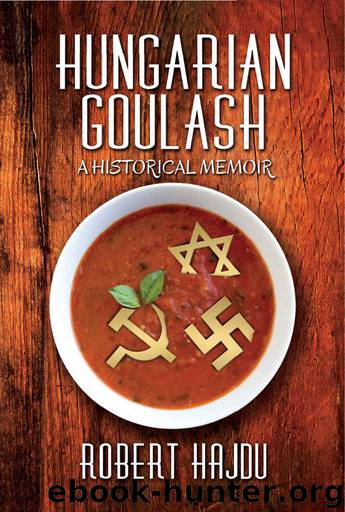
Author:Hajdu, Robert
Language: eng
Format: epub
Published: 2015-04-28T16:00:00+00:00
CHAPTER 6
The Revolution Lost
IN HUNGARY THE REVOLUTIONARY FEVER of 1848 took the form of a nationalist movement. By then, as you know, the German prince and sort of many-headed hydra who wore the Austrian imperial crown and ruled from Vienna had been for three and a half centuries also wearing the Hungarian royal crown. Under the Habsburgs, the German minority living throughout the kingdom had grown and the Magyars themselves had been increasingly Teutonified. But during the first half of the 19th century a reaction had set in, the yearning for the recovery of a Hungarian identity became a collective ache, and the ethnic urge was approaching birthright grade. Then on March 15th, with recitations and proclamations Sándor Petőfi and other poets and writers inspired the nobility and middle classes of Buda and Pest to join the liberal political opposition, and all of them together to formulate a program of reforms. Promptly then, appointed representatives of these groups produced the Twelve Points, which, in essence, demanded national independence, a limited democracy and bourgeois liberalism. Then, because the aristocracy also supported this program, and because the revolution raging at the same time in Vienna frightened the imperial authorities, the reforms quickly became law. The Diet enacted them, and its Viennese masters signed off. And so, in just a few weeks, the modern, nationalist, liberal revolution achieved its goals: Hungary had a new government accountable to a new National Assembly.
During the early 1830s, when Louis Kossuth first emerged as a journalist and a public figure, he was already committed to the cause of Hungarian national identity and self-determination. As a subversive, he did a few years behind bars at the end of that decade but then just continued his tireless agitation, flashing his extraordinary genius for oratory at every turn and soon becoming the spokesman of the reform movement. In 1847 he was elected to the Diet as the deputy from Pest, and there quickly assumed the leadership. And then, after the March-15th call to revolution in Pest and the rapid granting of the reformers’ demands by the emperor-king, Kossuth became a member of the new government, and then in the whirlwind of changing international circumstances and the storm of reaction whipped up by the quick victory, he took the helm as the national leader.
By August the revolutionary fires had been put out in other parts of Europe, and surely, they said in Vienna, it was now time to deal with the Magyars. So first the Austrians goaded the large Croatian minority living within Hungary to demand its own independence. When the Magyars refused, being no less fond of ethnic lording-over than the Austrians, the Croatians attacked with a large army. And then the Austrians themselves attacked. You wouldn’t have put your money on the Magyars, but for almost a year they held their own in this War of Independence against the greatly superior enemy forces. When things were not going well, and right to the very end, they believed that foreign powers would provide the necessary aid.
Download
This site does not store any files on its server. We only index and link to content provided by other sites. Please contact the content providers to delete copyright contents if any and email us, we'll remove relevant links or contents immediately.
Fanny Burney by Claire Harman(26676)
Empire of the Sikhs by Patwant Singh(23150)
Out of India by Michael Foss(16992)
Leonardo da Vinci by Walter Isaacson(13427)
Small Great Things by Jodi Picoult(7264)
The Six Wives Of Henry VIII (WOMEN IN HISTORY) by Fraser Antonia(5569)
The Wind in My Hair by Masih Alinejad(5155)
A Higher Loyalty: Truth, Lies, and Leadership by James Comey(5031)
The Crown by Robert Lacey(4879)
The Lonely City by Olivia Laing(4872)
Millionaire: The Philanderer, Gambler, and Duelist Who Invented Modern Finance by Janet Gleeson(4552)
The Iron Duke by The Iron Duke(4420)
Papillon (English) by Henri Charrière(4338)
Sticky Fingers by Joe Hagan(4268)
Joan of Arc by Mary Gordon(4171)
Alive: The Story of the Andes Survivors by Piers Paul Read(4097)
Stalin by Stephen Kotkin(4025)
Aleister Crowley: The Biography by Tobias Churton(3680)
Ants Among Elephants by Sujatha Gidla(3502)
