Faked Out: The companion novel to the bestselling Faking It by Elisa Lorello
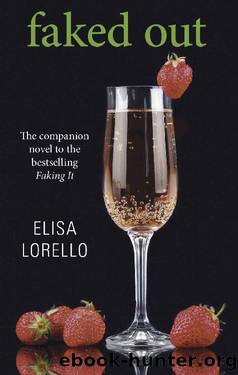
Author:Elisa Lorello [Lorello, Elisa]
Language: eng
Format: epub
Tags: Romance
Publisher: Missouri Breaks Press
Published: 2018-05-31T23:00:00+00:00
For some reason I had expected Andi to show up wearing something sexy, like a cocktail dress. Instead she appeared in jeans, a light blue tank top, and flip-flops. Her naturally wavy hair, growing longer every day, was pulled back in a headband. Then again, I hadnât dressed up for the occasion either, sporting my usual jeans and a U2 tour shirt, thus I donât know why I was expecting her to.
We started with the writing tutorial first. Andi had assigned me to read Platoâs Phaedrusâa text so tedious it wouldâve made a better form of execution than the hemlock. These were some of the classical texts and some of the earliest forms of argument and rhetoric, Andi explained. Furthermore, she explained Phaedrus to me as Platoâs slam against the sophists and a philosophical foray into provisional vs. absolute truth. She lost me.
âThe sophists were the talk show hosts, televangelists, and motivational speakers of their time,â she explained. âThe Stephen Colberts. Orators for hireâhave quill, will travel. And they were regaled as rock stars with their grandiloquent ability to move the masses and make them swoon.â
âSounds like a good gig,â I said.
âPlato didnât think so. Heâs saying that sophistry is nothing more than âcookery,â a bunch of bells and whistles, and that rhetoric isnât so much a pursuit of truth as it is a means of persuasion.â
âSo, when you called me âa modern-day sophistâ that day, you werenât paying me a compliment?â
She opened her mouth, as if to say something, then closed it again. I winked. See? I remember things.
âBut hereâs the cool thing,â she pressed on. âIf you really study the text, Plato is teaching, and he uses metaphor and tropes used in rhetoric to do so.â
She was animated, clearly geeked out by this stuff, prompting me to tease her a little. âSo?â
âSo? Do you realize that this is the stuff that Iâm still teaching to this day? Metaphor? Rhetoric as a means of communication and persuasion? Plato paved the way for guys like Aristotle who systematized the whole thing, modes of discourse and all.â
Never let anyone tell you readers arenât sexy.
âAnd truth?â I asked.
âWhat about truth?â she countered.
âIs rhetoric a means to truth or not?â
âPlato didnât think so. He thought sophistic rhetoric actually got in the way of the search for absolute truth, which sort of contradicts what I teach today. I say language is a way to make meaning, to express truth in many forms. Plato sought to use rhetoric analytically and dialectically. Read the text again and youâll see itâlook at the dialectic between Socrates and Phaedrus.â
Read it again? Iâd rather eat the paper on which it was printed.
âIâll pass,â I said.
âItâs an acquired taste,â she replied, as if sheâd heard my mental metaphor.
We moved on to her next lesson: describe the Warhol painting without using any words typically found in an art reviewâkind of like Taboo for art critics. After that, I had to write an impromptu speechâI even created a metaphor inspired by the Platonic âcookery,â which impressed Andi.
Download
This site does not store any files on its server. We only index and link to content provided by other sites. Please contact the content providers to delete copyright contents if any and email us, we'll remove relevant links or contents immediately.
| African American | Contemporary |
| Divorce | Domestic Life |
| Friendship | Mothers & Children |
| Single Women | Sisters |
The Hating Game by Sally Thorne(19238)
Still Me by Jojo Moyes(11255)
Most of All You by Mia Sheridan(9501)
The Break by Marian Keyes(9358)
Where the Crawdads Sing by Delia Owens(8611)
The Kiss Quotient by Helen Hoang(7228)
Darker: Fifty Shades Darker as Told by Christian (Fifty Shades of Grey Series) by E L James(7220)
Little Fires Everywhere by Celeste Ng(7184)
Small Great Things by Jodi Picoult(7122)
Burn for You (Slow Burn Book 1) by J.T. Geissinger(7084)
Into the Water by Paula Hawkins(6986)
The Seven Husbands of Evelyn Hugo by Taylor Jenkins Reid(6669)
The Mistress Wife by Lynne Graham(6480)
Without Merit by Colleen Hoover(6049)
Beach Read by Emily Henry(5402)
Royally Screwed by Emma Chase(5294)
Eleanor Oliphant Is Completely Fine by Gail Honeyman(5275)
Elite Ops - 01 - Wild Card by Lora Leigh(5106)
Beloved (The Salvation Series Book 1) by Corinne Michaels(4705)
