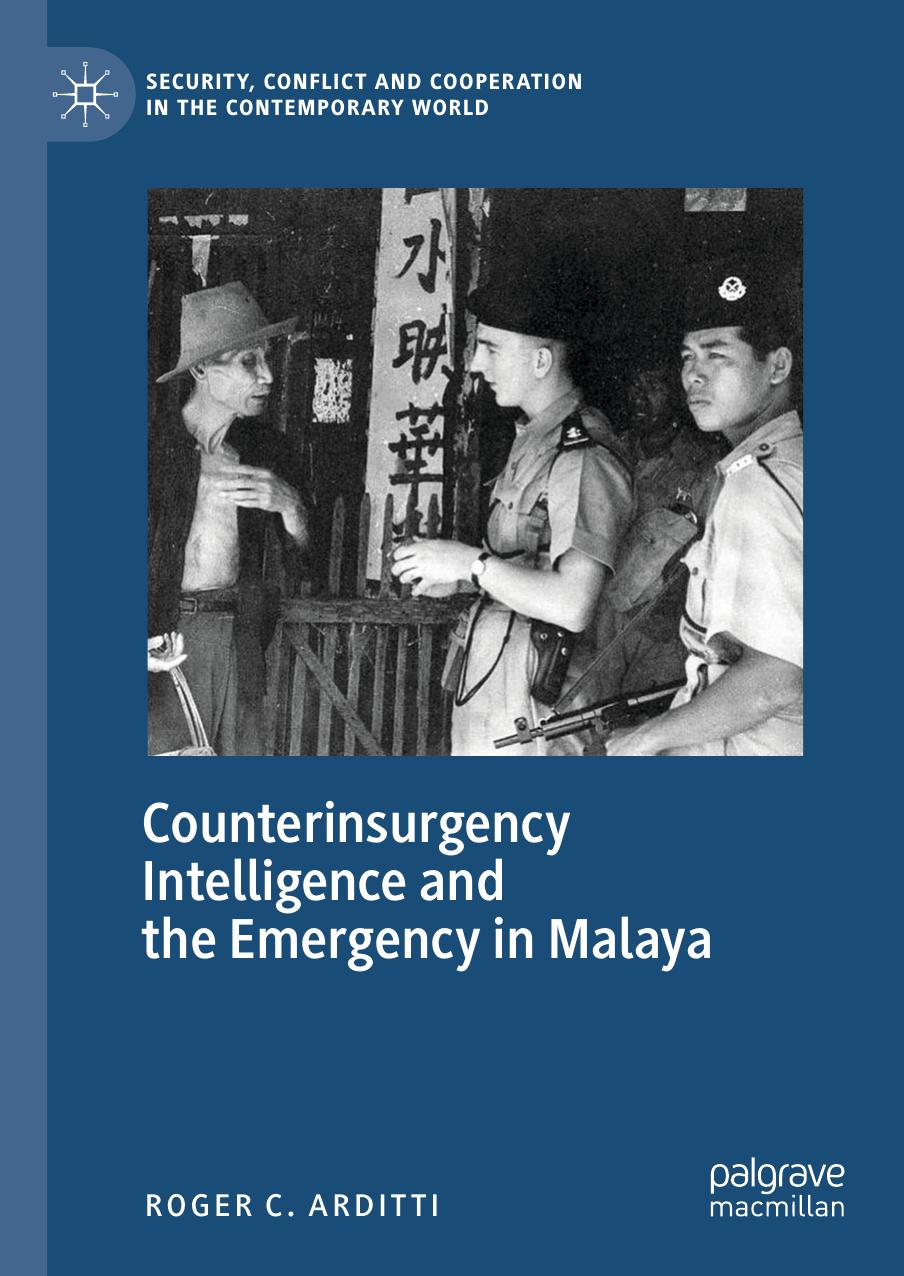
Counterinsurgency Intelligence and the Emergency in Malaya by Roger C. Arditti
Author:Roger C. Arditti
Language: eng
Format: epub, pdf
ISBN: 9783030166953
Publisher: Springer International Publishing
The Initial Plan to Restore Law and Order
By 26 June 1948 the Malayan authorities had devised a plan to restore order to the Federation, which was followed until the appointment of General Sir Harold Briggs as Director of Operations in 1950. MacDonald explained to Creech Jones that the authorities in Malaya had constructed a two-phase plan to tackle the insurgent threat. The objective during phase one was “to restore law and order in the settled areas of the territory and to maintain the economic life of the country and to restore morale.” During the first phase troops would “undertake offensive operations to round up gangsters and to oppose force with force.” The security forces would establish “road blocks and traffic controls, mount periodical sweeps as a result of a murder or robberies committed or upon information received as to the whereabouts of wanted persons, and widespread searches for arms and other incriminating evidence.” These operations were underpinned by the provision of static guards for “police stations, power stations, prisons, warehouses, factories, docks, harbours and other vital posts.” These were to be maintained primarily, but not exclusively, by the rapidly expanding Special Constabulary. The aim of the first phase would “be to apprehend or liquidate the enemy force and, in so far as this does not succeed, completely drive them [into] the jungle.”6 The second phase of the Federation‘s plan would “comprise the operations necessary to liquidate the guerrilla bands whose headquarters are in the jungle. This will involve the destruction of their camps, cutting off food supplies, and uncovering dumps of arms and equipment. These operations will be primarily military in nature in which, however, the police will participate.”7
At first glance the authorities appeared to have a reasonable number of personnel to implement these plans. For instance, in 1948 there were roughly 9000 police officers in post, a number which rose rapidly to over 67,025 by 1952.8 Also, at the beginning of the Emergency there were ten battalions of infantry available to help restore law and order. Each infantry battalion in Malaya had about seven hundred men, of which roughly four hundred would be available to be put into the field. As such General Aston Wade, General Officer Commanding (GOC), Malaya, had approximately four thousand soldiers, perhaps less if one takes into account the chronic shortages in the battalions in Malaya in 1948, to support the police.9 Further, there were roughly 9000 RAF personnel with Air Command Southeast Asia (ACSEA), supporting some 100 operational aircraft in the region.10 Therefore at the beginning of the emergency, the government had approximately 26,000 police and military personnel to identify and detain or kill some 3000–5000 members of the communist’s guerrilla army (known initially as the Malaya Peoples’ Anti British Army—MPABA; and then as the Malayan Races Liberation Army) which operated predominantly in the jungle, and unknown number of supporters (known as the Min Yuen) within squatter areas and towns.11
Download
Counterinsurgency Intelligence and the Emergency in Malaya by Roger C. Arditti.pdf
This site does not store any files on its server. We only index and link to content provided by other sites. Please contact the content providers to delete copyright contents if any and email us, we'll remove relevant links or contents immediately.
| Africa | Americas |
| Arctic & Antarctica | Asia |
| Australia & Oceania | Europe |
| Middle East | Russia |
| United States | World |
| Ancient Civilizations | Military |
| Historical Study & Educational Resources |
The Sympathizer by Viet Thanh Nguyen(4464)
The Rape of Nanking by Iris Chang(4281)
World without end by Ken Follett(3524)
Ants Among Elephants by Sujatha Gidla(3504)
Blood and Sand by Alex Von Tunzelmann(3260)
Japanese Design by Patricia J. Graham(3233)
The Queen of Nothing by Holly Black(2698)
City of Djinns: a year in Delhi by William Dalrymple(2592)
India's Ancient Past by R.S. Sharma(2504)
Foreign Devils on the Silk Road: The Search for the Lost Treasures of Central Asia by Peter Hopkirk(2497)
Tokyo by Rob Goss(2489)
Inglorious Empire by Shashi Tharoor(2477)
In Order to Live: A North Korean Girl's Journey to Freedom by Yeonmi Park(2418)
Tokyo Geek's Guide: Manga, Anime, Gaming, Cosplay, Toys, Idols & More - The Ultimate Guide to Japan's Otaku Culture by Simone Gianni(2414)
India's biggest cover-up by Dhar Anuj(2390)
The Great Game: On Secret Service in High Asia by Peter Hopkirk(2380)
Goodbye Madame Butterfly(2299)
Batik by Rudolf Smend(2227)
Living Silence in Burma by Christina Fink(2099)
