Conversations with JFK by Michael O'Brien
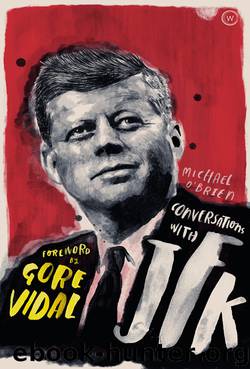
Author:Michael O'Brien
Language: eng
Format: epub
Publisher: Watkins Media
IMAGE OR SUBSTANCE?
Before he became president, Kennedy’s public image was superficial and one-dimensional, paying scant attention to his political views. Jack’s youth, war heroism, handsome features, large energetic family, great wealth and stunning wife made excellent copy. The media mainly portrayed a captivating politician, a radiant celebrity. Photographers from national magazines took hundreds of photos of him. Jack Gould, the New York Times’ television columnist, called him “the most telegenic personality of our times”. A question still unanswered was whether the glamorous image was backed by strengths commensurate with the high responsibilities of presidential office.
William Shannon in a 1957 column wrote that you were “attractive” in the same way as a television or movie star but asked what that trait had to do with statesmanship. He said you downgraded issues and upgraded charm.
Shannon made a crucial error. It wasn’t me who downgraded issues and upgraded charm. I tackled issues and articulated them. It was the media and the public that downgraded issues and upgraded charm. Most of the feature stories were initiated by the magazines themselves, not by me or my staff.
“Should I try to discourage them so you won’t be interrupted so much?” my secretary Evelyn Lincoln asked me. “By no means,” I told her. If I know one thing, it’s that a politician can kill himself faster by playing hard-to-get with the press than he can by jumping off the Capitol dome. As long as they want to talk to me, I want to talk to them. Maybe longer.
You seem interested in the whole business of journalism. What’s the basis of that rapport?
I’d done some reporting myself and I like the milieu. I’m interested and amused by gossip about the office politics on newspapers and magazines. Shooting the breeze with journalists also gives me a special insight into the whole business of communicating information to the public. That’s important.
Do you think your press friendships protect your favourable image?
If you’re implying that I manage the news, you’re wrong. If I mess up, journalist friends are the first to report it. It’s their job.
Part of your shining image as a presidential candidate was your youth. But why were you in such a rush? “If I were his father,” said James Reston in the New York Times in 1957, “I would tell him to slow down. His age is against him now; in another few years it won’t be. He has time.”
I answered that critique when Harry Truman questioned my youth and maturity at the Democratic convention in 1960. I told a press conference that to exclude from positions of trust and command all those below the age of 44 would have kept Jefferson from writing the Declaration of Independence, Washington from commanding the continental Army, Madison from fathering the Constitution, Hamilton from serving as Secretary of the Treasury, Clay from being elected Speaker of the House, and Christopher Columbus from even discovering America.
Your book, Profiles in Courage, won the Pulitzer Prize in biography in 1957. That was marvelous publicity for you.
Download
This site does not store any files on its server. We only index and link to content provided by other sites. Please contact the content providers to delete copyright contents if any and email us, we'll remove relevant links or contents immediately.
Fanny Burney by Claire Harman(26602)
Empire of the Sikhs by Patwant Singh(23084)
Out of India by Michael Foss(16853)
Leonardo da Vinci by Walter Isaacson(13336)
Small Great Things by Jodi Picoult(7140)
The Six Wives Of Henry VIII (WOMEN IN HISTORY) by Fraser Antonia(5515)
The Wind in My Hair by Masih Alinejad(5095)
A Higher Loyalty: Truth, Lies, and Leadership by James Comey(4962)
The Crown by Robert Lacey(4814)
The Lonely City by Olivia Laing(4801)
Millionaire: The Philanderer, Gambler, and Duelist Who Invented Modern Finance by Janet Gleeson(4478)
The Iron Duke by The Iron Duke(4354)
Papillon (English) by Henri Charrière(4274)
Sticky Fingers by Joe Hagan(4198)
Joan of Arc by Mary Gordon(4110)
Alive: The Story of the Andes Survivors by Piers Paul Read(4031)
Stalin by Stephen Kotkin(3965)
Aleister Crowley: The Biography by Tobias Churton(3640)
Ants Among Elephants by Sujatha Gidla(3467)
