Celestial Empire by Isaacson Nathaniel;
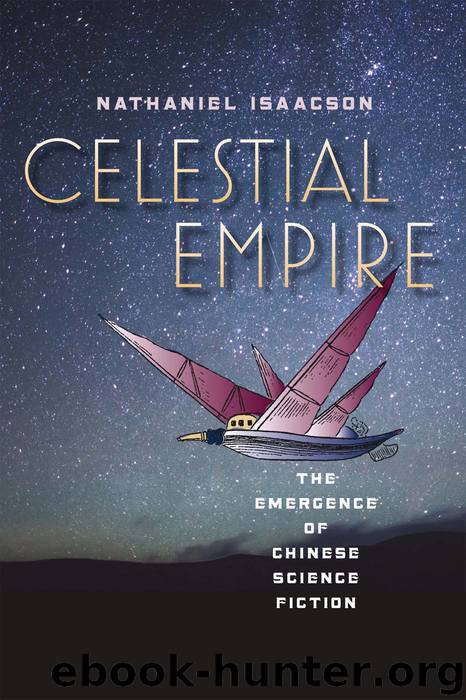
Author:Isaacson, Nathaniel;
Language: eng
Format: epub
Publisher: Wesleyan University Press
Published: 2017-04-16T04:00:00+00:00
Colonial Modernity c. 1934
Having recently returned to China after a five-year stay in England and a six-month writing and teaching layover in Singapore, depressed at the defeat of Chinese troops following the Manchurian Incident, and wondering why Chinese people on the mainland were not as politically active as overseas Chinese he had met in Singapore, the author found himself in a state of deep concern for the future of his country. On a personal level, Lao She wrote that depression was one of the primary motivators behind his decision to write the novel (Lao She, “Wo zenyang xie,” 544–545; Guan Jixin, 167; Zhang Guixing, 1997). Lao She’s depression was no doubt attributable in part to the ongoing political crisis that gripped Republican China. The author’s suffocating image of Chinese culture has been attributed to the fact that not only had China lost to a foreign enemy, but that its own cultural decay and selfishness were to blame for the national plight (Guan Jixin, 172).
In 1915, Japan’s Twenty-One Demands forced Yuan Shikai and the government of the Republic of China to cede control of Manchuria and much of the Chinese economy to the expanding Japanese empire. China had supported Allied forces in World War I, on the condition that colonial concessions to Germany be returned. However, the 1919 Treaty of Versailles eventually resulted in the transfer of German holdings to Japan. While protests on the part of students at Peking University led to the May Fourth Movement, a moment that would be historically recognized as the initial spark for the fire of China’s Communist revolution, the short-term outlook was much bleaker. In the meantime, 1916–1928 marked China’s Warlord Era, during which control of the “Republic” was indeed the province of local governors, military commanders, and other strongmen, while territories like Tibet and Mongolia, never fully incorporated into the Qing Empire, declared their independence. While the Warlord Era was officially brought to an end with Jiang Jieshi’s (Chiang Kai-shek, 1887–1975) Northern Expedition of 1926–1928, the country remained fragmented until the end of the civil war in 1949. The 1931 Manchurian Incident, a conflict manufactured by Japanese forces in Manchuria, led to the occupation of Shenyang in the name of Japan’s “self-defense,” and Chinese protests of the Japanese occupation were soon met with an attack on Shanghai. China’s appeals to the League of Nations led to condemnation of Japan’s actions but no intervention on the part of the international community. Viewing resistance to Japan’s clearly superior military to be futile, military leaders like Jiang Jieshi opted instead to purge internal opposition prior to any resistance to external aggression (Spence, 310–434).
To a great degree, Lao She’s opinions of world affairs were shaped by his deep familiarity with Western literature and culture. He had lived in England for five years, during which time he taught Chinese and studied Western literature and literary criticism; later in his career he published extensive work on these subjects (Song Yongyi, 41). He stands apart from intellectuals like Lu Xun
Download
This site does not store any files on its server. We only index and link to content provided by other sites. Please contact the content providers to delete copyright contents if any and email us, we'll remove relevant links or contents immediately.
| Fantasy | Gaming |
| Science Fiction | Writing |
Sita - Warrior of Mithila (Book 2 of the Ram Chandra Series) by Amish(54822)
The Crystal Crypt by Dick Philip K(36834)
Cat's cradle by Kurt Vonnegut(15295)
Always and Forever, Lara Jean by Jenny Han(14872)
Ready Player One by Cline Ernest(14615)
The Last by Hanna Jameson(10226)
Year One by Nora Roberts(9761)
Persepolis Rising by James S. A. Corey(9334)
The remains of the day by Kazuo Ishiguro(8947)
Never let me go by Kazuo Ishiguro(8847)
Red Rising by Pierce Brown(8731)
Dark Space: The Second Trilogy (Books 4-6) (Dark Space Trilogies Book 2) by Jasper T. Scott(8157)
The handmaid's tale by Margaret Atwood(7727)
The Circle by Dave Eggers(7090)
Frank Herbert's Dune Saga Collection: Books 1 - 6 by Frank Herbert(7037)
The Testaments by Margaret Atwood(6864)
Legacy by Ellery Kane(6635)
Pandemic (The Extinction Files Book 1) by A.G. Riddle(6509)
Six Wakes by Mur Lafferty(6218)
