Alpha Centauri: The Return (T-Space Alpha Centauri Book 3) by Alastair Mayer
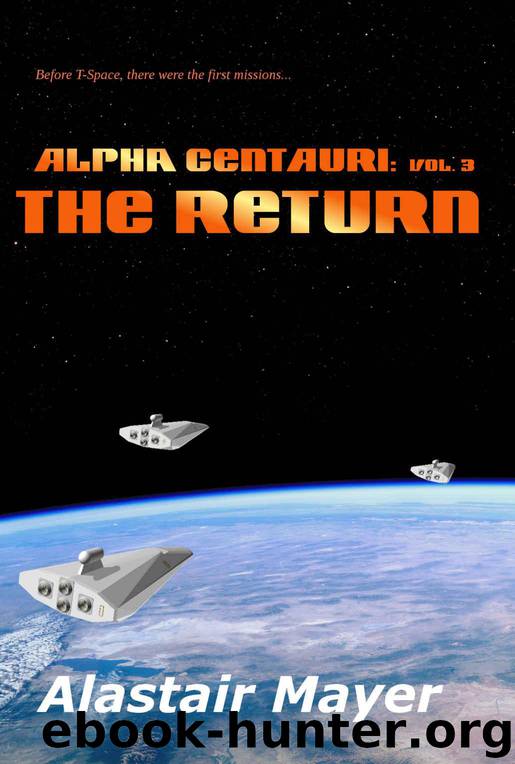
Author:Alastair Mayer
Language: eng
Format: mobi, epub, azw3
Publisher: Mabash Books
Published: 2017-07-27T06:00:00+00:00
Chapter 18: Ryden gets an assignment
Skrellan Pharmaceutical Labs, Earth
“The squidberry extract turns out not to have antibiotic properties after all,” said Dr. Dennis Lodgson, head of research at Skrellan.
Victoria Holmes, Lodgson’s boss and Vice President of Research for Skrellan, took the news in stride. “Oh, that’s disappointing.” The extract had inhibited the growth of several different bacterial cultures, and yet it bore no chemicals similar to penicillin or any other antibiotic with which they were familiar. Despite that, it also appeared to inhibit some disease-causing amoeba species and even certain cancer tissue cultures. “What is the issue, then? Too toxic?” That was a common problem with potential antibiotics—they also killed healthy mammalian cells.
Lodgson grinned. “No indeed. I won’t go into all the details, not least because we don’t fully understand them yet, but it appears to have mTOR inhibitory effects similar to those of rapamycin, as well as telomerase effects. One component–the extract has several interesting biochemicals, not least the neurochemicals which may attract the tree-squids, although the berries themselves are also high in sugars and proteins—but one component may also have DNA-repair enhancing properties like some of our better anti-radiation drugs.”
Holmes took a moment to digest all this. Lodgson was brilliant but he liked to hear himself talk. However, he got results often enough that she put up with him. It sounded like the berries were a veritable pharmacopeia of useful drugs, if they could be separated out and proven, or modified, to have minimal harmful side effects. “Okay, so we have a potential new antirad drug. That’s useful and valuable. Telomerase has something to do with cell aging, correct? Wouldn’t that increase the risk of cancer? And what’s mTOR inhibition? Rapamycin is an immunosuppressant, isn’t it?”
“That’s its primary use, yes. Some analogs are also cancer inhibitors through various pharmacokinetic pathways, and a component of typical anti-radiation drugs. But decreased TOR activity has also been found to increase longevity in a number of species. We now think the colony-inhibition we saw in preliminary screening was because the species were just reproducing much slower than normal, they were growing more slowly but living correspondingly longer. In short, it seems to be an anti-aging drug. We’re tentatively calling it cephalomycin.”
“The marketers will want a catchier name than that. It sounds like some kind of antibiotic.”
“Yes, the ‘mycin’ suffix is commonly used for fungi-derived drugs. In this case, we think the cephalomycin comes from a yeast that grows on the surface of squidberries. ‘Cephalo’ from cephalopod, of course.”
Then the other thing Lodgson had said sank in. “Wait, did you say ‘anti-aging drug’?” The implications were huge. There were some anti-aging drugs and regimens already, human lifespans were steadily being pushed back as cures and treatments for diseases were found, but there was still the inevitable wearing out of organs and tissues. Skin aged and wrinkled, bones weakened, joints became less supple. New drugs and treatments were always being sought, and could carry a high profit margin.
“I did. We ran a few mouse trials.
Download
Alpha Centauri: The Return (T-Space Alpha Centauri Book 3) by Alastair Mayer.epub
Alpha Centauri: The Return (T-Space Alpha Centauri Book 3) by Alastair Mayer.azw3
This site does not store any files on its server. We only index and link to content provided by other sites. Please contact the content providers to delete copyright contents if any and email us, we'll remove relevant links or contents immediately.
| Fantasy | Gaming |
| Science Fiction | Writing |
Sita - Warrior of Mithila (Book 2 of the Ram Chandra Series) by Amish(55304)
The Crystal Crypt by Dick Philip K(37053)
Cat's cradle by Kurt Vonnegut(15556)
Ready Player One by Cline Ernest(15144)
Always and Forever, Lara Jean by Jenny Han(15069)
The Last by Hanna Jameson(10380)
Year One by Nora Roberts(9961)
Persepolis Rising by James S. A. Corey(9567)
The remains of the day by Kazuo Ishiguro(9223)
Never let me go by Kazuo Ishiguro(9102)
Red Rising by Pierce Brown(9000)
Dark Space: The Second Trilogy (Books 4-6) (Dark Space Trilogies Book 2) by Jasper T. Scott(8331)
The handmaid's tale by Margaret Atwood(7908)
Frank Herbert's Dune Saga Collection: Books 1 - 6 by Frank Herbert(7346)
The Circle by Dave Eggers(7259)
The Testaments by Margaret Atwood(7105)
Legacy by Ellery Kane(6772)
Pandemic (The Extinction Files Book 1) by A.G. Riddle(6671)
Six Wakes by Mur Lafferty(6409)
