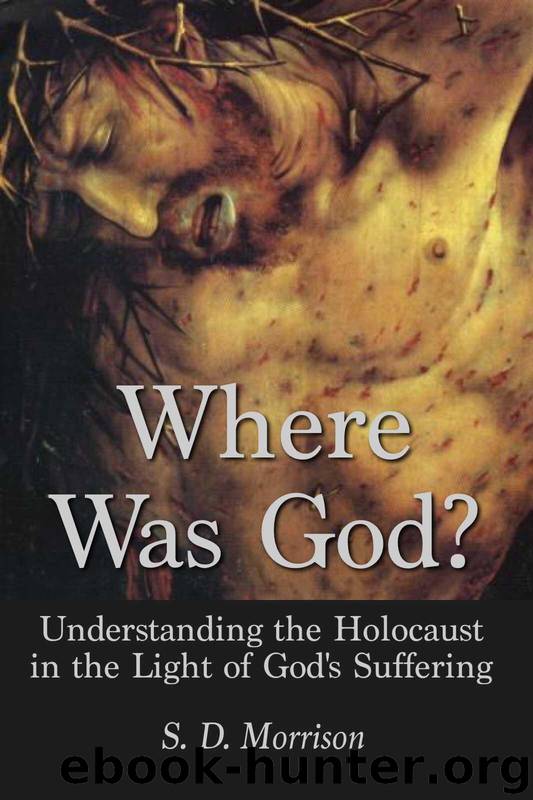
Where Was God?: Understanding the Holocaust in the Light of God's Suffering by S. D. Morrison
Author:S. D. Morrison [Morrison, S. D.]
Language: eng
Format: epub
Publisher: Beloved Publishing
Published: 2014-12-16T17:00:00+00:00
————
In our textbooks we read that, “..Suffering is overcome by suffering, and wounds are healed by wounds. For the suffering in suffering is the lack of love, and the wounds in wounds are the abandonment, and the powerlessness in pain is unbelief. And therefore the suffering of abandonment is overcome by the suffering of love, which is not afraid of what is sick and ugly, but accepts it and takes it to itself in order to heal it. Through his own abandonment by God, the crucified Christ brings God to those who [feel] abandoned by God. Through his suffering he brings salvation to those who suffer. Through his death he brings eternal life to those who are dying.”7
Before we conclude our Christological approach to theodicy, we must take it one step further still. To say that God only meets us and is affected by our suffering is not enough. God must also undo our suffering and heal our pain, He must meet us in our death in order to resurrect us to new life. In suffering in our suffering God does not justify or glorify suffering. Instead, God suffers for the sake of undoing suffering. God meets us in our darkness in order to shine the light of His love. God meets us in our pain in order to make us whole. In a paradoxical way, the power of God undoes the power of sin and death through the self-sacrifical love of Jesus Christ dying on the cross.
Bonhoeffer wrote from prison that, “…Christ helps us, not by virtue of his omnipotence, but by virtue of his weakness and suffering.... Only the suffering God can help.”8
The Gospel of Jesus Christ reveals the starling fact that God is not like the Gods and Goddesses of Greek mythology. God is not an inhuman God; God is the God of mankind. He is the God of Abraham, Isaac, and Jacob. He is our God, and He is for us. He is the suffering God because we are a suffering people and He has joined Himself to us. The gospel proclaims that God has met us in our sufferings. God has found us in the darkness of our abandonment and rejection and despair and He has healed us and included us in Himself. All our humanity is felt from within God’s very self because He has taken our humanity upon Himself. All of it, both the good and the bad, is now history in God’s existence. God participates both in our human victories of courage and valor, and in our human sorrows of pain and suffering.
Additionally, if we take this one step further still, we develop an important, new dynamic for soteriology. For most, the Gospel message proclaims salvation to offenders. The Gospel claims that God can forgive anyone. If you murder, commit sin after sin, and come to God repentant and humble you can be forgiven. This is the outrageous grace of God! But what of the victims of sin? What about those who
Download
This site does not store any files on its server. We only index and link to content provided by other sites. Please contact the content providers to delete copyright contents if any and email us, we'll remove relevant links or contents immediately.
The Secret Power of Speaking God's Word by Joyce Meyer(3176)
Signature in the Cell: DNA and the Evidence for Intelligent Design by Stephen C. Meyer(3126)
Real Sex by Lauren F. Winner(3014)
The Holy Spirit by Billy Graham(2944)
The Gnostic Gospels by Pagels Elaine(2527)
Jesus by Paul Johnson(2352)
Devil, The by Almond Philip C(2324)
23:27 by H. L. Roberts(2245)
The Nativity by Geza Vermes(2226)
Chosen by God by R. C. Sproul(2160)
All Things New by John Eldredge(2158)
Angels of God: The Bible, the Church and the Heavenly Hosts by Mike Aquilina(1954)
The Return of the Gods by Erich von Daniken(1929)
Angels by Billy Graham(1922)
Knowing God by J.I. Packer(1852)
Jesus of Nazareth by Joseph Ratzinger(1811)
The Gnostic Gospel of St. Thomas by Tau Malachi(1793)
Evidence of the Afterlife by Jeffrey Long(1784)
How To Be Born Again by Billy Graham(1775)
