What Is College For? The Public Purpose of Higher Education by Lagemann Ellen Condliffe & Lewis Harry
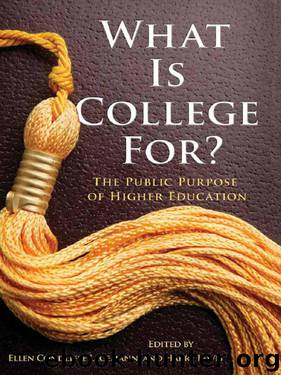
Author:Lagemann, Ellen Condliffe & Lewis, Harry [Lagemann, Ellen Condliffe]
Language: eng
Format: epub
Publisher: Teachers College Press
Published: 2011-11-17T22:00:00+00:00
The durability and efficacy of the liberal arts college model derives from the strong practices and principles I have outlined here—calling students to what is complex, difficult, and slow; cultivating focus and participation; offering some degree of “time out” and immunity from immediate consequences; sustaining friendship and learning in community; embracing contradictions. These practices, which are needed now more than ever, serve to shape what I have called the liberated consumer by giving each student not only the capacity for individual agency but also a sense of responsibility and commitment to collective well-being. President Obama’s insistence that quitting high school is “quitting on your country” implicitly acknowledges the dangers of unfettered consumerism and “being uniquely, completely, imperially alone.” Liberal arts colleges today educate liberated, conscious, citizen-consumers using a distinctive recipe that generally calls for 4 years in residence, low student-faculty ratios, abundant options for cocurricular and extracurricular activities, a broadly diverse yet commonly motivated student body, and other increasingly rare (and expensive) ingredients. But if the core purposes and principles were seen as important, there could be other ways to approach them. Whatever the curriculum, it could be explicitly framed by similar objectives for all students: to embrace an appropriate level of challenge, pay attention, seek and be granted time for reflection, prize participation, and offer friendship. Some goals might be even more easily achieved in “vocational training”—such as the notion of production and participation, which is understood as an antidote to passive consumption.
To say that we have some fundamental purposes in common, furthermore, is not to say we have all purposes in common, or that all institutions of higher education need to be designed to do the same thing at the same time in the same way. Just like the purposes of liberal arts colleges, the purposes of the entire American system of higher education or further education—running the gamut from 1-year training programs to research universities—could be seen as appropriately multiple and diverse and sometimes, indeed, contradictory. The contradictions and tensions between sectors will block any movement at all if we are trying to reduce the purposes of education to some unitary, easily measured goals—or if we overindulge in market competition. But if we also acknowledge here that in fact its contradictions and tensions are at the very heart of what makes American higher education a highly complicated, interesting, and creative system for educating liberated consumers, the next big question becomes clear: Where and how can we acknowledge, understand, celebrate, and then leverage our multiple, complicated purposes more effectively?
Download
This site does not store any files on its server. We only index and link to content provided by other sites. Please contact the content providers to delete copyright contents if any and email us, we'll remove relevant links or contents immediately.
The Art of Coaching Workbook by Elena Aguilar(51165)
Trainspotting by Irvine Welsh(21643)
Twilight of the Idols With the Antichrist and Ecce Homo by Friedrich Nietzsche(18625)
Fangirl by Rainbow Rowell(9229)
Periodization Training for Sports by Tudor Bompa(8254)
Change Your Questions, Change Your Life by Marilee Adams(7761)
This Is How You Lose Her by Junot Diaz(6877)
Asking the Right Questions: A Guide to Critical Thinking by M. Neil Browne & Stuart M. Keeley(5761)
Grit by Angela Duckworth(5605)
Red Sparrow by Jason Matthews(5468)
Paper Towns by Green John(5179)
Room 212 by Kate Stewart(5105)
Ken Follett - World without end by Ken Follett(4723)
Housekeeping by Marilynne Robinson(4436)
The Sports Rules Book by Human Kinetics(4379)
Papillon (English) by Henri Charrière(4263)
Double Down (Diary of a Wimpy Kid Book 11) by Jeff Kinney(4261)
The Motorcycle Diaries by Ernesto Che Guevara(4089)
Exercise Technique Manual for Resistance Training by National Strength & Conditioning Association(4063)
