The Uttaratantra in the Land of Snows by Wangchuk Tsering;
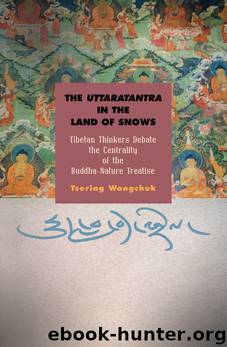
Author:Wangchuk, Tsering;
Language: eng
Format: epub
Publisher: State University of New York Press
Published: 2017-04-10T04:00:00+00:00
Chapter 1
1. For more information on the life story of Ngok, see Ralf Kramer, The Great Translator: Life and Wroks of rNgog Blo ldan shes rab (München: Indus Verlag, 2007); David P. Jackson, “An Early Biography of rNgok Lo-tsā-ba bLo ldan shes rab,” in Tibetan Studies: Proceedings of the 6th Seminar of the International Association for Tibetan Studies, ed. Per Kvaerne (Oslo: Institute for Comparative Research in Human Culture, 1994), 372–92. Also see van der Kuijp, Contributions to the Development of Tibetan Epistemology, 29–48, and Kevin Vose, Resurrecting Candrakīrti: Disputes in the Tibetan Creation of Prāsaṅgika (Boston: Wisdom Publications, 2009), 45–49, for Ngok’s life story.
2. For a brief history of Sangpu Neuthok (gsang phu ne’u thog) monastery, see Leonard W. J. van der Kuijp, “The Monastery of Gsang-phu ne’u-thog and Its Abbatial Succession from ca. 1073 to 1250,” Berliner Indologische Studien 3 (1987): 103–10. The monastery was established by Ngok Lekpé Sherap (tenth–eleventh centuries). For a brief life story of Ngok Lekpé Sherap (rngog legs pa’i shes rab), see Vose, Resurrecting Candrakīrti, 46–47. Also, see van der Kuijp, Contributions to the Development of Tibetan Epistemology, 31–32.
3. In his Contributions to the Development of Tibetan Epistemology, 32–33, van der Kuijp says, “While RNgok Lo-tsā-ba [Ngok] is best known for his work in the so-called pāramitāyāna which includes epistemology, prajñāpāramitā, madhyamaka, and abhidharma, his literary activities that pertain to the vajrayāna should also not be underestimated insofar as he translated some eighteen works that fall within this domain of Buddhism.” For the abbatial lineage of the Sangpu monastery, see Shunzu Onoda, “Abbatial Successions of the Colleges of gSang phu sne’u thog Monastery” (Bulletin of the National Museum of Ethnology 15, no. 4 (1990): 1057.
4. For more information about Chapa, see van der Kuijp, Contributions to the Development of Tibetan Epistemology, 59–84.
5. In his Contributions to the Development of Tibetan Epistemology, 61, van der Kuijp states, “It is important to stress that Phya-pa was unilingual and had no knowledge of Sanskrit whatsoever; this point is repreatedly underlined by the Tibetan historians themselves.”
6. van der Kuijp, Contributions to the Development of Tibetan Epistemology, 69.
7. Vose’s Resurrecting Candrakīrti examines the arguments that the two thinkers formulate in great detail.
8. In his commentary on the Madhyamakāvatāra, Jayānanda states, “Moreover, in order to point out [some] other sutras that require interpretation, … For instance, those that teach the tathāgata-essence require interpretation.” “yang drang ba’i don gyi mdo sde gzhan bstan par bya ba’i phyir … dper na de bzhin gshegs pa’i snying po gsungs pa de ni drang ba’i don yin la.” See Jayānanda, dbu ma la ’jug pa’i ’grel bshad (snga ’gyur rnying ma’i glegs bam rin po che’i dbu phyogs, n.d.), 1057. Henceforth, Explanation of the Madhyamakāvatāra. Jayānanda devotes a substantial number of pages to explaining the difference between definitive meaning and provisional meaning and why the tathāgata-essence teachings are provisional. Yet as Kano points out, “[Jayānanda] obviously accepts the Buddha nature doctrine as an authoritative teaching. Jayānanda states it impossible to accept the meaning
Download
This site does not store any files on its server. We only index and link to content provided by other sites. Please contact the content providers to delete copyright contents if any and email us, we'll remove relevant links or contents immediately.
| Africa | Americas |
| Arctic & Antarctica | Asia |
| Australia & Oceania | Europe |
| Middle East | Russia |
| United States | World |
| Ancient Civilizations | Military |
| Historical Study & Educational Resources |
Cecilia; Or, Memoirs of an Heiress — Volume 1 by Fanny Burney(32563)
Cecilia; Or, Memoirs of an Heiress — Volume 2 by Fanny Burney(31962)
Cecilia; Or, Memoirs of an Heiress — Volume 3 by Fanny Burney(31945)
The Secret History by Donna Tartt(19105)
Sapiens: A Brief History of Humankind by Yuval Noah Harari(14394)
Leonardo da Vinci by Walter Isaacson(13342)
The Radium Girls by Kate Moore(12036)
Sapiens by Yuval Noah Harari(5375)
How Democracies Die by Steven Levitsky & Daniel Ziblatt(5225)
The Wind in My Hair by Masih Alinejad(5104)
Homo Deus: A Brief History of Tomorrow by Yuval Noah Harari(4923)
Endurance: Shackleton's Incredible Voyage by Alfred Lansing(4790)
Man's Search for Meaning by Viktor Frankl(4612)
The Silk Roads by Peter Frankopan(4538)
Millionaire: The Philanderer, Gambler, and Duelist Who Invented Modern Finance by Janet Gleeson(4483)
The Rape of Nanking by Iris Chang(4224)
Joan of Arc by Mary Gordon(4119)
The Motorcycle Diaries by Ernesto Che Guevara(4106)
Stalin by Stephen Kotkin(3973)
