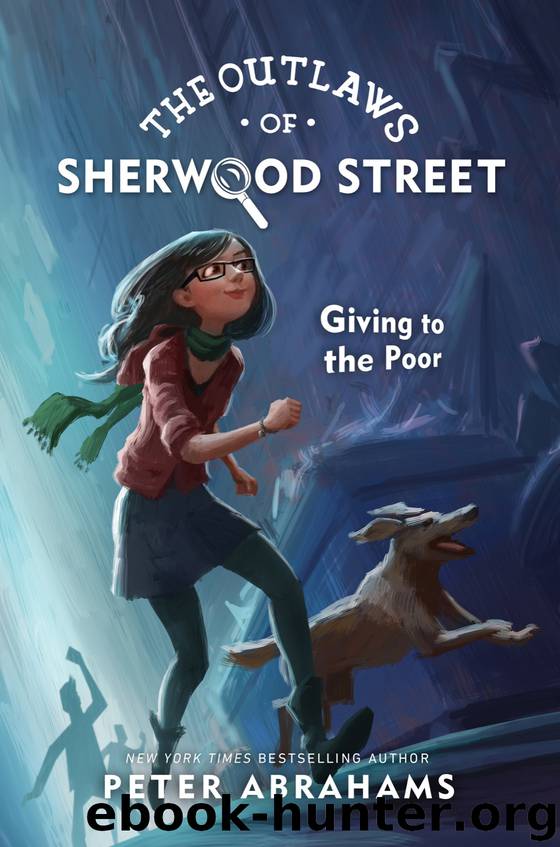
The Outlaws of Sherwood Street: Giving to the Poor by Peter Abrahams
Author:Peter Abrahams
Language: eng
Format: epub
Publisher: Penguin Group US
Published: 2013-04-29T04:00:00+00:00
14
We met Silas at HQ. It was cold but not cold enough to see your breath: the space heater, pulled up close to Silas’s feet, glowed red.
“Muffins,” I said, putting a bag of them on the desk.
Silas opened the bag, poked through. “No icing? I like icing.”
“These are healthy,” I said. “Blueberry, cranberry, orange, and carrot.”
“Carrot cake?” Silas said.
“Maybe.”
He took the carrot muffin. “Tut-Tut loves blueberries,” he said, taking a big bite. “They don’t have them in Haiti,” he added—or something like that, hard to tell with his mouth so full.
“Speaking of Tut-Tut,” I said, and started in on a description of our visit to the museum.
“Huh?” Silas said, interrupting before I’d barely gotten out of the blocks. “You saw my stupid father?”
“Yeah,” I said. “See, we got the idea that—”
“Without even telling me first?”
There was a silence. No comeback occurred to me. I turned to Ashanti. She looked Silas in the eye and said, “You’re one hundred percent right.”
Silas gazed at her. Seeing her in a totally new way? I was considering that when he shook his head and said, “Can’t go that far. One hundred percent represents a degree of certainty you’d never find in situations like this. Call it about ninety-eight percent.”
Another silence. And then Ashanti and I were laughing our heads off.
“What?” said Silas. “What’s funny?”
We couldn’t put it into words, didn’t even try. “The point is,” I said, “we’ve got to do something about Tut-Tut, and we thought your father was the type who might help out.”
“Because he gets involved with every cause that comes along, even at the cost of neglecting his own family?” Silas said.
“Yeah,” said Ashanti, “if you want to put it that way.”
Silas nodded. “Makes sense. Did he go for it?”
“He did,” I said.
“You left out the charm, of course.”
“Not exactly,” I said. And we told him about Dutch silver and his father’s research into trading beads.
“What does it mean?” Silas said. “Was the charm part of the twenty-four-dollar deal? Selling Manhattan, all that?”
I took off the charm, laid it on the desk. Did it look centuries old? Not that I could see. Nor did it look brand-new. Or in any way magical. But if Wilders was right, the homeless woman who had dropped it had been sitting in front of a once-sacred place.
“Suppose,” Ashanti said, “it was part of the deal. Did it have magic properties then, or did it get them as a result?”
“Huh?” said Silas.
“What didn’t you understand?” Ashanti said.
“Any of it. I didn’t get any of it. Zip, zilch, nada.”
“How can anyone be so smart and so dumb at the same time?” Ashanti said.
“The dumb part of me can’t tell you,” said Silas.
Ashanti blinked a long slow blink, a danger sign. She turned to me. “Do you see what I’m talking about?”
“Uh,” I said, “some kind of balancing thing? Making the trade for Manhattan actually more even?”
“Kind of,” Ashanti said. “After the fact. More even. More just.”
I kind of hoped that the charm might—not hear us, of course, but in some way react, show a little solidarity.
Download
This site does not store any files on its server. We only index and link to content provided by other sites. Please contact the content providers to delete copyright contents if any and email us, we'll remove relevant links or contents immediately.
Shadow Children #03 - Among the Betrayed by Margaret Peterson Haddix(11979)
Among the Betrayed by Margaret Peterson Haddix(11675)
Six of Crows by Leigh Bardugo(10333)
Fangirl by Rainbow Rowell(9388)
Harry Potter and the Cursed Child - Parts One and Two Playscript by J.K. Rowling & John Tiffany & Jack Thorne(8203)
Shadow and Bone by Leigh Bardugo(6900)
Ranger's Apprentice 1 - The Ruins of Gorlan by John Flanagan(5990)
The Silver Mask by Holly Black & Cassandra Clare(5601)
The Ballad of Songbirds and Snakes (A Hunger Games Novel) (The Hunger Games) by Suzanne Collins(5127)
Siege and Storm by Leigh Bardugo(5066)
Percy Jackson 1 - The Lightning Thief by Riordan Rick(5042)
His Dark Materials 1 - The Golden Compass by Philip Pullman(4632)
Harry Potter and the Cursed Child: The Journey by Harry Potter Theatrical Productions(4564)
Papillon (English) by Henri Charrière(4347)
The miraculous journey of Edward Tulane by Kate DiCamillo(4191)
Predator's Gold by Philip Reeve(3894)
Erebos by Ursula Poznanski(3825)
Good by S. Walden(3638)
Harry Potter and the Prisoner of Azkaban by J K Rowling(3633)
