The Nature of Revolution by Tyner James;
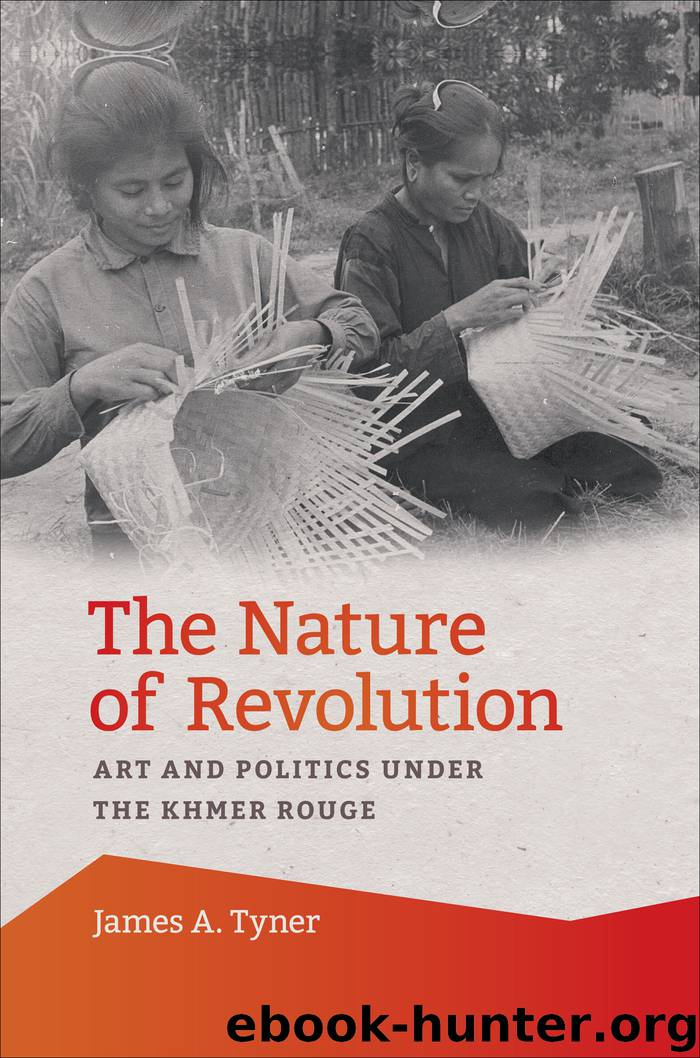
Author:Tyner, James; [Tyner, James;]
Language: eng
Format: epub
ISBN: 9780820354392
Publisher: University of Georgia Press
Published: 2019-01-15T07:00:00+00:00
The Poetics of Building Socialism
I contend that the CPK, as a Marxist-Leninist vanguard party, understood nature and humanity not as binaries but instead as oppositional contradictions. Humanity, consequently, was not external to nature, but rather nature and humanity were dialectic. The CPK, therefore, premised a unity of opposites whereby labor, a physical activity that transforms nature, would dialectically transform humanity and thereby build socialism. This is illustrated in the CPK Four-Year Plan: “In our educational system there are no examinations and no certificates; it is a system of learning through the collective and in the concrete movement of the socialist revolution and the building of socialism in the specific bases especially the cooperatives, factories, and military units.”48 It was this transformative quality on which Khmer Rouge citizenship was founded.
Thus, beyond the aforementioned rudimentary curricula designed to provide a minimum level of school-based learning (e.g., reading, writing, arithmetic, and geography), the CPK promoted a collective and public form of education based on hard work and sacrifice. An equivalency was established whereby the cultivation of rice fields would equate with a cultivation of political consciousness; dialectically, a proper political consciousness would contribute to increased agricultural productivity. In this way, socialism was to be built rapidly—and properly. The Four-Year Plan explains, “We must choose [people with] backgrounds that adhere to the revolutionary movement and have the quality to grasp the Party’s educational line and are able to expand their own capacity in the concrete movement.”49 Likewise, a classified report dated May 28, 1977, noted that “enemies” were inciting citizenry to oppose the construction of dams and the planting of rice, claiming that the harvests would not be shared by the workers. Khmer Rouge cadres, in turn, were to properly “educate” the people. Ominously, this was to “isolate enemies and further investigate them.”50 In other words, it was necessary that people understand the significance of their work, that labor—and not the individual gain of foodstuffs—was paramount. Dialectically, this education would draw out those internal enemies who lacked proper political consciousness and hence would resolve the so-called contradictions between appropriate work efforts and those deemed inappropriate.
This was the purported vanguard role of the CPK. For this reason, men, women, and children were deployed to wage war on nature, not simply (or even primarily) to defeat nature but rather to nurture a proper revolutionary attitude. By extension, it was for this reason that the CPK used a form of public pedagogy. Through poetry, youth, in particular, were to imagine a world different from that of their elders—a world ostensibly free of monarchies, feudalism, and imperialism. This provided a balance, therefore, to the widespread use of fiery language deployed during the civil war.
Military metaphors were still used by the CPK after the revolution, and numerous slogans, songs, speeches, articles, and even poems reflected this usage. However, once in power, the CPK subtly altered its procedures for publicizing its policies. At a meeting held March 8, 1976, the Standing Committee of the CPK cautioned, “We must explain, not be wild and disorderly, do not let it be seen that we want to suppress.
Download
This site does not store any files on its server. We only index and link to content provided by other sites. Please contact the content providers to delete copyright contents if any and email us, we'll remove relevant links or contents immediately.
| Africa | Americas |
| Arctic & Antarctica | Asia |
| Australia & Oceania | Europe |
| Middle East | Russia |
| United States | World |
| Ancient Civilizations | Military |
| Historical Study & Educational Resources |
Cecilia; Or, Memoirs of an Heiress — Volume 1 by Fanny Burney(32543)
Cecilia; Or, Memoirs of an Heiress — Volume 2 by Fanny Burney(31939)
Cecilia; Or, Memoirs of an Heiress — Volume 3 by Fanny Burney(31928)
The Secret History by Donna Tartt(19037)
Sapiens: A Brief History of Humankind by Yuval Noah Harari(14360)
Leonardo da Vinci by Walter Isaacson(13315)
The Radium Girls by Kate Moore(12013)
Sapiens by Yuval Noah Harari(5363)
How Democracies Die by Steven Levitsky & Daniel Ziblatt(5211)
The Wind in My Hair by Masih Alinejad(5085)
Homo Deus: A Brief History of Tomorrow by Yuval Noah Harari(4901)
Endurance: Shackleton's Incredible Voyage by Alfred Lansing(4764)
Man's Search for Meaning by Viktor Frankl(4573)
The Silk Roads by Peter Frankopan(4525)
Millionaire: The Philanderer, Gambler, and Duelist Who Invented Modern Finance by Janet Gleeson(4462)
The Rape of Nanking by Iris Chang(4201)
Joan of Arc by Mary Gordon(4098)
The Motorcycle Diaries by Ernesto Che Guevara(4088)
Stalin by Stephen Kotkin(3956)
