The Nature of Plants by Huegel Craig N.;
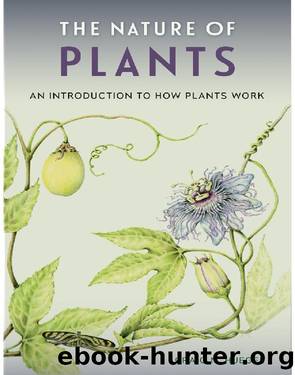
Author:Huegel, Craig N.; [Неизв.]
Language: eng
Format: epub
Publisher: University Press of Florida
Published: 2019-11-06T20:00:00+00:00
INNER STEM STRUCTURE
In most ways, the inner structure of a stem resembles that of a root. The major differences lie mostly in the way the three tissue systems are designed. Stems of all vascular plants have dermal, vascular, and ground tissue.
The dermal layer of herbaceous stems and the periderm of woody ones have only minor differences from the dermal layer of roots. Although the cell types are virtually identical, the root dermal layer produces trichomes (root hairs), whereas the stem may not. When present, stem trichomes take a completely different form, and they can assume a great many shapes. None is involved in absorbing water. The dermal layer in many herbaceous species also produces a waxy cuticle on the surface of the stem to impede water loss. Such a function is incomprehensible for a root. Roots are designed to maximize water absorption, not impede it.
Stems transport water from the roots to the top of the plant and transport other materials, such as sugars and hormones, in both directions between the foliage and the roots. These materials are carried within the xylem and phloem, respectively. The cells of the vascular tissue in a stem are identical in structure to those of a root. The cells are arranged a bit differently in a stem, but that does not affect the way they work.
Download
This site does not store any files on its server. We only index and link to content provided by other sites. Please contact the content providers to delete copyright contents if any and email us, we'll remove relevant links or contents immediately.
Sapiens: A Brief History of Humankind by Yuval Noah Harari(14492)
The Tidewater Tales by John Barth(12724)
Mastermind: How to Think Like Sherlock Holmes by Maria Konnikova(7472)
The Thirst by Nesbo Jo(7035)
Do No Harm Stories of Life, Death and Brain Surgery by Henry Marsh(6992)
Why We Sleep: Unlocking the Power of Sleep and Dreams by Matthew Walker(6807)
Life 3.0: Being Human in the Age of Artificial Intelligence by Tegmark Max(5647)
Sapiens by Yuval Noah Harari(5424)
The Body: A Guide for Occupants by Bill Bryson(5216)
The Longevity Diet by Valter Longo(5122)
The Rules Do Not Apply by Ariel Levy(5052)
The Immortal Life of Henrietta Lacks by Rebecca Skloot(4660)
Animal Frequency by Melissa Alvarez(4527)
Why We Sleep by Matthew Walker(4506)
The Hacking of the American Mind by Robert H. Lustig(4446)
Yoga Anatomy by Kaminoff Leslie(4424)
All Creatures Great and Small by James Herriot(4378)
Double Down (Diary of a Wimpy Kid Book 11) by Jeff Kinney(4357)
Embedded Programming with Modern C++ Cookbook by Igor Viarheichyk(4237)
