The artificial propagation of salmon on the Pacific Coast of the United States by Stone Livingston 1836-1912
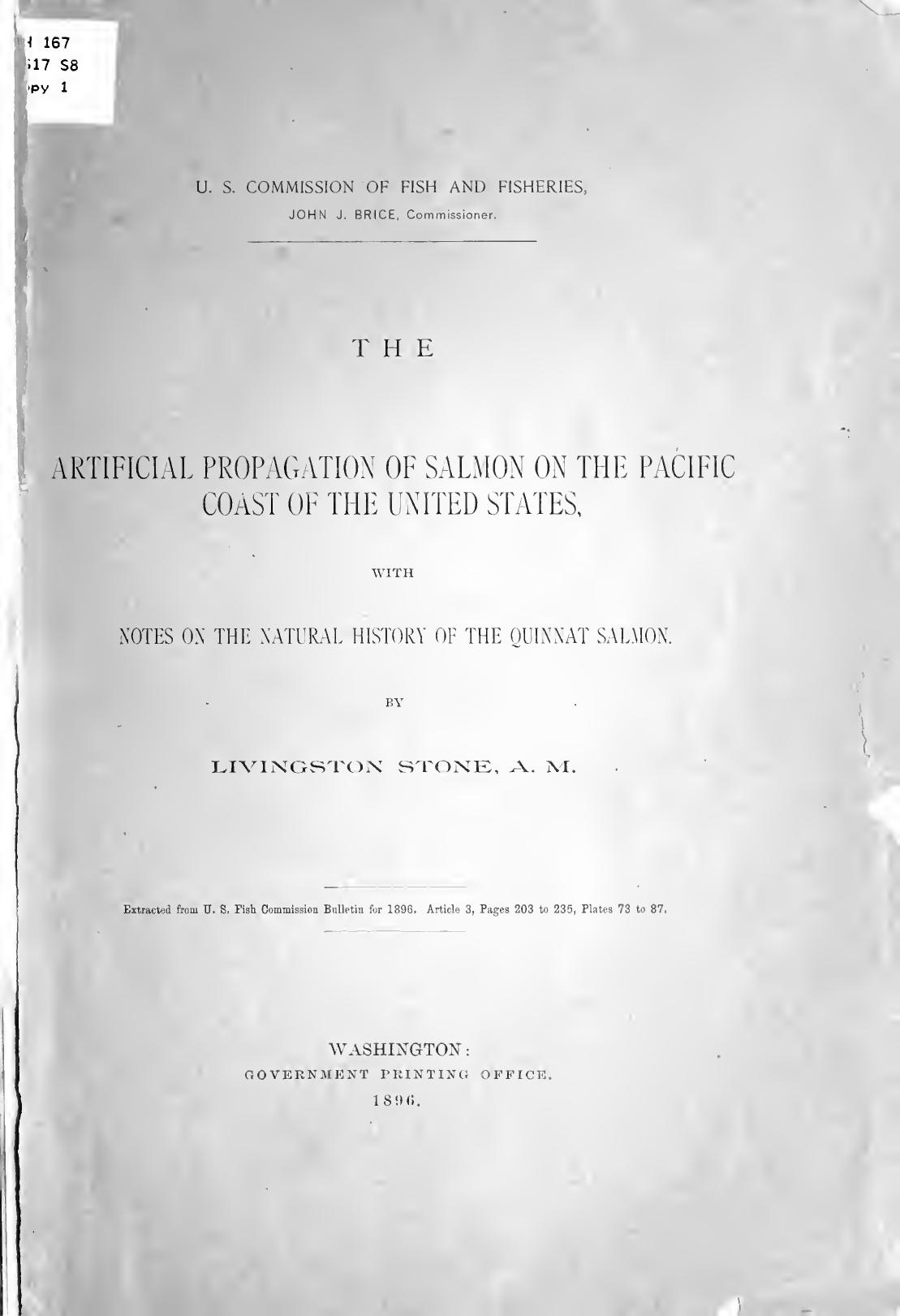
Author:Stone, Livingston, 1836-1912. [from old catalog]
Language: eng
Format: epub, pdf
Tags: Fish culture, Pacific salmon
Publisher: Washington, Govt., print. off.
Published: 1896-03-25T05:00:00+00:00
this uew California salmou that abounded in warm latitudes on the Pacific Coast. That this did not prove to be the result was a stupendous surprise and disappointment. The eggs hatched out beautifully. The young fry, when deposited in the fresh-water streams seemed to thrive eepially well. Tiiey grew rapidly and when the proper time came were observed to go down in vast numbers to the sea. What afterwards became of them will jn-obably remain forever an nufathoniable mysteiy. Except in very rare isolated instances, these millions of young salmon were never seen again. What became of them? Where did they go? Are any of them still alive anywhere in the boundless ocean? Or are they all dead? And if they are dead, what killed them? Much as this information has been desired, there lives no one who can answer these questions. Some have thought that they wandered oft" to the far Xorth, and so became lost to the civilized world. Others thought that they strayed out into the ocean and were devoured by marine animals and larger fish. Professor Baird once jokingly remarked to tlie writer that he thought they had found an underground jiassage beneath the continent, and had returned by it to the Pacific. One thing is certain, and that is that these millions of salmon have disappeared as completely from the Atlantic Ocean' and its tributaries as if they had all been devoured years ago by the monsters of the deep.
Referring to this unaccountable and disheartening fact, Hon. Marshall McDonald, United States Fish Commissioner, said, in his report for 1888—
These - experiments [stockiug Atlantic rivers with Califoruia salmon] were undertaken on a scale unprecedented in the history of fish-culture. Millions of eggs were transferred to the eastern stations, hatched out, and the fry plauted ia uearly every one of the larger rivers south of the Hudson. In no single case did the experiment prove satisfactory, and the Commissioner was forced reluctantly to abandon an experiment which, reasoning from a priori considerations, gave fair promises of success, and which, had it succeeded, would have given us a new and valuable fishery in the Atlantic rivers.
This, however, is only one side of the case. As soon as the requisite space of time had elapsed after the United States Fish Commission began to return young salmou fry to the Sacramento, the fishes of that river showed a great increase. New canneries sprang u]) every succeeding year. The market for fresh and salted salmon in San Francisco felt the effects of the salmon-breeding work on the McCloud.
The following interesting statement appears in the United States Fish Commissioner's Report for 1882, page 840:
One of the last official acts of the late Hon. B. B. Redding, .as California fish commissioner, before he died, was to write a letter to Professor Baird in regard to this station, in which he stated tliat several hundred thousand dollars had been invested in canneries on the Sacramento River, and that tliis capital and these men would be ultimately thrown out of employment if the salmon hatching at this station should be given Tip.
Download
The artificial propagation of salmon on the Pacific Coast of the United States by Stone Livingston 1836-1912.pdf
This site does not store any files on its server. We only index and link to content provided by other sites. Please contact the content providers to delete copyright contents if any and email us, we'll remove relevant links or contents immediately.
| Africa | Americas |
| Arctic & Antarctica | Asia |
| Australia & Oceania | Europe |
| Middle East | Russia |
| United States | World |
| Ancient Civilizations | Military |
| Historical Study & Educational Resources |
Cecilia; Or, Memoirs of an Heiress — Volume 1 by Fanny Burney(32679)
Cecilia; Or, Memoirs of an Heiress — Volume 2 by Fanny Burney(32037)
Cecilia; Or, Memoirs of an Heiress — Volume 3 by Fanny Burney(32022)
The Secret History by Donna Tartt(19382)
Sapiens: A Brief History of Humankind by Yuval Noah Harari(14494)
Leonardo da Vinci by Walter Isaacson(13437)
The Radium Girls by Kate Moore(12126)
Sapiens by Yuval Noah Harari(5425)
How Democracies Die by Steven Levitsky & Daniel Ziblatt(5295)
The Wind in My Hair by Masih Alinejad(5162)
Homo Deus: A Brief History of Tomorrow by Yuval Noah Harari(4980)
Endurance: Shackleton's Incredible Voyage by Alfred Lansing(4872)
Man's Search for Meaning by Viktor Frankl(4688)
The Silk Roads by Peter Frankopan(4629)
Millionaire: The Philanderer, Gambler, and Duelist Who Invented Modern Finance by Janet Gleeson(4561)
The Rape of Nanking by Iris Chang(4286)
The Motorcycle Diaries by Ernesto Che Guevara(4183)
Joan of Arc by Mary Gordon(4181)
Stalin by Stephen Kotkin(4030)
