Religion and Politics Under Capitalism by Arvidsson Stefan;
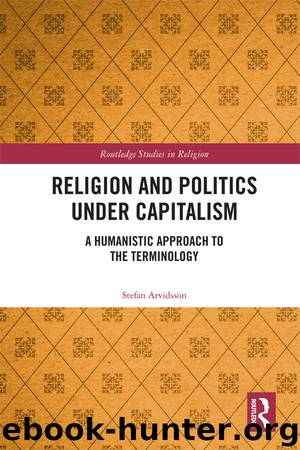
Author:Arvidsson, Stefan;
Language: eng
Format: epub
Publisher: Taylor & Francis (CAM)
Published: 2019-04-13T16:00:00+00:00
5 “Everything religion” and the capitalist framework
A catalogue of “everything religion”
This chapter might come across as somewhat unsystematic. There is, however, a common thread running through it that consists of exposing an understanding of religion that might be called modernistic, existential or spiritual, and discussing how this understanding has supported numerous daring – but, in the end, misguided – claims about “everything religion”. I then plea for situating the study of religion and politics within the conceptual framework of capitalism. In passing, I refute the idea of a present-day, post-secular condition and conclude with some reflections on a dialectical view of humankind that forms a bridge to the subsequent chapter on humanism.
Charles Taylor presents us with the argument that behind the secular mentality, we can excavate theological conceptualisations that has developed over the last 500 years. Comparably, the Political Religion School saw religious notions behind the persuasive forces of totalitarian ideologies and regimes. Renowned historian of religions, Mircea Eliade, explains to his readers: “In short, the majority of men ‘without religion’ still hold to pseudo religions and degenerated mythologies”.1 This line of argument, or way of investigation – of detecting things religious/sacred/theological beneath the surface of things secular/profane/philosophical – is currently popular. One flagrant example is Jonathan Benthall’s Returning to Religion: Why a Secular Age is Haunted by Faith (2008) in which he states: “It is already commonplace to argue that political doctrines such as communism and Nazism, some movements in the arts, and intellectual schools such as psychoanalysis all have religioid aspects. I extend the argument to include some other social movements”.2 Among the “parareligions” Benthall encountered during his explorations, we find: humanitarianism, animal rights and environmentalist movements, psychotherapy and even archaeology and anthropology. Equally generous is historian Michel Burleigh, who states that “‘science’, ‘progress’, ‘morality’, ‘money’, ‘culture’, ‘humanity’ and ‘sport’ have become objects of devotion and refocused religiosity”.3
When we examine recent discussions on secularisation, it is with some astonishment that we learn the following:
1 There is no such thing as secular mass politics; on the contrary, this form of politics is based on fanaticism rooted in religious sentiments. This is the lesson taught by the Political Religion School, but also, inter alia, by philosopher John Gray on utopianism and “apocalyptic politics”, and by political scientist Mark Lilla.4 Indeed, the first line in Gray’s Black Mass: Apocalyptic Religion and the Death of Utopia (2007) states, “[m]odern politics is a chapter in the history of religion”.
2 There is no such thing as a generic secular politics discourse, as in reality it is built on the pillars of theology. Concepts such as “justice”, “equality”, “peace”, “freedom”, “community”, “utopia”, and so forth, are historically secularised theological concepts, and consequently in some fundamental sense still are theological concepts. This is the lesson to be learned from the so-called political theology, advocated by prominent scholars such as Carl Schmitt and Leo Strauss.5
3 There is no such thing as profane high culture, because this form of culture is the product of (a perverted) engagement with the sacred. This is the lesson offered by various theologians, historians of religion and psychologists.
Download
This site does not store any files on its server. We only index and link to content provided by other sites. Please contact the content providers to delete copyright contents if any and email us, we'll remove relevant links or contents immediately.
| Africa | Americas |
| Arctic & Antarctica | Asia |
| Australia & Oceania | Europe |
| Middle East | Russia |
| United States | World |
| Ancient Civilizations | Military |
| Historical Study & Educational Resources |
Cecilia; Or, Memoirs of an Heiress — Volume 1 by Fanny Burney(32652)
Cecilia; Or, Memoirs of an Heiress — Volume 2 by Fanny Burney(32019)
Cecilia; Or, Memoirs of an Heiress — Volume 3 by Fanny Burney(32003)
The Secret History by Donna Tartt(19351)
Sapiens: A Brief History of Humankind by Yuval Noah Harari(14475)
Leonardo da Vinci by Walter Isaacson(13422)
The Radium Girls by Kate Moore(12106)
Sapiens by Yuval Noah Harari(5416)
How Democracies Die by Steven Levitsky & Daniel Ziblatt(5284)
The Wind in My Hair by Masih Alinejad(5149)
Homo Deus: A Brief History of Tomorrow by Yuval Noah Harari(4971)
Endurance: Shackleton's Incredible Voyage by Alfred Lansing(4858)
Man's Search for Meaning by Viktor Frankl(4679)
The Silk Roads by Peter Frankopan(4608)
Millionaire: The Philanderer, Gambler, and Duelist Who Invented Modern Finance by Janet Gleeson(4546)
The Rape of Nanking by Iris Chang(4272)
The Motorcycle Diaries by Ernesto Che Guevara(4170)
Joan of Arc by Mary Gordon(4166)
Stalin by Stephen Kotkin(4017)
