Reading the Bible Again For the First Time by Marcus J. Borg
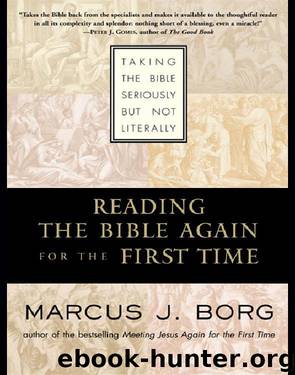
Author:Marcus J. Borg
Language: eng
Format: mobi
ISBN: 9780061763441
Publisher: HarperCollins
Published: 2012-01-02T01:06:46+00:00
10
Reading Revelation Again
“Revelation is widely popular for the wrong reasons,” says biblical scholar Raymond Brown, “for a great number of people read it as a guide to how the world will end, assuming that the author was given by Christ detailed knowledge of the future that he communicated in coded symbols.”1 Indeed, a substantial percentage of fundamentalist and conservative-evangelical Christians read Revelation as forecasting the imminent “end of the world” and second coming of Christ.
The conviction that Jesus is coming soon, or at least that he may be, is widespread. According to one national public-opinion poll, sixty-two percent of Americans (not just American Christians, mind you) have “no doubts” that Jesus will come again.2 Another poll reports that one-third believe the world will end soon.3
I call a reading of Revelation that emphasizes the imminent second coming of Christ a “millennialist” interpretation. That view has flourished in the last half-century. During the last thirty years, books by Hal Lindsey, beginning with The Late Great Planet Earth, have sold over forty million copies. During the decade of the 1970s, Lindsey was the best-selling nonfiction(?) author in the English-speaking world. In the last several years, a series of novels on “the rapture” by Tim LaHaye and Jerry B. Jenkins have been on the best-seller lists. A millennialist reading of Revelation is a frequent theme of television and radio evangelists and “prophecy conferences” throughout the world. Recently, as I surfed through my viewing options on TV, I saw one of the best-known television evangelists standing in front of a chalkboard displaying biblical “signs of the end” and suggesting that 2007 may be the year of the second coming. Speaking in the context of a fund-raising drive, he sent this message: “You don’t want to be burdened when Jesus comes again.”
The millennialist interpretation is not universally accepted, however. In fact, the interpretation of Revelation divides the contemporary church. But those Christians who reject the millennialist view often lack an alternate interpretation, choosing instead to ignore Revelation. The majority of mainline Christians have little familiarity with this troubling text; they avoid it in personal devotions and seldom hear it preached about (for there are few texts from Revelation in the lectionary, which sets out the portions of the Bible assigned for reading in public worship). Readers are puzzled by Revelation’s difficult and bizarre imagery, perplexed by its scenes of destruction and divine violence, and put off by the message, “Jesus is coming soon and you’d better be ready, or you’ll be in big trouble.” To them, the God of Revelation and the message of Revelation seem to have little to do with the gospel of Jesus. They are willing (even if not happy) to leave Revelation to others.
Introduction
Revelation stands at the end of the New Testament and thus at the end of the Christian Bible. However, it was not the last document of the New Testament to be written, nor did its author know that it would someday conclude the Christian Bible. Its placement at the
Download
This site does not store any files on its server. We only index and link to content provided by other sites. Please contact the content providers to delete copyright contents if any and email us, we'll remove relevant links or contents immediately.
The Five People You Meet in Heaven by Mitch Albom(3550)
The Secret Power of Speaking God's Word by Joyce Meyer(3161)
Real Sex by Lauren F. Winner(3005)
Name Book, The: Over 10,000 Names--Their Meanings, Origins, and Spiritual Significance by Astoria Dorothy(2969)
The Holy Spirit by Billy Graham(2938)
0041152001443424520 .pdf by Unknown(2842)
How The Mind Works by Steven Pinker(2811)
ESV Study Bible by Crossway(2772)
Ancient Worlds by Michael Scott(2677)
Churchill by Paul Johnson(2576)
The Meaning of the Library by unknow(2563)
The ESV Study Bible by Crossway Bibles(2546)
The Gnostic Gospels by Pagels Elaine(2517)
MOSES THE EGYPTIAN by Jan Assmann(2411)
Jesus by Paul Johnson(2349)
City of Stairs by Robert Jackson Bennett(2337)
The Complete Dead Sea Scrolls in English (7th Edition) (Penguin Classics) by Geza Vermes(2269)
The Nativity by Geza Vermes(2224)
Ancient Near Eastern Thought and the Old Testament by John H. Walton(2220)
