Reaction, Revolution and The Birth of Nazism by Nick Shepley
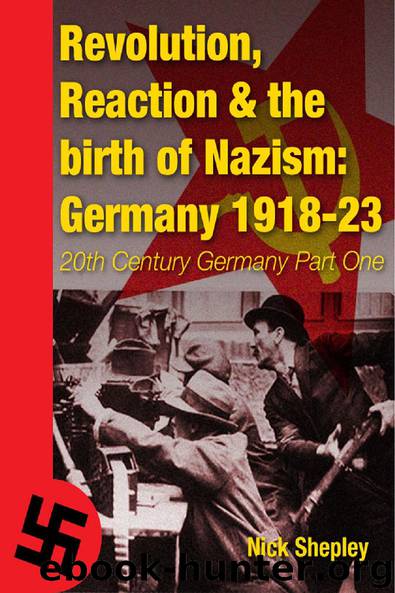
Author:Nick Shepley
Language: eng
Format: epub
Tags: German, Revolution, World War One, SPD Party, KPD, USPD, Spartacist League, Hitler, Rosa Luxemburg, Karl Liebknecht, Kaiser Wilhelm II
ISBN: 9781783331154
Publisher: Andrews UK Limited 2013
Published: 2013-07-02T00:00:00+00:00
Part Three: The Treaty
Far from being the product of communists and traitors, the armistice was signed by politicians desperate to stave off a communist revolution in Germany. They knew full well that unless something was done to end the war and bring an end to the near starvation levels of hunger that were affecting Germany, a Bolshevik revolution was inevitable.
The German delegation crossed in five cars from the German border into France, and we can but speculate as to their reactions when they saw the results of four years of war, driving silently through a shattered landscape. They were eventually taken by train to Foch’s own private carriage which sat in a railway siding in the forest of Compeigne. There was no scope for negotiating, the German delegation had no place to bargain from and they were aware that every moment that they prevaricated was a moment lost. There were 35 initial demands including the cessation of hostilities, they ranged from the removal of all German troops from France, Belgium, Luxembourg and Alsace Lorraine and the removal of all German forces to the east banks of the Rhine, leaving a western demilitarised zone to the abolition of the Treaty of Brest Litovsk. Germany’s wartime conquests were lost in one fell swoop, along with her navy that was to be interred at Scapa Flow. All German submarines were to be handed over to the Royal Navy and 5,000 of Germany’s cannons, 25,000 machine guns, 1,700 aircraft, 5,000 locomotives and 150,000 railcars. The German Army was to be left effectively toothless against further attack. The real destruction of German military, economic and diplomatic power was yet to begin however, the final reckoning for Germany would be concluded in the first six months of 1919 at the Paris Peace Conference that would in large part decide the shape of the 20 th Century.
The conference met in January 18 th 1919, some 48 years to the day since the German Empire had been proclaimed in the Hall of Mirrors at Versailles. In total five treaties would be imposed upon the Central Powers, redrawing the map of most of Europe and the Middle East and redistributing colonies of the vanquished powers between the victors as mandates and protectorates. For six months the city became the home of a de facto world government as Woodrow Wilson, David Lloyd George, Georges Clemenceau and to a lesser extent Italy’s Vittorio Orlando attempted to build a new world out of the ashes of the old. Four Empires had collapsed, two more were greatly weakened, revolution had broken out and was ongoing during and after the conference, new nationalisms had emerged from the fragments of multinational empires and new powers such as Japan demanded to be recognised on the world stage for their contribution to the war. National self determination was a principal that Wilson was keen to apply to the new world that emerged in 1919, but it would not be a principal that would be universal in its application.
Download
This site does not store any files on its server. We only index and link to content provided by other sites. Please contact the content providers to delete copyright contents if any and email us, we'll remove relevant links or contents immediately.
| Africa | Americas |
| Arctic & Antarctica | Asia |
| Australia & Oceania | Europe |
| Middle East | Russia |
| United States | World |
| Ancient Civilizations | Military |
| Historical Study & Educational Resources |
Cecilia; Or, Memoirs of an Heiress — Volume 1 by Fanny Burney(32546)
Cecilia; Or, Memoirs of an Heiress — Volume 2 by Fanny Burney(31943)
Cecilia; Or, Memoirs of an Heiress — Volume 3 by Fanny Burney(31929)
The Secret History by Donna Tartt(19052)
Sapiens: A Brief History of Humankind by Yuval Noah Harari(14368)
Leonardo da Vinci by Walter Isaacson(13316)
The Radium Girls by Kate Moore(12018)
Sapiens by Yuval Noah Harari(5365)
How Democracies Die by Steven Levitsky & Daniel Ziblatt(5215)
The Wind in My Hair by Masih Alinejad(5091)
Homo Deus: A Brief History of Tomorrow by Yuval Noah Harari(4908)
Endurance: Shackleton's Incredible Voyage by Alfred Lansing(4769)
Man's Search for Meaning by Viktor Frankl(4581)
The Silk Roads by Peter Frankopan(4526)
Millionaire: The Philanderer, Gambler, and Duelist Who Invented Modern Finance by Janet Gleeson(4465)
The Rape of Nanking by Iris Chang(4203)
Joan of Arc by Mary Gordon(4100)
The Motorcycle Diaries by Ernesto Che Guevara(4089)
Stalin by Stephen Kotkin(3957)
