Pioneers of Jazz by Lawrence Gushee;
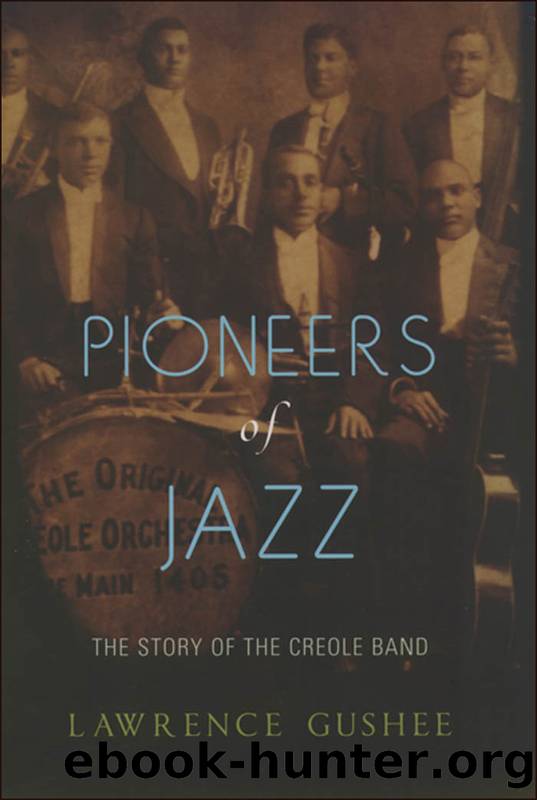
Author:Lawrence Gushee; [Gushee;, Lawrence]
Language: eng
Format: epub
ISBN: 9780199732333
Publisher: OxfordUP
Published: 2005-09-15T05:00:00+00:00
One would like to think that our musicians scored a hit of such proportions at the Montmartre that they were kept on for many weeks, just as had happened with the Original Dixieland Jazz Band at Reisenweberâs. Such was not the case: on March 19 the dailies carried the Montmartre ad as before, except that the Creole Band had been replaced with âThe Original California âJazzâ Band from Frisco in âJazzâ Music.â They were to remain at the Montmartre through the end of May, for a run of eleven weeks.
A columnist for the New York Globe & Commercial Advertiser, S. Jay Kaufman had a wonderful opportunity butâfrom our point of viewâdropped the ball. He wrote:
Because you wanted to know what a Jass Band is we went to the Winter Garden on Sunday night and last night at Reisenweberâs. At the Winter Garden the band is called the Creole Band, and at Reisenweberâs they call it the Original Dixieland Jass Band. What is a Jass Band? Edward [sic] B. Edwards, who gave us his engraved card which read âTrombonistâ and who is the leader of the originals, said: âA Jass Band is composed of oboes, clarinets, cornets, trombones, banjos and always a drum ⦠But the music is a matter of the ear and not of technique. None of us knows music. One carries the melody and the others do what they please. Some play counter melodies, some play freak noises, and some just play. I canât tell you how. You âgot to feelâ Jass. The time is syncopated. Jass I think means a jumble. We came from New Orleans by way of Chicago ⦠To us it seemed a lot of weird effects intended to make one dance with every part of oneâs body but the feet. And later the dancer did a Jass dance that would have made a jelly fish wonder why it was so named.68
Why did the Creole Band leave Doraldinaâs Montmartre after a mere two weeks? Two decades later, Nick LaRocca was to insist that they had flopped; but there is no contemporary commentary to that effect (see below). A more reasonable hypothesis, in my opinion, is that the Shuberts simply loaned the act to Marcus Loew to help him out at a rather difficult time. There is evidence supporting this idea in the advance publicity printed in the Portland, Maine, Daily Eastern Argus on April 26, 1917, the day they were to open in that city at the New Portland Theatre.
The display ad read, âHereâs the Big Shubert Management Act that has made New York sit up / The Creole Band / Sometimes Called the Jazz Band â¦â but the significant detail is in the text of the publicity puff:
⦠so good that they are under the management of the Shuberts and are obtained from them by Marcus Loew for a limited number of engagements at some of the best Loew houses.69
The Loew vaudeville interests would have had a very good reason to call on the Shubertsâor anyone elseâfor assistance.
Download
This site does not store any files on its server. We only index and link to content provided by other sites. Please contact the content providers to delete copyright contents if any and email us, we'll remove relevant links or contents immediately.
The Goal (Off-Campus #4) by Elle Kennedy(13651)
Kathy Andrews Collection by Kathy Andrews(11812)
Diary of a Player by Brad Paisley(7557)
Assassin’s Fate by Robin Hobb(6197)
What Does This Button Do? by Bruce Dickinson(6194)
Big Little Lies by Liane Moriarty(5790)
Altered Sensations by David Pantalony(5093)
Pale Blue Dot by Carl Sagan(4996)
Sticky Fingers by Joe Hagan(4188)
The Death of the Heart by Elizabeth Bowen(3605)
The Heroin Diaries by Nikki Sixx(3543)
Beneath These Shadows by Meghan March(3298)
Confessions of a Video Vixen by Karrine Steffans(3298)
How Music Works by David Byrne(3259)
The Help by Kathryn Stockett(3139)
Jam by Jam (epub)(3071)
Harry Potter 4 - Harry Potter and The Goblet of Fire by J.K.Rowling(3057)
Computational Linguistics and Intelligent Text Processing: 20th International Conference, CICLing 2019 La Rochelle, France, April 7â13, 2019 Revised Selected Papers, Part I by Alexander Gelbukh(2978)
Strange Fascination: David Bowie: The Definitive Story by David Buckley(2857)
