Paulo Freire's Intellectual Roots by Lake Robert; Kress Tricia;
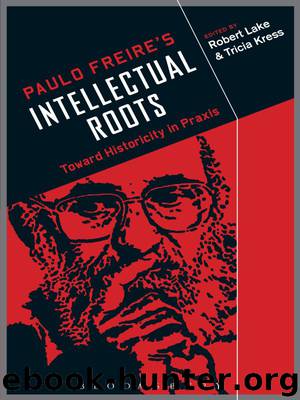
Author:Lake, Robert; Kress, Tricia;
Language: eng
Format: epub
Publisher: Bloomsbury Publishing
Published: 2013-03-14T16:00:00+00:00
Freedom is in being, not having
Capitalism, according to Fromm, has freed man further spiritually, mentally, socially, politically, and economically. Man, under the capitalist system learned to “rely on himself, to make responsible decisions, to give up both soothing and terrifying superstitions . . . [he] became free from mystifying elements; [he] began to see himself objectively and with fewer and fewer illusions” (i.e. to become critically conscious), and hence he became increasingly free from traditional bonds, he became free to become more. As this freedom “from” grew, “positive” freedom (the growth of an active, critical, responsible self) advanced as well. However, capitalism also had other effects on the process of growing freedom as well. “It made the individual more alone and isolated and imbued him with a feeling of insignificance and powerlessness” (p. 108). It also increased doubt and skepticism, and all of these factors made man more anxious about freedom.
The principle of individualist activity characteristic of a capitalistic economy put the individual on his own feet. Whereas under the feudal system of the Middle Ages, everyone had a fixed place in an ordered and transparent social system under capitalism; if one was unable to stand on his own two feet, he failed, and it was entirely his own affair. Obviously this is not productive work that leads to freedom and biophilia but rather it is oppressive and necrophilious.
That this principle furthered the process of individualization is obvious and is always mentioned as an important item on the credit side of modern culture. But in furthering “freedom from,” this principle helped to sever all ties between one individual and the other and thereby isolated and separated the individual from his fellow men. (pp. 105–6)
The results of Capitalism in terms of increasing freedom “from” and the strength of the individual character that it built, have lead people to assume that modern man “has become the center and purpose of all activity, that what he does he does for himself, that the principle of self-interest and egotism are the all-powerful motivations of human activity” (p. 109). “Yet, much of what seemed to him to be his purpose was not his” (ibid.). Rather, the capital that he earned and created no longer served him—he served it. “Man became a cog in the vast economic machine . . . to serve a purpose outside of himself” (p. 110). Man became a servant to the very machines he built, which gave him a feeling of personal insignificance and powerlessness. Those who did not have capital and had to sell their labor to earn a living suffered similar psychological effects, according to Fromm, because they too were merely cogs in the great economic machine, and hence instruments of “suprapersonal economic factors.”
Modern man believed that he was freeing himself, but was really submitting to aims that were not his own. As such, he became untrue to himself. He did not work for himself, his happiness, or his freedom, rather, his work was done either to serve more powerful others or to acquire capital.
Download
This site does not store any files on its server. We only index and link to content provided by other sites. Please contact the content providers to delete copyright contents if any and email us, we'll remove relevant links or contents immediately.
The Art of Coaching Workbook by Elena Aguilar(51156)
Trainspotting by Irvine Welsh(21635)
Twilight of the Idols With the Antichrist and Ecce Homo by Friedrich Nietzsche(18618)
Fangirl by Rainbow Rowell(9228)
Periodization Training for Sports by Tudor Bompa(8250)
Change Your Questions, Change Your Life by Marilee Adams(7753)
This Is How You Lose Her by Junot Diaz(6873)
Asking the Right Questions: A Guide to Critical Thinking by M. Neil Browne & Stuart M. Keeley(5752)
Grit by Angela Duckworth(5598)
Red Sparrow by Jason Matthews(5463)
Paper Towns by Green John(5175)
Room 212 by Kate Stewart(5102)
Ken Follett - World without end by Ken Follett(4719)
Housekeeping by Marilynne Robinson(4434)
The Sports Rules Book by Human Kinetics(4377)
Double Down (Diary of a Wimpy Kid Book 11) by Jeff Kinney(4257)
Papillon (English) by Henri Charrière(4255)
The Motorcycle Diaries by Ernesto Che Guevara(4087)
Exercise Technique Manual for Resistance Training by National Strength & Conditioning Association(4057)
