Pastoral Epistles, Volume 46 by Bruce M. Metzger
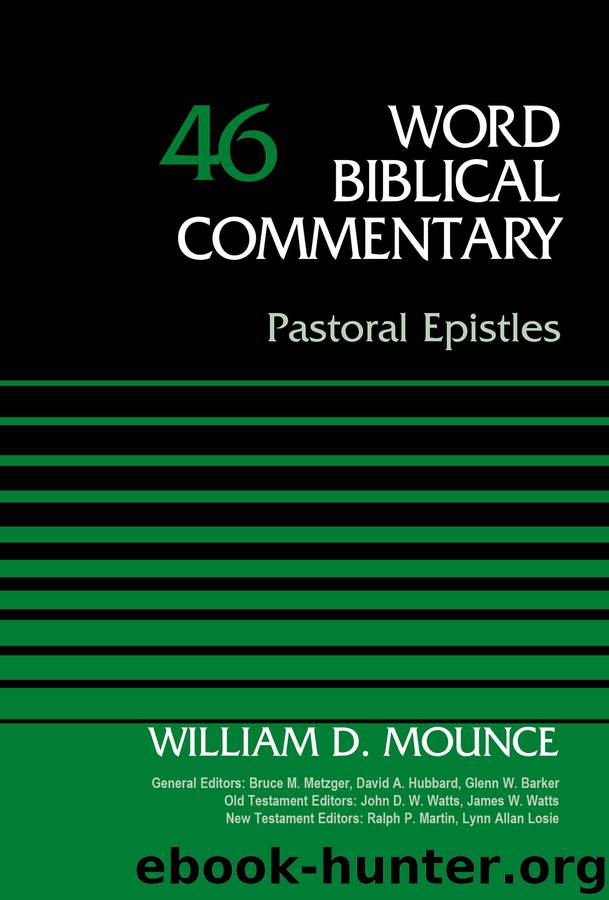
Author:Bruce M. Metzger
Language: eng
Format: epub
Tags: REL006070 Religion / Biblical Commentary / New Testament
Publisher: Zondervan
Explanation
Having described the Ephesian problem in 1 Tim 4:1–5, Paul continues the same pattern established in chap. 1 of encouraging Timothy in his task. In one of the most personal sections in all the NT Paul shows his deep concern for both Timothy’s personal well-being and his ministry. This does not mean that Timothy has ceased ministering; it means that he needs encouragement in a difficult situation. The tone of this section is different from the rest of the epistle. Instead of merely debating the heresy or attacking the opponents, Paul shows that part of an effective approach is the positive presentation of correct doctrine and proper conduct. What follows comprises more than simple instructions to Timothy. These verses provide a paradigm of effective ministry for ministers of all ages and all times. The twelve imperatives form seven parts to Paul’s paradigm of effective ministry.
(1) Personally, Timothy is daily to rely on Scripture and its teaching. This emphasis is repeated again in this section (cf. v 13) and is emphasized in Paul’s second epistle to Timothy. (2) Timothy is to stay away from the heresy, as all ministers should stay away from silly and empty arguments about the meaning of words that produce nothing but controversy and have nothing to do with godliness. While it is obvious that physical exercise is good, the goal of godliness is much more important because its fruits last forever. This is why Paul struggles so in his ministry, a ministry of the proclamation of salvation for all, a salvation that leads to godliness. (3) Timothy is to stand firm, commanding obedience to his instruction.
(4) The fourth part of the paradigm Paul is creating can well be described by the words of Elihu, the young friend of Job who did not speak at first out of respect for the older three friends. But as one whom God had blessed with wisdom, he was no longer able to keep silent: “I am young in years, and you are aged; therefore I was timid and afraid to declare my opinion to you. I said, ‘Let days speak, and many years teach wisdom.’ But it is the spirit in a man, the breath of the Almighty, that makes him understand. It is not the old that are wise, nor the aged that understand what is right” (Job 32:6b–9). Paul warns the Ephesians and Timothy about two excesses well guarded by Elihu. They must not look down on Timothy because he is younger than they, and Timothy must guard against the excesses of youth by being an example both in public and in private, thereby warranting their respect. It is not sufficient simply to demand respect; one’s actions should prove oneself worthy. (5) Paul repeats again the emphasis of v 6 that Timothy must make Scripture, the text and its doctrine, central to his life and ministry. Ministry is to be biblically based. (6) Throughout the Psalms and the narrative texts in the OT the Israelites are told to
Download
This site does not store any files on its server. We only index and link to content provided by other sites. Please contact the content providers to delete copyright contents if any and email us, we'll remove relevant links or contents immediately.
The Five People You Meet in Heaven by Mitch Albom(3550)
The Secret Power of Speaking God's Word by Joyce Meyer(3167)
Real Sex by Lauren F. Winner(3006)
Name Book, The: Over 10,000 Names--Their Meanings, Origins, and Spiritual Significance by Astoria Dorothy(2978)
The Holy Spirit by Billy Graham(2942)
0041152001443424520 .pdf by Unknown(2843)
How The Mind Works by Steven Pinker(2811)
ESV Study Bible by Crossway(2773)
Ancient Worlds by Michael Scott(2680)
Churchill by Paul Johnson(2577)
The Meaning of the Library by unknow(2564)
The ESV Study Bible by Crossway Bibles(2547)
The Gnostic Gospels by Pagels Elaine(2527)
MOSES THE EGYPTIAN by Jan Assmann(2411)
Jesus by Paul Johnson(2351)
City of Stairs by Robert Jackson Bennett(2339)
The Complete Dead Sea Scrolls in English (7th Edition) (Penguin Classics) by Geza Vermes(2270)
The Nativity by Geza Vermes(2226)
Ancient Near Eastern Thought and the Old Testament by John H. Walton(2221)
