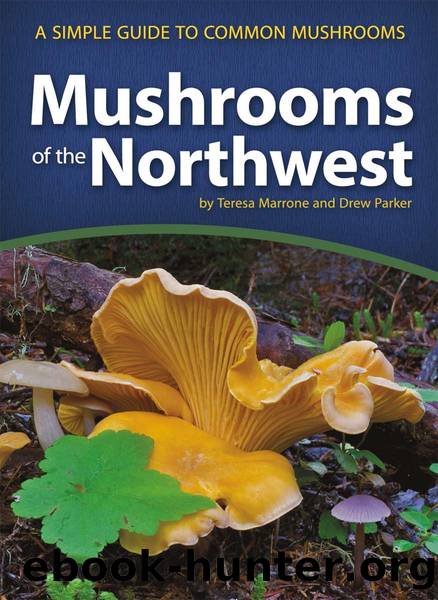
Mushrooms of the Northwest by Marrone Teresa; Parker Drew;
Author:Marrone, Teresa; Parker, Drew;
Language: eng
Format: epub
ISBN: 5944639
Publisher: Adventure Publications
Published: 2019-11-15T00:00:00+00:00
Rosy Gomphidius
Clustered Slime Spike
Gills and ring darkened by spores (G. glutinosus shown)
Purple Slime Spike
Purplish Cortinarius
Cortinarius spp.
HABITAT: Cortinarius are mycorrhizal. All species discussed here associate with conifers; Violet Cort may also be found near hardwoods.
DESCRIPTION: Cortinarius have a cobwebby veil (called a cortina; see photo on pg. 13) covering the gills of young specimens. The veil disintegrates with age, sometimes leaving a ring remnant on the stem. Spores are brownish; they typically darken the mature gills and ring remnant. Caps are conical at first, becoming wider and fairly flat, often with a central hump (umbo). Gills are attached to the stem, sometimes running down it slightly. Our area has several Corts with purplish attributes. ⢠Many Corts have dry caps. The two discussed here are fairly large, with caps up to 5 inches wide. Violet Cort (C. violaceus) is deep violet to violet-black overall, with purplish flesh; older specimens fade to brownish. Caps are hairy or scaly, with a rough texture. Gills are fairly widely spaced. Stems are up to 7 inches tall, with a swollen or club-shaped base. It has a mildly sweet odor that some compare to cedar wood. Lilac Cort (C. traganus) has pale lilac caps and stems; gills are brownish-yellow and closely spaced. Stems are less than 4 inches tall and roughened with irregular pale patches. Flesh is brownish. Lilac Cort has a pear-like odor. ⢠Other Corts have caps that are slimy or sticky when wet. The two discussed here are medium-size, with caps that are typically 2 to 3 inches wide; stems are 2 to 3 inches tall and moderately slender. Gills of both are closely spaced. C. occidentalis are violet-blue overall when young, fading to grayish-purple or tan. Flesh is bluish to bluish-gray; it stains purplish when cut or bruised. This species has little odor. C. subfoetidus (uncommon in our area) is noted for its highly sweet, unpleasant odor. Caps are bluish-lavender to pale pinkish lilac; the centers fade to pinkish-tan but the edges remain lavender. This species has a universal veil that leaves a lilac-colored sheath on the lower part of the stem.
SPORE PRINT: Rust-brown to cinnamon-brown.
SEASON: Summer through fall.
OTHER NAMES: C. occidentalis is also listed as C. mutabilis.
COMPARE: Young Blewits are purplish overall, but they have no veil and no ring zone on the stem; spores are pale pink to pinkish-buff.
NOTES: Violet Cort is edible but not choice. The others listed here should be considered inedible; some may be toxic.
Download
This site does not store any files on its server. We only index and link to content provided by other sites. Please contact the content providers to delete copyright contents if any and email us, we'll remove relevant links or contents immediately.
Sapiens: A Brief History of Humankind by Yuval Noah Harari(14493)
The Tidewater Tales by John Barth(12724)
Mastermind: How to Think Like Sherlock Holmes by Maria Konnikova(7472)
The Thirst by Nesbo Jo(7035)
Do No Harm Stories of Life, Death and Brain Surgery by Henry Marsh(6992)
Why We Sleep: Unlocking the Power of Sleep and Dreams by Matthew Walker(6808)
Life 3.0: Being Human in the Age of Artificial Intelligence by Tegmark Max(5647)
Sapiens by Yuval Noah Harari(5425)
The Body: A Guide for Occupants by Bill Bryson(5216)
The Longevity Diet by Valter Longo(5122)
The Rules Do Not Apply by Ariel Levy(5052)
The Immortal Life of Henrietta Lacks by Rebecca Skloot(4661)
Animal Frequency by Melissa Alvarez(4528)
Why We Sleep by Matthew Walker(4506)
The Hacking of the American Mind by Robert H. Lustig(4446)
Yoga Anatomy by Kaminoff Leslie(4424)
All Creatures Great and Small by James Herriot(4378)
Double Down (Diary of a Wimpy Kid Book 11) by Jeff Kinney(4357)
Embedded Programming with Modern C++ Cookbook by Igor Viarheichyk(4238)
