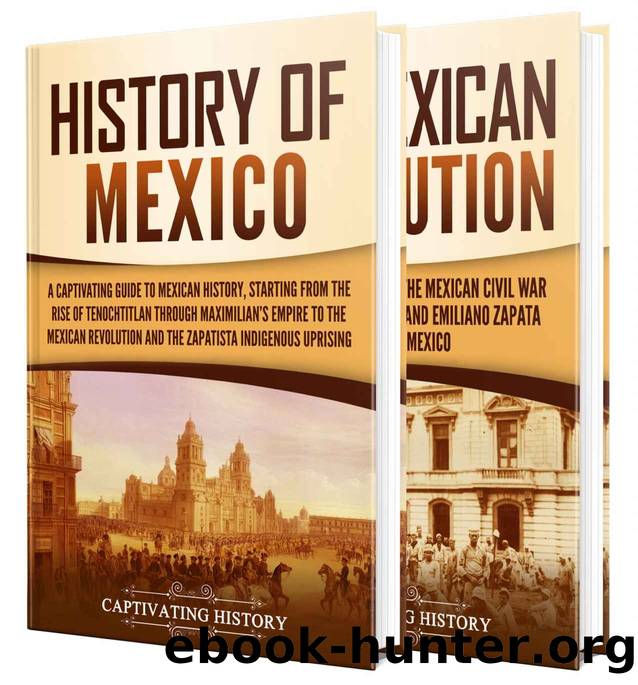
Mexican History: A Captivating Guide to the History of Mexico and the Mexican Revolution by Captivating History
Author:Captivating History [History, Captivating]
Language: eng
Format: azw3
Published: 2020-06-15T00:00:00+00:00
Part 2: THE MEXICAN REVOLUTION
A Captivating Guide to the Mexican Civil War and How Pancho Villa and Emiliano Zapata Impacted Mexico
Introduction
The Mexican Revolution was a defining moment of the 20th century. The Mexican fight for democracy, equality, and justice sent shockwaves around the world. No other episode in its history has left a deeper mark. It is a three-act drama full of politics, persecution, and war, not to mention earthquakes, signs in the sky, and even spiritualist sessions, while being populated by larger-than-life villains, international spies, and the universally known figures of Pancho Villa and Emiliano Zapata. In fact, our modern idea ofââ ârevolutionâ owes much to what happened in this country between 1910 and 1920.
Although the uprisings of the oppressed classes have occurred since antiquity, Mexico in the 20th century is a unique caseâthis was the first triumphant popular revolution that, unlike others, was able to establish a popular government that carried out extensive social transformations without resorting to state terror, as was the case in the Soviet Union and China. It integrated marginalized groups into national life, and it gave birth to a refurbished nation, where, for a hundred years, there has not been a new coup dâétat, a problem that devastated other Latin American countries during the 20th century. In a way, the course of the First World War was defined through Mexico, and the ideological expressions that emerged during that decade, such as the Plan of Ayala and the 1917 Constitution, influenced movements as far away as the Russian Revolution, the Republic of Weimar, and the Zapatista uprising of 1994. Several Central American insurrections in the last quarter of the 20th century owe much to its influence.
Hence, the Mexican Revolution has been an inexhaustible well for historians and novelists. Books in various languages could fill a large library, from the first accounts when the roar of the cannons had barely died down to the third decade of the 21st century, which has already seen the appearance of new volumes and biographies. The books entitled âA Short Historyâ¦â of the Mexican Revolution, or something of the like, are legion. One of the most interesting aspects of the Mexican Revolution is that it was one of the first wars in the world to be widely documented through photography and cinema. Emiliano Zapata, in the imagination of the inhabitants of Mexico City, was the âMexican Attila,â a savage from the mountains leading hordes of bandits who raped and destroyed, which is something that the press of the capital deliberately fabricated. When Zapataâs peasant army finally marched into the city, the citizens found that the reality was quite different.
Finally, the Mexican Revolution was not just one more war in a long list but an almost genetic transformation of the nation that, in its aftermath, was able to create a cultural and intellectual movement that formed the identity of what is now recognized as typically âMexican,â such as Diego Riveraâs murals and Saturnino Herránâs paintings, the music of Manuel M. Ponce, and the novels of Mariano Azuela.
Download
This site does not store any files on its server. We only index and link to content provided by other sites. Please contact the content providers to delete copyright contents if any and email us, we'll remove relevant links or contents immediately.
The Art of Coaching Workbook by Elena Aguilar(51165)
Trainspotting by Irvine Welsh(21643)
Twilight of the Idols With the Antichrist and Ecce Homo by Friedrich Nietzsche(18623)
Fangirl by Rainbow Rowell(9229)
Periodization Training for Sports by Tudor Bompa(8254)
Change Your Questions, Change Your Life by Marilee Adams(7760)
This Is How You Lose Her by Junot Diaz(6877)
Asking the Right Questions: A Guide to Critical Thinking by M. Neil Browne & Stuart M. Keeley(5759)
Grit by Angela Duckworth(5605)
Red Sparrow by Jason Matthews(5467)
Paper Towns by Green John(5179)
Room 212 by Kate Stewart(5105)
Ken Follett - World without end by Ken Follett(4723)
Housekeeping by Marilynne Robinson(4436)
The Sports Rules Book by Human Kinetics(4379)
Papillon (English) by Henri Charrière(4263)
Double Down (Diary of a Wimpy Kid Book 11) by Jeff Kinney(4261)
The Motorcycle Diaries by Ernesto Che Guevara(4089)
Exercise Technique Manual for Resistance Training by National Strength & Conditioning Association(4063)
