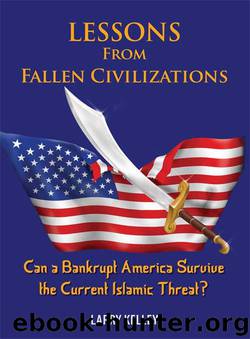
Lessons from Fallen Civilizations: Can a bankrupt America survive the current Islamic threat? by Kelley Larry
Author:Kelley, Larry [Kelley, Larry]
Language: eng
Format: mobi, epub
Publisher: Hugo House Publishers, Ltd.
Published: 2012-09-01T07:00:00+00:00
John and Jacqueline Kennedy, November 22, 1963, moments before the to bullets fired by Lee Harvey Oswald struck the President.
While it did not use overt Marxist phraseology, for each according to his need, from each according to his means, this was a central pillar of liberalism. It proudly advocated the redistribution of wealth, while ambivalent about how the US should use its power to halt Communist expansion. While liberalism proclaimed itself to be anti-communist, it rejected nationalism and, by 1955, it was internationalist and accommodationist to Soviet expansion.
Liberalism, according to its most authoritative proponents, held that those who did not subscribe to its tenants were conspiratorial, bigoted, and delusional. Moreover, as Schlesinger proclaimed in his book, The Vital Center, liberalism was no longer a belief that resided on the political spectrum to the left of anything. Despite the fact that the country elected aging war hero Dwight Eisenhower, a Republican, to two terms as president, by the close of the decade, polling data confirmed that liberalism had become the central organizing American political philosophy.
In 1951, the alternative to liberalism, modern conservatism, was born with the graduation of an audacious student from Yale, William F. Buckley. His book, God and Man at Yale, grew out of an alumni day address that he was poised to deliver but was prohibited from doing so. The essence of Buckley’s thesis was that the liberalism that dominated the Yale faculty was overwhelmingly hostile to Judeo-Christendom and capitalism and something should be done about it. The book drew a storm of angry negative reviews from prominent literary and academic figures such as McGeorge Bundy. It made Buckley, at age 26, a national figure and the preeminent spokesman for a new, albeit fledgling, philosophical and political movement—conservatism.
By 1954, the nation’s capital was in an uproar over the hearings conducted by the House Committee for Un-American Activities. It’s chairman, Joe McCarthy, contended that the government was not doing enough to stop penetration by a hostile Soviet Union and that something should also be done about it. Buckley picked the unfolding drama to publish his second book, McCarthy and His Enemies, co-written with his brother-in-law, Brent Bozell. The book’s careful examination of numerous cases pursued by McCarthy, enraged the Liberal establishment even more than had his first book. As Elliot Abrams wrote recently, “It was in the McCarthy era that the iron triangle of liberal bureaucrats, a liberal press, and liberal Democrats in Congress was first evident.” 110 While the iron triangle destroyed McCarthy, Buckley gained greater notoriety and more converts to the conservative cause throughout heartland America, where most were unabashedly anti-communist.
One year later, in 1955, Buckley founded his magazine, National Review, and hired Whittaker Chambers, the celebrated Communist defector whose testimony corroborated much of McCarthy’s accusations. In his excellent requiem to Buckley, John O’Sullivan wrote that “Bill’s philippics against the “new Republicanism” of Eisenhower and Richard Nixon . . . set a high standard for invective.” 111
Buckley wrote, “The Eisenhower approach was designed not to solve problems, but to refuse, essentially, to recognize that problems exist, and so, to ignore them.
Download
Lessons from Fallen Civilizations: Can a bankrupt America survive the current Islamic threat? by Kelley Larry.epub
This site does not store any files on its server. We only index and link to content provided by other sites. Please contact the content providers to delete copyright contents if any and email us, we'll remove relevant links or contents immediately.
| Africa | Americas |
| Arctic & Antarctica | Asia |
| Australia & Oceania | Europe |
| Middle East | Russia |
| United States | World |
| Ancient Civilizations | Military |
| Historical Study & Educational Resources |
Cecilia; Or, Memoirs of an Heiress — Volume 1 by Fanny Burney(32666)
Cecilia; Or, Memoirs of an Heiress — Volume 2 by Fanny Burney(32034)
Cecilia; Or, Memoirs of an Heiress — Volume 3 by Fanny Burney(32014)
The Secret History by Donna Tartt(19377)
Sapiens: A Brief History of Humankind by Yuval Noah Harari(14493)
Leonardo da Vinci by Walter Isaacson(13436)
The Radium Girls by Kate Moore(12126)
Sapiens by Yuval Noah Harari(5425)
How Democracies Die by Steven Levitsky & Daniel Ziblatt(5295)
The Wind in My Hair by Masih Alinejad(5162)
Homo Deus: A Brief History of Tomorrow by Yuval Noah Harari(4980)
Endurance: Shackleton's Incredible Voyage by Alfred Lansing(4872)
Man's Search for Meaning by Viktor Frankl(4687)
The Silk Roads by Peter Frankopan(4628)
Millionaire: The Philanderer, Gambler, and Duelist Who Invented Modern Finance by Janet Gleeson(4556)
The Rape of Nanking by Iris Chang(4286)
The Motorcycle Diaries by Ernesto Che Guevara(4183)
Joan of Arc by Mary Gordon(4181)
Stalin by Stephen Kotkin(4030)
