Karl Barth by David L. Mueller
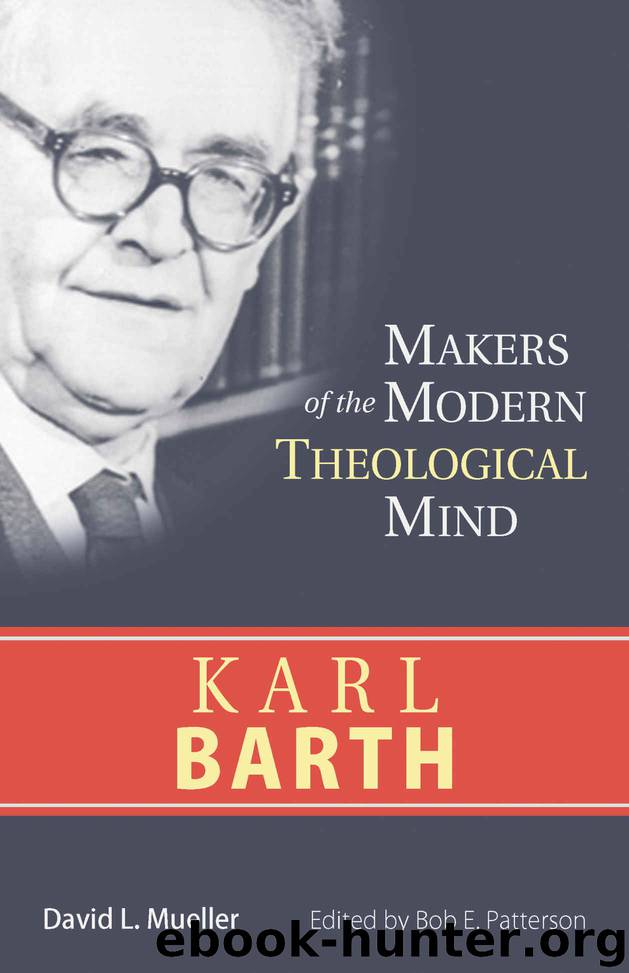
Author:David L. Mueller [Mueller, David L.]
Language: eng
Format: azw3
Tags: theologian, Christian biography, Modern theology, doctrine of revelation, church history
Published: 2018-04-12T04:00:00+00:00
BARTH VS. NATURAL THEOLOGY
One of the points at which Anglo-Saxon theologians have been most critical of Barth is with respect to his consistent repudiation of natural theology and therewith his seemingly wholly negative estimate of God’s revelation of himself in creation and man. This analysis of Barth’s position is quite accurate: indeed, in his Gifford Lectures in the years 1937–38, Barth referred to himself as an “avowed opponent of all natural theology.”[113] However, in order to understand Barth’s critique of natural theology, as well as his opposition to Catholic and Protestant use of the possibility of establishing a knowledge of God on the basis of the being common to both (analogia entis), and finally, his critique of man’s “religion” as the pathway to knowledge of God, one must remember that they all derive from his developing christocentric doctrine of revelation.
All of these approaches to the knowledge of God are variants of what we designated “anthropological theology” at the outset of this chapter. This means that in Barth’s view they speak about a knowledge of God which is possible on the basis of a universal revelation (general revelation) in creation, human history, or in the human consciousness. In his exposition of Romans, in the German church struggle, in his heated debate with Emil Brunner in 1934, and at different points in the Church Dogmatics, Barth develops an attack on natural theology which is without parallel in modern theology.
Barth recognizes that natural theology has played a prominent role in the history of the church from post-apostolic times to the present. Since the Middle Ages, Roman Catholicism has accepted and utilized a natural theology which establishes its knowledge of God, the Creator, on the basis of man’s capacity as a rational being to interpret the revelation of God in nature, history, and in the human consciousness. According to Catholic dogma, this preliminary knowledge of God as Creator is supplemented by the truths about God which derive from the supernatural revelation of God attested in the Bible and interpreted by the Church. Though the Protestant Reformers made an occasional “unguarded” use of natural theology, Barth does not view them as advocates of natural theology. However, Protestant Orthodoxy did make use of natural theology and prepared the way for its inrush and importance in Protestant theology following the Enlightenment. As a consequence, Barth interprets Protestant theology of the last two hundred years in terms of repeated attempts to synthesize nature and grace. It tried to join a theology based on revelation in creation with a theology derived from God’s redemptive activity in Israel and the church with its focus in Jesus Christ.[114]
The years of the German church struggle solidified Barth’s attitude toward natural theology. He stood staunchly opposed to the German Christians who advocated a synthesis of German National Socialism as a second source of revelation with the gospel. In his estimate, this pernicious synthesis was not different in kind from others developed in neo-Protestantism. All detracted from the central revelation in Jesus Christ. This accounts for Barth’s heated “No!” against Brunner in 1934.
Download
This site does not store any files on its server. We only index and link to content provided by other sites. Please contact the content providers to delete copyright contents if any and email us, we'll remove relevant links or contents immediately.
The Secret Power of Speaking God's Word by Joyce Meyer(3161)
Signature in the Cell: DNA and the Evidence for Intelligent Design by Stephen C. Meyer(3123)
Real Sex by Lauren F. Winner(3005)
The Holy Spirit by Billy Graham(2938)
The Gnostic Gospels by Pagels Elaine(2517)
Jesus by Paul Johnson(2349)
Devil, The by Almond Philip C(2324)
23:27 by H. L. Roberts(2245)
The Nativity by Geza Vermes(2224)
Chosen by God by R. C. Sproul(2158)
All Things New by John Eldredge(2155)
Angels of God: The Bible, the Church and the Heavenly Hosts by Mike Aquilina(1951)
The Return of the Gods by Erich von Daniken(1925)
Angels by Billy Graham(1919)
Knowing God by J.I. Packer(1848)
Jesus of Nazareth by Joseph Ratzinger(1802)
The Gnostic Gospel of St. Thomas by Tau Malachi(1781)
Evidence of the Afterlife by Jeffrey Long(1775)
How To Be Born Again by Billy Graham(1775)
