John Kennedy by Burns James MacGregor;
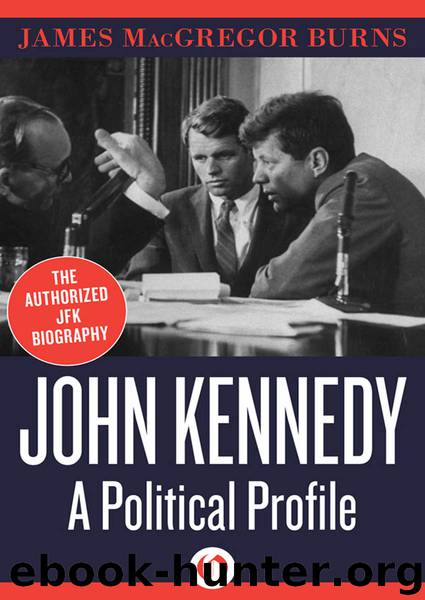
Author:Burns, James MacGregor;
Language: eng
Format: epub
Publisher: Open Road Media
“Profiles in Courage”
Once Kennedy was out of immediate danger from his operation, his aides began to worry about his mental state. How would he take this prolonged inaction? They did not need to worry. As soon as he could read and write, he got to work on a problem that intrigued him—political courage displayed by noted American legislators. It was not a new subject for the Senator; earlier in the year, before his hospitalization, he had done a little research and writing on the problem. Actually, his interest in political courage ran back at least fifteen years, to the time when he was writing Why England Slept and returning again and again to the failure of most English politicians to defy public opinion and rearm Britain while there was yet time. But now he had a long opportunity to write and think.
For the Senator, writing a book in a hospital bed was no great problem. Alerted to his needs, the Legislative Reference Service of the Library of Congress sent him cartons of books. In Washington, Sorensen acted as literary amanuensis, digging up factual material, checking with historians and other experts, going over drafts. Arthur Krock, an old family friend, and several others advised on examples of courage that should be included in the book; Krock in particular contended that Senator Taft deserved a chapter because of his unpopular stand against the Nürnberg trials, and Kennedy agreed. Jules Davids, a Georgetown University professor, and James M. Landis, prominent New Dealer and former Harvard Law School dean, long a close friend and now legal adviser to the Senator’s father, helped a good deal in the preparation of several chapters.
But the brunt of the writing fell on Kennedy himself, lying in his bed in a ground-floor room or sitting out by the pool in front of the big stucco house in Palm Beach. In his loose, widely spaced hand he wrote on heavy white paper in a red stiff-covered “minute book” of the type used in law offices. Progress was slow. His thoughts in writing, as in conversing informally, would race ahead of his power to get the words out as he wished them to appear; he paused often to cross out sentences and paragraphs and make additions in the margins. He dictated the second draft to a secretary.
Slowly the examples of political courage piled up. The first was John Quincy Adams, whose struggles with the Federalist party had fascinated Kennedy long before he had entered the Senate. Another New Englander, Daniel Webster, Kennedy included for his support of Clay’s compromise between the North and South, although Kennedy acknowledged that. Webster was not as illustrious as he looked, for he had demanded and accepted retainers from the Bank of the United States. One of the most notable essays dealt with Edmund Ross, of Kansas, who said—rightly—that he had looked down into his political grave when, over the bitter protests of his constituents, he saved President Johnson from impeachment. And one of the most moving told of George W.
Download
This site does not store any files on its server. We only index and link to content provided by other sites. Please contact the content providers to delete copyright contents if any and email us, we'll remove relevant links or contents immediately.
| U.K. Prime Ministers | U.S. Presidents |
Waking Up in Heaven: A True Story of Brokenness, Heaven, and Life Again by McVea Crystal & Tresniowski Alex(37815)
Empire of the Sikhs by Patwant Singh(23090)
We're Going to Need More Wine by Gabrielle Union(19055)
Hans Sturm: A Soldier's Odyssey on the Eastern Front by Gordon Williamson(18596)
Leonardo da Vinci by Walter Isaacson(13342)
The Radium Girls by Kate Moore(12036)
Tools of Titans by Timothy Ferriss(8403)
Educated by Tara Westover(8061)
How to Be a Bawse: A Guide to Conquering Life by Lilly Singh(7495)
Permanent Record by Edward Snowden(5852)
The Last Black Unicorn by Tiffany Haddish(5643)
The Rise and Fall of Senator Joe McCarthy by James Cross Giblin(5284)
Promise Me, Dad by Joe Biden(5157)
The Wind in My Hair by Masih Alinejad(5104)
A Higher Loyalty: Truth, Lies, and Leadership by James Comey(4967)
The Crown by Robert Lacey(4821)
The Iron Duke by The Iron Duke(4367)
Joan of Arc by Mary Gordon(4119)
Stalin by Stephen Kotkin(3973)
