How Can I Be Right with God? (Crucial Questions) by R.C. Sproul
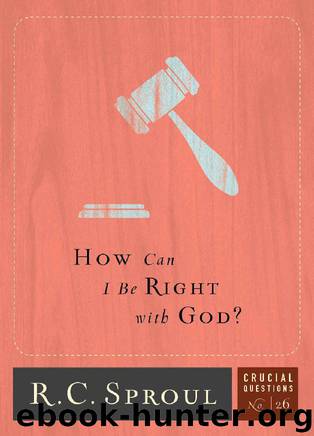
Author:R.C. Sproul
Language: eng
Format: mobi, epub
Publisher: Ligonier Ministries, Inc. - USA
Published: 2017-11-08T16:00:00+00:00
Chapter Six
BY CHRIST
ALONE
In the sixth session of the Council of Trent, the Roman Catholic Church defined its doctrine of justification, giving a list of more than twenty canons of denunciation—views that they repudiated, including the Reformation view. But in their exposition of the doctrine of justification, the church decreed that faith is necessary for justification.
Some say that the Roman Catholic Church thinks that faith is insignificant, unimportant, or unnecessary. One of the worst slanders against the Roman Catholic Church is that the difference between Rome and Protestants is the Protestants believe in justification by faith, and the Catholics believe in justification by works, as if the Roman church didn’t believe in the necessity of faith. That is simply not true.
In the canons of the Council of Trent, the Roman church said three fundamental things about faith as it relates to justification: faith is the initial movement; it is the foundation of justification; and it is the root of justification. Thus, the Roman Catholic Church does not teach that justification happens apart from faith, because it’s by faith that we enter into the sacraments and we receive the infusion of the righteousness of Christ, and it’s by faith that we work with that infused grace, that we cooperate with it and assent to it so that righteousness then begins to inhere within us.
But what’s missing in the Roman Catholic formula regarding faith is the word sola. When Luther made the declaration sola fide—that justification is by faith alone—that word alone is what provoked a lot of the controversy. The Reformers would say, in response to the Council of Trent, that faith is not only the initial step, foundation, or root of justification; it is all you need for justification to follow, that is, for a person to receive the imputation of the righteousness of Christ. The only thing we need to get the benefit of the work of Christ is faith. Anyone who has true faith immediately and completely receives all the benefits of the work of Jesus Christ. Calvin insisted that justification is not just initiated by faith, it is completed by faith. The very second someone has true faith, God declares him justified and imputes to him all of the merit of Christ, so that all that Christ is and all that He has accomplished becomes his.
Luther referred to the righteousness that justifies us as extra nos, meaning “outside of us.” He meant that the righteousness that justifies us is not our own. He used another Latin phrase to capture this idea: alienum iustitsia, which means “alien righteousness.” When Luther said that the justice or righteousness by which we are justified is an alien righteousness, a righteousness that is extra nos, he meant that the righteousness that justifies the Christian, and the only righteousness that could ever justify a Christian, is the righteousness that inherently belongs to Jesus. It’s given to us and counted for us, but properly speaking it is Jesus’ own righteousness.
If indeed the righteousness by which
Download
How Can I Be Right with God? (Crucial Questions) by R.C. Sproul.epub
This site does not store any files on its server. We only index and link to content provided by other sites. Please contact the content providers to delete copyright contents if any and email us, we'll remove relevant links or contents immediately.
The Secret Power of Speaking God's Word by Joyce Meyer(3172)
Signature in the Cell: DNA and the Evidence for Intelligent Design by Stephen C. Meyer(3125)
Real Sex by Lauren F. Winner(3013)
The Holy Spirit by Billy Graham(2943)
The Gnostic Gospels by Pagels Elaine(2527)
Jesus by Paul Johnson(2352)
Devil, The by Almond Philip C(2324)
23:27 by H. L. Roberts(2245)
The Nativity by Geza Vermes(2226)
Chosen by God by R. C. Sproul(2160)
All Things New by John Eldredge(2157)
Angels of God: The Bible, the Church and the Heavenly Hosts by Mike Aquilina(1954)
The Return of the Gods by Erich von Daniken(1929)
Angels by Billy Graham(1921)
Knowing God by J.I. Packer(1852)
Jesus of Nazareth by Joseph Ratzinger(1808)
Evidence of the Afterlife by Jeffrey Long(1783)
The Gnostic Gospel of St. Thomas by Tau Malachi(1782)
How To Be Born Again by Billy Graham(1775)
