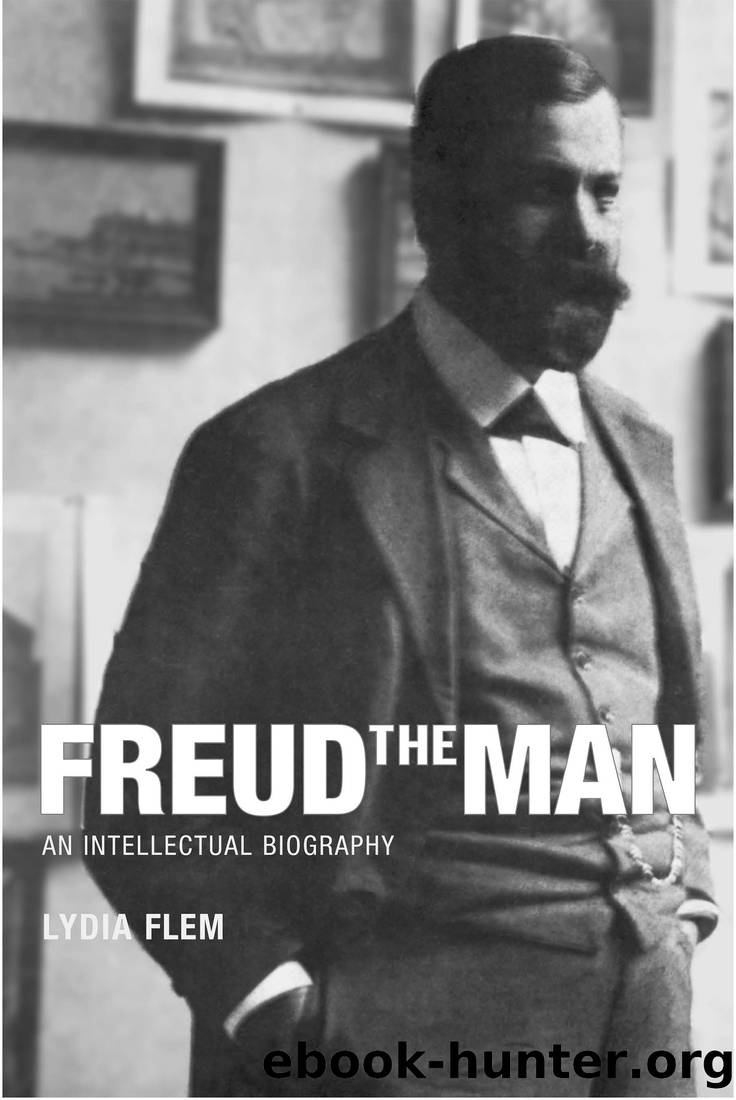
Freud the Man by Lydia Flem
Author:Lydia Flem [Flem, Lydia]
Language: eng
Format: epub
Publisher: Other Press
Published: 2020-09-15T00:00:00+00:00
Freud is quite prepared to be critical of himself and is rarely satisfied with his own style. He has within him a hidden sense of form, an appreciation for beauty, a seeking after âperfection.â54
The question of case histories, in particular, preoccupies him greatly. He considers that he has not found an irreproachable and exemplary way of reconstructing them, but it seems important to him not to give up the attempt.55 During the Wednesday evening meetings, Freud sometimes gives advice to his disciples. Impelled by pedagogic duty, he suggests, for example, that Sadger present his work a bit more attractively.56 On another occasion, Freud emphasizes that unformulated case histories have not been fully thought through, concluding that a careful and yet artistic exposition, as in his presentation of the Dora case, is the only acceptable procedure.57
Freud constantly faces the problems inherent in writing about a knowledge of the invisible, accessible only through the zigzags, quantum leaps, oblique pathways, and winding passages of unconscious associations. He has to admit that linear exposition is not very appropriate for the descriptions of psychic processes, which are intertwined and unfold simultaneously in different psychic strata.58 Freud is not intimidated by doubts or obstacles: he describes himself as an explorer braving wild oceans or a chemist handling explosive materials. Attracted by novelty and uncertainty, he is not one of those âbelieversâ who require scientific discourse to serve as a âcatechismâ for them.59 It is clear to him that â[i]n developing a new science, one has to make its theories vague. You cannot make things clear-cut. But when you write, the public demands that you make things definite, else they think that you do not know what you are saying.â60 Attentive to this adventurous aspect of his intellectual approach, Freud, like a mountain guide, warns his reader about pitfalls, preparing him to leap into the unknown, the uncertain: âIf we have the courage to proceed in the same way, we shall be setting forth on a path which will lead us first to something unexpected and incomprehensible, but which will perhaps, by a devious route, bring us to a goal.â61
Since he likes to speak directly to his readers, Freud imagines that they fall into three temperamental categories: âthe sceptical, the optimistic, and the ambitious.â62 He seeks to win the readerâs trust and win his conviction; guessing the problems that will arise in his mind and the nature of his criticism, he tries to reply point by point. He takes his resistances into account, as though he were one of his patients in analysis, and no doubt hopes to be read in turn with a certain associative freedom. Here, for example, are some of his remarks to the reader in his Introductory Lectures on Psycho-Analysis: âYou will protest with some annoyanceâ¦. I should reply: Patience, Ladies and Gentlemen! I think your criticism has gone astrayâ¦. That is what I should say in order to retain your interestâ¦.â63 âI should like to invite you to follow me along another track.
Download
This site does not store any files on its server. We only index and link to content provided by other sites. Please contact the content providers to delete copyright contents if any and email us, we'll remove relevant links or contents immediately.
Unwinding Anxiety by Judson Brewer(73060)
The Art of Coaching by Elena Aguilar(53274)
The Fast Metabolism Diet Cookbook by Haylie Pomroy(21149)
Rewire Your Anxious Brain by Catherine M. Pittman(18659)
Healthy Aging For Dummies by Brent Agin & Sharon Perkins RN(17048)
Talking to Strangers by Malcolm Gladwell(13376)
The Art of Thinking Clearly by Rolf Dobelli(10495)
Mindhunter: Inside the FBI's Elite Serial Crime Unit by John E. Douglas & Mark Olshaker(9350)
Crazy Rich Asians by Kevin Kwan(9297)
The Compound Effect by Darren Hardy(8978)
Tools of Titans by Timothy Ferriss(8403)
Periodization Training for Sports by Tudor Bompa(8278)
Becoming Supernatural by Dr. Joe Dispenza(8225)
Wonder by R. J. Palacio(8118)
Crystal Healing for Women by Mariah K. Lyons(7936)
Bodyweight Strength Training by Jay Cardiello(7920)
Change Your Questions, Change Your Life by Marilee Adams(7788)
Therapeutic Modalities for Musculoskeletal Injuries, 4E by Craig R. Denegar & Ethan Saliba & Susan Saliba(7723)
Nudge - Improving Decisions about Health, Wealth, and Happiness by Thaler Sunstein(7712)
