Fork-Tailed Devil: The P-38 by Caidin Martin
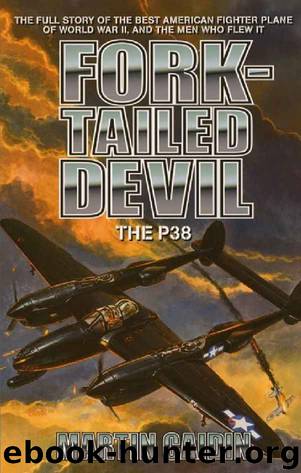
Author:Caidin, Martin [Caidin, Martin]
Language: eng
Format: epub
Tags: General, Aviation, History, Military, World War II
ISBN: 9780743479622
Google: nrANAAAACAAJ
Amazon: 0743413180
Publisher: iBooks
Published: 2003-04-15T21:11:58+00:00
CHAPTER 15
TOUGH UNDERBELLY
THERE’S SOMETHING OF A problem in relating the P-38 story in that period following the end of fighting in North Africa. The Lightnings went on to Sardinia and Italy and lower France, and stormed up beyond Italy into central Europe and Germany, and fanned out to the nations on the far side of Italy, and even flew shuttle-bombing escort missions to and from Russia.
The problem? Well, for one thing, the P-38 wasn’t a controversial airplane here. No one questioned what it could do. They saw that in the weekly combat reports and evaluations. No one questioned the worth of the airplane; everyone wanted it, and desperately. They wanted 38s in the Ninth, the Twelfth, and the Fifteenth Air Forces. They wanted them for convoy cover, for long-range patrol, ground attack, against enemy fighters and bombers, for anti-shipping strikes, night fighting, bomber escort—in short, there was a constant din for more and more P-38s.
Production was turning them out in ever-greater numbers back in the States, but everyone, it seemed (with the exception of VIII Fighter Command, which was still puzzled by the extraordinary showing of the Lightning in its final months of combat), beat the table for P-38s.
The description of ground attack—loco busting missions—of the 20th and 55th Fighter Groups over Germany and France was almost a duplication of ground-attack missions of the P-38s stampeding out of North Africa against Sardinia, Sicily and Italy. There the mission was stated simply enough. Destroy the enemy in the air and then chew him up on the ground. Stop him where he stood—wreck his rail communications, turn his highways into deathtraps, his seas into bloodied waters, his airfields into carnage: in short, to the maximum extent possible destroy his mobility and set him up for the Allied ground forces.
The effectiveness of airpower in a campaign often defies statistical evaluation, simply because a covering screen of fighters, if they do not shoot down a single airplane, can be 100 per cent effective simply by their presence—which keeps enemy aircraft away from the ground forces. In the Sicily invasion (and the entire island was taken in thirty-eight days) Lightnings were assigned all-out strafing missions over the western and southeastern parts of the island.
Every available fighter of every type was thrown into the campaign, and another example of little-publicized success was in the mission of fighters assigned to Coastal duties, which managed either to shoot down every reconnaissance plane of the Germans or Italians, or else drive them off, so that the enemy remained completely in the dark about details of the invasion. The surprise was of course tactical rather than strategic, but its effect was enormous on the outcome of the invasion and subsequent drives inland. But even the full strength of available tactical airpower wasn’t considered enough. As noted in the official AAF History:
“. . . The air forces undertook a special effort toward interdiction of the enemy’s movements from the interior toward the assault areas. They met the new commitment by temporarily transferring two groups of U.
Download
This site does not store any files on its server. We only index and link to content provided by other sites. Please contact the content providers to delete copyright contents if any and email us, we'll remove relevant links or contents immediately.
| Africa | Americas |
| Arctic & Antarctica | Asia |
| Australia & Oceania | Europe |
| Middle East | Russia |
| United States | World |
| Ancient Civilizations | Military |
| Historical Study & Educational Resources |
Cecilia; Or, Memoirs of an Heiress — Volume 1 by Fanny Burney(32558)
Cecilia; Or, Memoirs of an Heiress — Volume 2 by Fanny Burney(31956)
Cecilia; Or, Memoirs of an Heiress — Volume 3 by Fanny Burney(31940)
The Secret History by Donna Tartt(19083)
Sapiens: A Brief History of Humankind by Yuval Noah Harari(14389)
Leonardo da Vinci by Walter Isaacson(13336)
The Radium Girls by Kate Moore(12026)
Sapiens by Yuval Noah Harari(5369)
How Democracies Die by Steven Levitsky & Daniel Ziblatt(5218)
The Wind in My Hair by Masih Alinejad(5095)
Homo Deus: A Brief History of Tomorrow by Yuval Noah Harari(4918)
Endurance: Shackleton's Incredible Voyage by Alfred Lansing(4780)
Man's Search for Meaning by Viktor Frankl(4604)
The Silk Roads by Peter Frankopan(4533)
Millionaire: The Philanderer, Gambler, and Duelist Who Invented Modern Finance by Janet Gleeson(4478)
The Rape of Nanking by Iris Chang(4211)
Joan of Arc by Mary Gordon(4109)
The Motorcycle Diaries by Ernesto Che Guevara(4098)
Stalin by Stephen Kotkin(3965)
