Five Views on Biblical Inerrancy (Counterpoints: Bible and Theology) by Zondervan
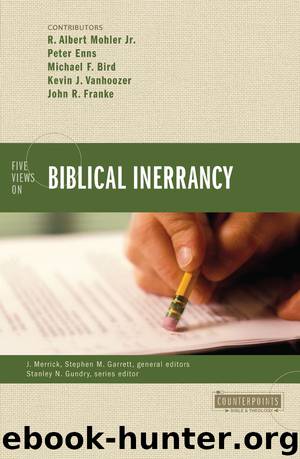
Author:Zondervan
Language: eng
Format: epub, mobi
ISBN: 9780310426578
Publisher: Zondervan
Published: 2013-12-10T00:00:00+00:00
RESPONSE TO MICHAEL F. BIRD
PETER ENNS
It’s always good to hear Bird’s lighthearted but insightful thoughts. Reading his essay was stimulating and refreshing, particularly his assessment of the problematic nature of inerrancy. I share Bird’s concern over the American fundamentalist and evangelical preoccupation with inerrancy, and look on with some jealousy that his own experiences have not been burdened with a “penchant to engage in bitter divisions over which nomenclature best suits our theological disposition,” as such defensive fence-building tends to “divide believers” and “inhibit Christian witness” (p. 146). At this juncture, though, I might suggest that, although non-American’s may be more relaxed about nomenclature, I am not sure they would be as relaxed about the concept behind it when pushed a bit. I see this tension in Bird’s own responses to at least two of the passages, that, though as remote from Mohler’s treatment as the Fall Classic is to a cricket test match, inerrantist concerns remain for Bird, even if couched in more nuanced phrasings.
Bird’s critique of the Chicago statement as “freighted with huge and unacknowledged hermeneutical assumptions,” not to mention “notions of truth [that] rely on modern presumptions of precision and exactitude” (p. 147), is spot on, and his extended engagement of that document is lucid. One small—at least at this point—correction on a specific matter: Bird comments on the CSBI’s handling of the creation story by remarking, “for many biblical scholars, Genesis 1–3 is not a blow-by-blow literal account of creation” (p. 147, my emphasis). Perhaps Bird is hedging so as not to cause unnecessary offense, but his understatement borders on false advertising. To say “many” could leave the impression that there are a good number (just not the majority) who read Genesis 1–3 as a blow-by-blow historical account, thus giving some credibility, if only minimal, to the CSBI’s assertion. The
truth is no one, outside of literalist fundamentalism, reads Genesis 1–3 this way, including nearly every inerrantist evangelical scholar I know. As minor as this may seem, I draw it out to put into even clearer relief than Bird does—namely, that a mistaken genre identification of the biblical creation accounts is the assumed default position of literalist inerrancy and that of the CSBI.
I also appreciate Bird’s comments on the problems inherent in harmonization (though hardline inerrantists would make short work of Bird’s critique by asserting a priori that the details of the stories must harmonize or the Word of God is rendered null and void). It strikes me, though, that focusing on “incidental” and “minor variations of detail” (p. 149) is a relatively easy problem to address within an inerrantist scheme. Bird feels that we should not focus on these harmless incidentals but on “the point of the story” (p. 148) that isn’t affected by them. Although we do run into variations that are minor and incidental in the Synoptic Gospels, the synoptic problem on the whole is more pressing and cuts more to the core of the CSBI’s shortcomings. The conquest accounts in Joshua and Judges,
Download
Five Views on Biblical Inerrancy (Counterpoints: Bible and Theology) by Zondervan.mobi
This site does not store any files on its server. We only index and link to content provided by other sites. Please contact the content providers to delete copyright contents if any and email us, we'll remove relevant links or contents immediately.
The Five People You Meet in Heaven by Mitch Albom(3649)
The Secret Power of Speaking God's Word by Joyce Meyer(3485)
Real Sex by Lauren F. Winner(3097)
The Holy Spirit by Billy Graham(3024)
Name Book, The: Over 10,000 Names--Their Meanings, Origins, and Spiritual Significance by Astoria Dorothy(3017)
0041152001443424520 .pdf by Unknown(2905)
How The Mind Works by Steven Pinker(2895)
ESV Study Bible by Crossway(2823)
Ancient Worlds by Michael Scott(2746)
Churchill by Paul Johnson(2672)
The Meaning of the Library by unknow(2642)
The ESV Study Bible by Crossway Bibles(2591)
The Gnostic Gospels by Pagels Elaine(2577)
MOSES THE EGYPTIAN by Jan Assmann(2466)
Jesus by Paul Johnson(2427)
City of Stairs by Robert Jackson Bennett(2413)
The Complete Dead Sea Scrolls in English (7th Edition) (Penguin Classics) by Geza Vermes(2326)
The Nativity by Geza Vermes(2260)
Ancient Near Eastern Thought and the Old Testament by John H. Walton(2250)
