Fifth Gospel (New Edition) by Patterson Stephen J.; Bethge Hans-Gebhard; Robinson James M
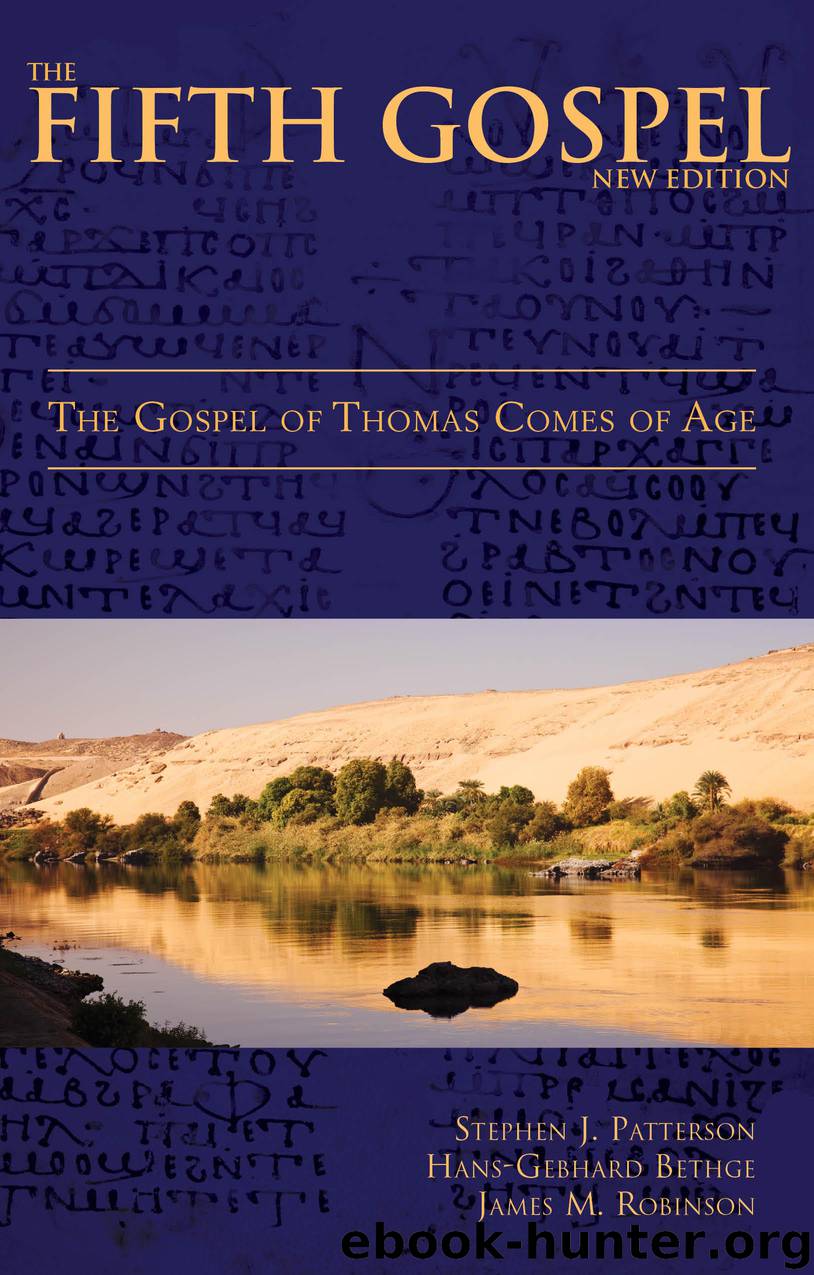
Author:Patterson, Stephen J.; Bethge, Hans-Gebhard; Robinson, James M.
Language: eng
Format: epub
Publisher: Bloomsbury Publishing
Published: 2011-08-22T16:00:00+00:00
CHAPTER 3
The Story of the Nag Hammadi Library1
James M. Robinson
I propose to discuss here the significance of the discovery of the Nag Hammadi Codices 50 years ago, in terms of what the Nag Hammadi Codices have meant for the discipline of New Testament scholarship. This significance is not limited to such specific issues as Gnosticism and the New Testament. My focus here is rather in terms of the sociology of knowledge: how has this important manuscript discovery, and the way it was handled over the past half-century, affected the shaping of Biblical Studies as a discipline?
The Discovery of the Nag Hammadi Library
The Nag Hammadi Codices were discovered toward the end of 1945, but how this date came to be established is something of a saga in its own right, and so can be narrated in some detail just to give a feel for the region, the participants, and how the discovery actually took place.
A young French graduate student and adventurer, Jean Doresse, originally the only source of information on the discovery, had dated it variously and without explanation to the beginning of 1946,2 then 1946 generally,3 then 1945,4 then 19475, or even 1948.6 Hence I sought to find more precise information about the time, place, participants, and specifics of the discovery.
The most obvious place to begin had apparently never been consulted – the Acquisitions Registry of the Coptic Museum in Cairo. Here the name of the person who sold the first codex, Codex III, to the Coptic Museum on October 4, 1946 for E£ 250 is listed by name: Rāghib Andarāwus “al-Qiss” Abd al-Sayyid. I tracked him down in retirement in September 1975 in the town of Qinaā in Upper Egypt, and he gave me information making it possible to unravel the whole story, with the help of the discoverer himself, Muḥammad Ἀlī al-Sammān in the hamlet al-Qaṣr across the Nile from Nag Hammadi.
Muḥammad Ἀlīa rustic peasant, was not able to put a calendar date to the discovery so many years after the fact, but it was associated in his mind with two things much more important to him at the time: when the local sugarcane harvest was over and the land lay fallow during the brief winter, he regularly dug the soft earth at the foot of the cliff that served as fertilizer for the fields. He had been digging fertilizer, he recalled, just a few weeks before the Coptic Christmas, which is January 6, when he made the discovery. This suggests the discovery was in a December.
With regard to the year, he again could only speak of it in terms more important to him at the time: the murder of his father in a blood feud. Muḥammad Ἀlī’s memory of that tragedy was as follows: one night his father, a night watchman for valuable irrigation machinery that had been imported from Germany, had killed a marauder from the nearby village Hạmra Dūm – a village that had an ongoing blood feud with Muḥammad Ἀlī’s own village al-Qaṣr. The
Download
This site does not store any files on its server. We only index and link to content provided by other sites. Please contact the content providers to delete copyright contents if any and email us, we'll remove relevant links or contents immediately.
The Five People You Meet in Heaven by Mitch Albom(3577)
The Secret Power of Speaking God's Word by Joyce Meyer(3242)
Real Sex by Lauren F. Winner(3027)
Name Book, The: Over 10,000 Names--Their Meanings, Origins, and Spiritual Significance by Astoria Dorothy(2990)
The Holy Spirit by Billy Graham(2961)
0041152001443424520 .pdf by Unknown(2850)
How The Mind Works by Steven Pinker(2822)
ESV Study Bible by Crossway(2782)
Ancient Worlds by Michael Scott(2693)
Churchill by Paul Johnson(2590)
The Meaning of the Library by unknow(2579)
The ESV Study Bible by Crossway Bibles(2554)
The Gnostic Gospels by Pagels Elaine(2537)
MOSES THE EGYPTIAN by Jan Assmann(2419)
Jesus by Paul Johnson(2366)
City of Stairs by Robert Jackson Bennett(2360)
The Complete Dead Sea Scrolls in English (7th Edition) (Penguin Classics) by Geza Vermes(2293)
The Nativity by Geza Vermes(2234)
Ancient Near Eastern Thought and the Old Testament by John H. Walton(2227)
